
Development and Design of Thai Song Dam Costumes Toward International Fashion: Nong Song Hong, Ban Phaeo District, Samut Sakhon Province
Article Sidebar
Main Article Content
Abstract
Background and Objectives: The Thai Song Dam costumes of Nong Song Hong Subdistrict, Ban Phaeo District, Samut Sakhon Province represent a long-standing body of weaving wisdom that has been passed down through generations. They constitute a valuable local identity worthy of preservation and transmission to future generations. This study aims to conserve, revitalize, and promote Thai Song Dam weaving traditions as a sustainable form of cultural heritage while exploring their adaptation within contemporary fashion contexts. Furthermore, it seeks to develop Thai Song Dam costumes into innovative fashion products that reflect ethnic identity and align with international fashion standards. The specific objectives were 1) to study the identity and symbolic meanings of Thai Song Dam textile patterns in Nong Song Hong, 2) to synthesize concepts for value creation and the development of Thai Song Dam costume design toward international fashion, and 3) to evaluate the developed fashion prototypes and promote cultural tourism within the community.
Methods: The study employed a mixed-methods approach combining participatory action research (PAR) and creative research. The data were gathered through field observations, in-depth interviews with ten artisans and elders, focus group discussions with community members and designers, and co-creation workshops producing ready-to-wear and high fashion collections. In addition, the quantitative data were collected from 150 consumers using structured questionnaires assessing satisfaction in five areas: cultural identity, design aesthetics, functionality, comfort, and market potential.
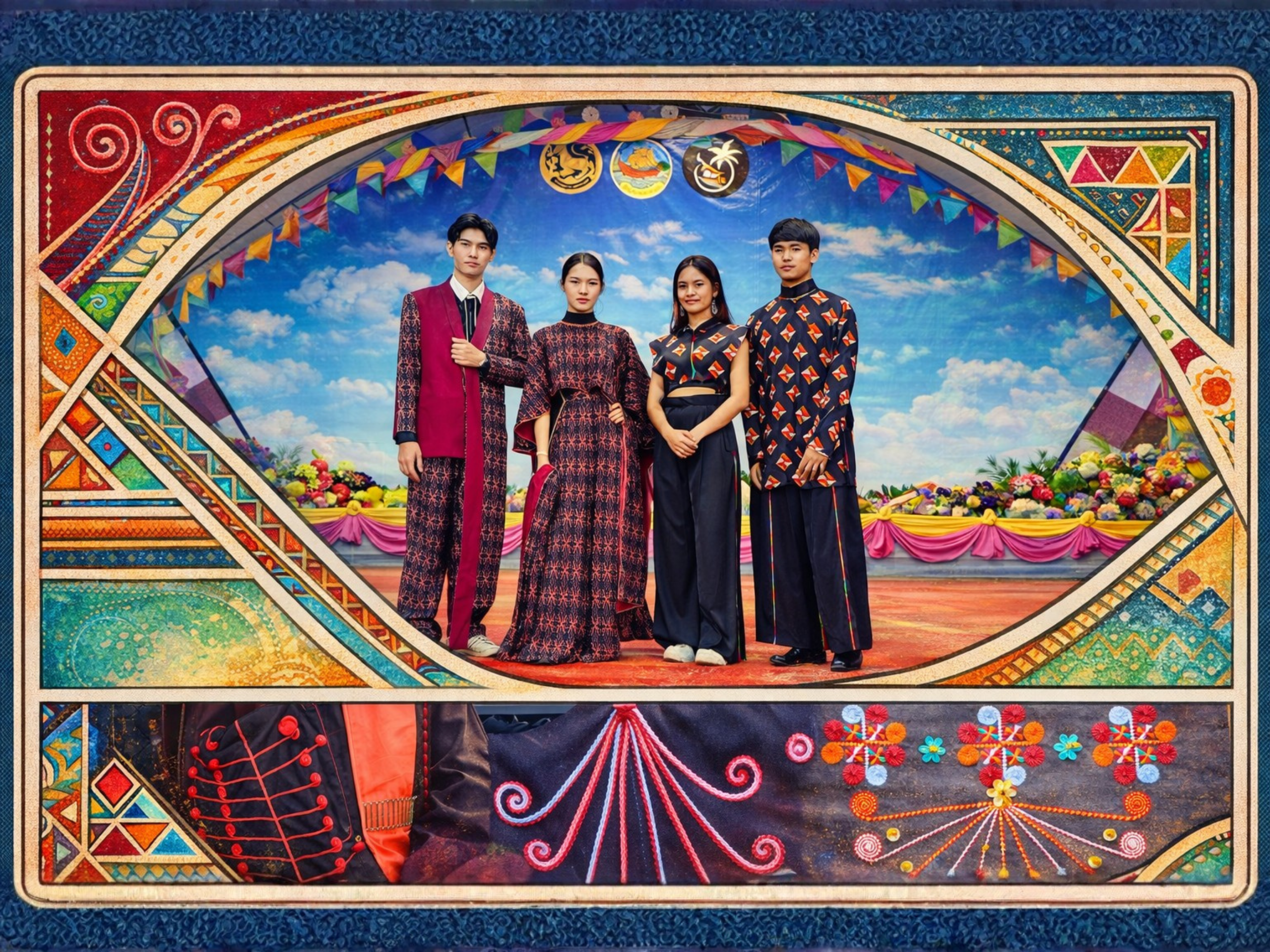
Results: The research findings revealed that significant Thai Song Dam motifs, such as the “Khok Khut” motif, which symbolizes strength, and the “Dok Paet” motif, which represents abundance, can be appropriately applied to contemporary fashion design, resulting in two fashion garment prototypes: 1) Ready-to-Wear, featuring indigo-dyed casual garments with simplified ethnic motifs, and 2) High Fashion, comprising gowns and suits with enlarged embroidered and digitally printed patterns. The overall level of satisfaction was high ( x = 4.37, S.D. = 0.41), indicating that consumers held positive perceptions toward the developed fashion prototypes. Cultural identity received the highest rating (x = 4.50, S.D. = 0.38), reflecting clear recognition and acceptance of the distinct ethnic identity. Other dimensions were also at a high level, including aesthetic design quality (x = 4.47, S.D. = 0.41), market potential (x = 4.43, S.D. = 0.39), wearing comfort (x = 4.25, S.D. = 0.40), and functionality (x = 4.18, S.D. = 0.46).
Application of this study: The project bridged traditional heritage and contemporary innovation, establishing a model for integrating cultural wisdom into creative economy. The participatory process empowered artisans, encouraged intergenerational knowledge transfer, and fostered a community brand identity aligned with Thailand’s “Soft Power” strategy.
Conclusions: This study aimed to preserve and develop the weaving wisdom of the Thai Song Dam community in Nong Song Hong, Ban Phaeo District, Samut Sakhon Province, so that it can be sustained as cultural heritage and appropriately extended into contemporary fashion. Employing a mixed-methods research design that integrates participatory action research and creative research, the study found that significant motifs of Thai Song Dam textiles, such as the “Khok Khut” and “Dok Paet” motifs, demonstrate strong potential for application in contemporary fashion design. This resulted in the development of two garment prototypes: ready-to-wear and high-fashion designs. Consumers expressed a high level of satisfaction with the prototypes, particularly in terms of cultural identity and design aesthetics. The study therefore demonstrates that integrating local wisdom with fashion innovation can generate cultural, economic, and creative tourism value, while sustainably supporting knowledge transmission and the enhancement of the community’s cultural power, or soft power.
Downloads
Article Details

This work is licensed under a Creative Commons Attribution-NonCommercial-NoDerivatives 4.0 International License.
References
Barthes, R. (1983). The Fashion System. New York: Hill & Wang.
Candy, L., & Edmonds, E. (2018). Practice-Based Research in Design and Art. London: Bloomsbury.
Chantachon, S. (2002). Cultural Dynamics of Ethnic Thai Groups. Mahasarakham: Mahasarakham University Press.
Craik, J. (2009). Fashion: The Key Concepts.Oxford: Berg.
Creswell, J. W., & Plano Clark, V. L. (2017). Designing and Conducting Mixed Methods Research. 3rd ed. Thousand Oaks, CA: SAGE.
Duangporn, T. (2011). Revitalization of Thai Handwoven Textiles for Global Markets. Journal of Fine Arts, 8(1), 22–35.
Fletcher, K. (2014). Sustainable Fashion and Textiles: Design Journeys. 2nd ed. London: Routledge. https://doi.org/10.4324/9781315767336
Fletcher, K., & Tham, M. (2019). Earth Logic: Fashion Action Research Plan. London: The JJF.
Freire, P. (1970). Pedagogy of the Oppressed. New York: Herder & Herder.
Gwilt, A. (2014). Fashion Design for Living. London: Bloomsbury.
Howkins, J. (2001). The Creative Economy: How People Make Money From Ideas. London: Penguin.
Kawamura, Y. (2005). Fashion-Ology: An Introduction to Fashion Studies. Oxford: Berg.
Kawicha, P. (2016). Hmong Fashion Adaptation Toward Sustainable Design. Journal of Art and Design, 3(2), 78–89.
Kemmis, S., & McTaggart, R. (2007). Participatory Action Research: Communicative Action and the Public Sphere. Thousand Oaks, CA: SAGE.
Kienwong, W. (2024). Figure 1 Conceptual Framework of Thai Song Dam Fashion Development.
Kienwong, W. (2024). Figure 2 Traditional Thai Song Dam Costumes.
Kienwong, W. (2024). Figure 3 Design Sketches and Prototype Garments Developed During Co-Creation Workshops.
Kienwong, W. (2025). Figure 4 Exhibition of Thai Song Dam Fashion Prototypes.
Kienwong, W. (2024). Figure 6 Summary Model of Thai Song Dam Fashion Development Linking Cultural Heritage → Participatory Design → Creative Economy → Soft Power → Sustainability.
Kienwong, W. (2024). Figure 7 Comparison of Traditional Dok Paet Weaving Pattern and its Reinterpretation in Ready-to-Wear Design.
Kienwong, W. (2025). Figure 8 High Fashion Presentation Inspired by Thai Song Dam.
Kienwong, W. (2024). Figure 9 Knowledge Transfer Between Elder Weavers and Fashion Students During Co-Creation Workshops.
Kienwong, W. (2024).Figure 10 Conceptual Framework of Thai Song Dam Fashion Development Linking Cultural Heritage → Participatory Design → Creative Economy → Soft Power → Sustainability.
Miles, M. B., Huberman, A. M., & Saldaña, J. (2014). Qualitative Data Analysis: A Methods Sourcebook. Thousand Oaks, CA: SAGE.
Ministry of Culture. (2022). National Cultural Strategy 2022–2037. Bangkok: Ministry of Culture, Thailand.
Nye, J. S. (2004). Soft Power: The Means to Success in World Politics. New York: Public Affairs.
Piamsuk, S. (2021). Participatory Innovation in Thai Craft Design. Journal of Cultural Entrepreneurship, 1(1), 15–29.
Phadungchai, S. (2020). Phuan Textile Transformation in Modern Fashion. Journal of Design and Innovation, 6(1), 12–27.
Sirithanya, P. (2006). E Thnic Textiles and Symbolism in Contemporary Thai Society. Journal of Cultural Studies, 5(2), 45–58.
Srisuchat, T. (1995). Ethnic Migration and Cultural Identity of Lao Song. Bangkok: Office of the National Culture Commission.
Suwannarat, P. (2018). Community-Based Fashion and Cultural Sustainability. Thai Journal of Creative Industries, 2(1), 30–46.
Thai Song Dam Research Group. (2024). Cultural Textile Development Report. Samut Sakhon: BSRU Press.
Thailand Creative Economy Agency. (2020). Creative Economy Framework 2020–2030. Bangkok: TCEA.
The United Nations Educational, Scientific and Cultural Organization (UNESCO). (2021). Intangible Cultural Heritage and Sustainable Development. Paris: UNESCO.
Thitiporn, P. (2019). Karen Weaving and Contemporary Fashion Integration. Creative Arts Journal, 4(2), 50–63.
United Nations Conference on Trade and Development (UNCTAD). (2010). Creative Economy Report. Retrieved 15 June 2025, from https://unctad.org/publication/creative-economy-report-2010
Vongsathorn, T. (2023). Heritage Innovation in Thai Textile Design. International Journal of Cultural Design, 12(2), 88–102.
Wongphuka, C. (2018). Symbolism of Lao Song textiles in Samut Sakhon. Thai Ethnography Review, 7(2), 75–90.
Young, J. O. (2010). Cultural Appropriation and the Arts.Oxford: Wiley-Blackwell.
