
Thai Cultural Reflection in the Translation of Address Terms from Chinese TV Series
Article Sidebar
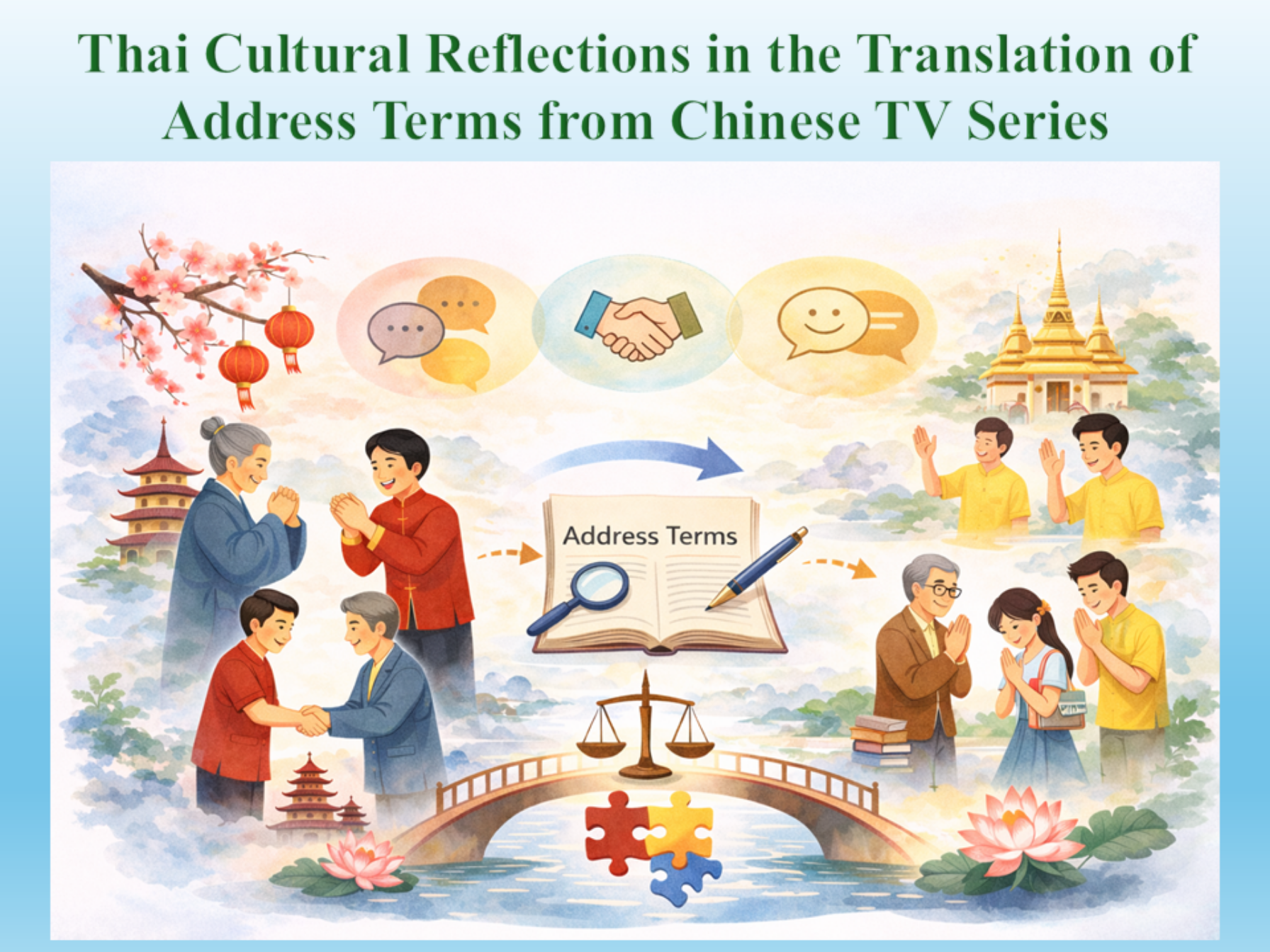
Main Article Content
Abstract
Background and Objectives: This study investigates the Thai cultural reflection embedded in the translation of Chinese address terms appearing in Thai subtitles of contemporary Chinese TV dramas. As address terms play a crucial role in expressing interpersonal relationships, hierarchy, and social values, the transfer of forms of address from Chinese into Thai therefore reflects the process of cultural negotiation and the translator’s adaptive strategies in achieving a balance between linguistic accuracy and cultural appropriateness. This study aimed to investigate how Thai subtitles convey and adapt the meanings of Chinese forms of address, and to analyze how these translation patterns reflect the cultural perspectives and communicative conventions of Thai society.
Methods: This study adopts a qualitative, descriptive design. The data were drawn from five Chinese TV series with Thai subtitles. Each address term was examined in terms of its linguistic form and its pragmatic function in the Thai subtitles. The analysis was guided by four theoretical frameworks: Vygotsky’s sociocultural theory (1978), which emphasizes the social context of language use; Goffman’s theory of face (1967); Brown & Levinson’s politeness theory (1987), which explains face concerns and strategic politeness; and Scollon & Scollon’s intercultural communication theory (1995), which accounts for cross-cultural adaptation strategies.
Results: The findings indicate that the translation of Chinese address terms into Thai subtitles reflects a process of cultural negotiation manifested in three major characteristics: 1) the Thai-oriented cultural transformation of address terms, whereby translators reduce the complexity of kinship distinctions, gender markers, and social status embedded in Chinese, to align with Thai communicative norms; 2) the preservation of Chinese cultural elements, in which original forms and hierarchical nuances are retained to maintain source-cultural identity and sociocultural meaning; and 3) the adjustment of politeness levels and face maintenance in the Thai context, achieved through the addition of prefixes and suffixes to conform to Thai norms of etiquette and social harmony. Overall, these three patterns demonstrate that translating address terms is not merely a lexical transfer but a process of cultural mediation that balances the hierarchical precision of Chinese with the flexibility and politeness conventions of Thai society.
Application of this study: The findings of this study can be applied to the development of culturally informed translation approaches, particularly in the translation of film and series subtitles, as well as in the teaching of Chinese and Thai languages from a cultural perspective. They can also contribute to intercultural communication training. Moreover, the study enhances understanding of the role of translators as “cultural mediators,” who must maintain a balance between linguistic accuracy and cultural appropriateness.
Conclusions: The translation of forms of address from Chinese television series into Thai subtitles is not merely a process of lexical substitution; rather, it involves cultural interpretation and adaptation that enables Thai audiences to understand and access the social values embedded in Chinese culture in ways that are compatible with the Thai context. Translators therefore play a crucial role in bridging the linguistic and cultural worlds of the two societies, facilitating mutual understanding. The findings indicate that the translation of forms of address constitutes a socio-cultural process that reflects the subtle coordination and mediation of identities between Chinese and Thai cultures.
Downloads
Article Details

This work is licensed under a Creative Commons Attribution-NonCommercial-NoDerivatives 4.0 International License.
References
Angsuwattanakul, M. (2016). Address Terms Used in Romantic Relationships. Master’s thesis, M.A. in Thai, Thammasat University, Thailand. (In Thai)
Baker, M. (1993). Corpus Linguistics and Translation Studies: Implications and Applications. In G. Francis & E. Tognini-Bonelli (Eds.), Text and Technology: In Honour of John Sinclair, (pp. 233-250). Amsterdam: John Benjamins.
Braun, F. (1988). Terms of Address: Problems of Patterns and Usage in Various Languages and Cultures. Berlin: Mouton de Gruyter.
Brown, P., & Levinson, S. C. (1987). Politeness: Some Universals in Language Usage. Cambridge: Cambridge University Press.
Brown, R., & Ford, M. (1961). Address in American English. Journal of Abnormal and Social Psychology, 62, 375-385.
Goffman, E. (1967). Interaction Ritual: Essays on Face-To-Face Behavior. New York: Anchor Books.
Jin, J. (2017). A Comparative Study of Chinese and Thai Address Terms — a Case Study of BA Jin’s Family and Kukrit Pramoj’s Four Reigns. Doctoral Dissertation, Ph.D. in Linguistics and Applied Linguistics, Central China Normal University, China.
Life Is a Long Quiet River. (2022). Life Is a Long Quiet River TV series on iQIYI. Retrieved 5 November 2023, from https://www.iq.com/album/ที่พักแห่งหัวใจ-2022-q5zz32kx9t?lang=th_th
Liu, X., Zhang, L., & Zhang, Y. (2010). Study on Addressing Terms and Relevant Culture in America and China. Journal of Language Teaching and Research, 1(5), 753-756.
Loetrakulwat, C. (1994). A Comparison of Address Term Usage in Thai and French. Master’s thesis, M.A. in Linguistics, Chulalongkorn University, Thailand. (In Thai)
Modern Marriage. (2022). Modern Marriage TV series on WeTV. Retrieved 30 October 2023, from https://wetv.vip/th/play/ib4og7y71ht5ejg/b00426tdvoq-EP1%3A_Modern_Marriage
My Best Friend’s Story. (2020). My Best Friend’s Story TV series on iQIYI. Retrieved 16 October 2023, from https://www.iq.com/album/มิตรภาพอันงดงาม-2020-ysyfli0865?lang=th_th
Nida, E. A. (1964). Toward a Science of Translating. Leiden: Brill.
Nothing But Thirty. (2020). Nothing But Thirty TV series on WeTV. Retrieved 8 October 2023, from wetv.vip/th/play/bm0s6gmfyo3m70d/v0034238z3k-EP1%3A_มันก็แค่_30
Nusatlert, A. (2013). The Use of Address Terms in Thai Political, Legal, Media and Academic Language. Journal of Humanities and Social Sciences (HUSOKKU), 30(3), 117–130. (In Thai)
Sarawit, W. (2016). Thai Address Terms According to Speakers’ Age, Gender and Relationship Factors. Rajabhat Journal of Science, Humanities and Social Sciences, 17(1), 169–179. (In Thai)
Scollon, R., & Scollon, S. W. (1995). Intercultural Communication: A Discourse Approach. Oxford: Blackwell.
Sriyaphai, W. (2013). Second-Person Pronouns in Thai: Usage, Emergence, Persistence and Loss. Romyasarn, 11(1), 44–52. (In Thai)
Suersatsalusakul, P., & Others. (2022). Cultural Reflections From Chinese Address Terms. Journal of Humanities & Social Sciences (JHUSOC), 20(2), 43–64. (In Thai)
Surono, S. (2018). Address Terms Across Cultures: A Sociopragmatic Analysis. In D. Djatmika et al. (Eds.), The Fourth PRASASTI International Conference on Linguistics (PRASASTI 2018), (pp. 316–324), August 1–2, 2018, Solo, Indonesia.
The Ideal City. (2021). The Ideal City TV series on iQIYI. Retrieved 22 October 2023, from https://www.iq.com/album/เมืองในอุดมคติ-2021-1zo488c3f8x?lang=th_th
Ting, J. (2005). A Comparative Study of Address Terms in Thai and Chinese. Master’s thesis, M.A. in Thai, Srinakharinwirot University, Thailand. (In Thai)
Tingsapat, K., & Prasitratthasin, A. (1988). The Use of Address Terms in Thai During the Rattanakosin Period. Bangkok: Chulalongkorn University. (In Thai)
Venuti, L. (1995). The Translator’s Invisibility: A History of Translation. London: Routledge.
Vygotsky, L. S. (1978). Mind in Society: The Development of Higher Psychological Processes. Cambridge, MA: Harvard University Press.
Wei, Q. (2005). A Comparative Study of Chinese and Thai Address Terms. Doctoral Dissertation, Ph.D. in Chinese Philology, Nanjing Normal University, China.
Yu, T., & Qiu, L. (2024). Analysis of Address Terms Translation Strategies: The Norms in the Translation of Address Terms in Moment in Peking. Lecture Notes in Education Psychology and Public Media, 51(1), 205-213.
