
A Cross-Cultural Study of Complaint Strategies via Spoken and Text-Messaging Modes: A Comparison of Native Korean Speakers, Native Thai Speakers, and Thai Learners of Korean
Article Sidebar
Main Article Content
Abstract
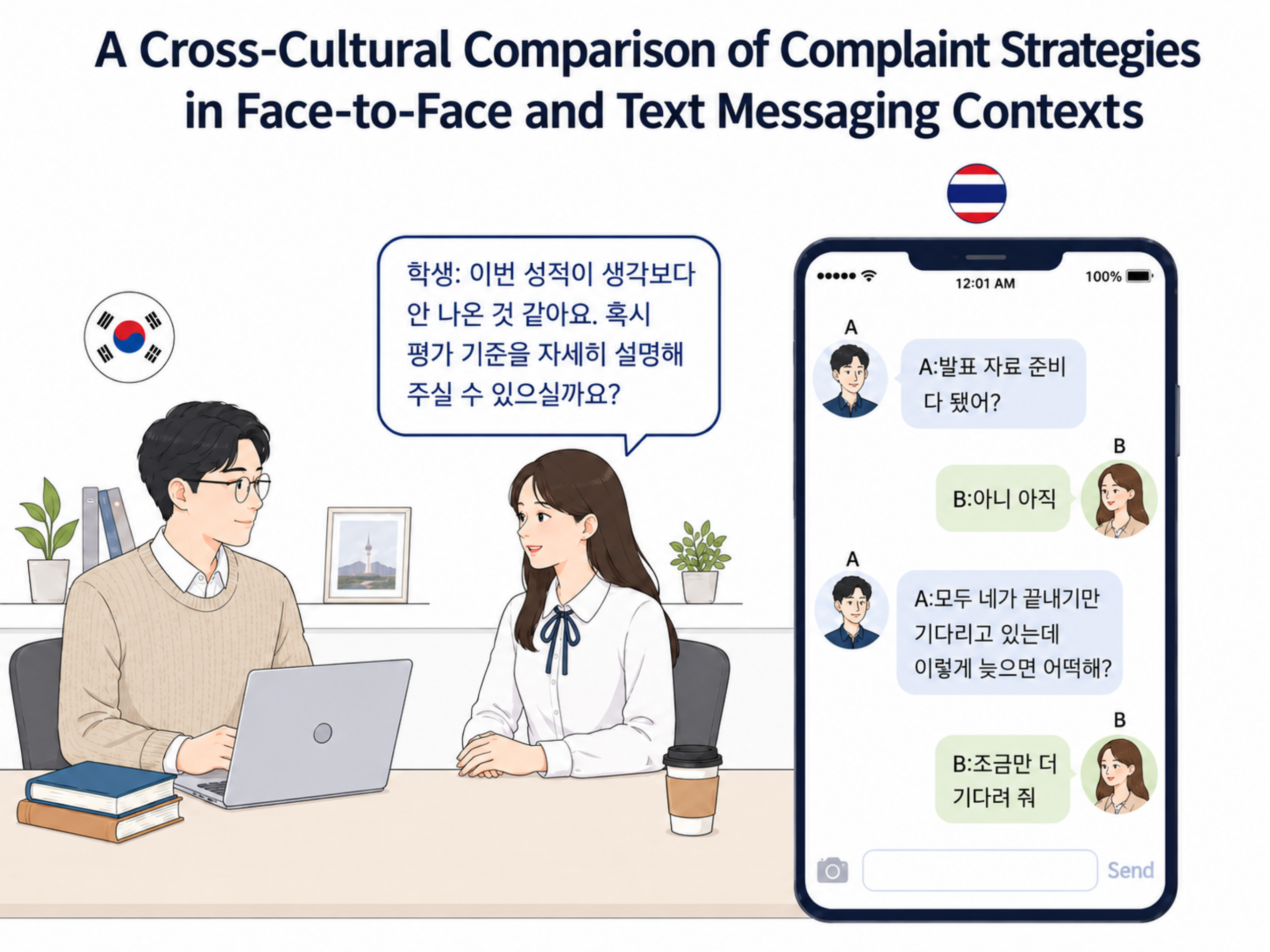
Background and Objectives: Human communication manifests in various forms. The expression of dissatisfaction constitutes one form of communication that may be conveyed through both verbal and nonverbal channels. While previous research has explored complaint strategies within individual linguistic communities, fewer studies have examined how sociocultural factors and communication patterns influence the use of linguistic strategies. This study aims to examine the speech act of expressing dissatisfaction and how linguistic strategies vary according to sociocultural factors and communication media. The study compares Korean native speakers, Thai native speakers, and Thai learners of Korean. It employs a research design that investigates two modes of communication: spoken interaction and text messaging via mobile phones. These modes reveal that each form of communication entails different interactional constraints. The study analyzes linguistic strategies used to express dissatisfaction in relation to varying sociocultural factors and communication patterns, as well as the development of interlanguage pragmatics reflected in Thai learners of Korean.
Methods: The data were collected from university students in Korea and Thailand using a discourse completion test (DCT). The scenarios were designed to take into account contextual factors, including public and private situations; social factors, particularly the interlocutors’ status; and communication modes, namely spoken interaction and text messaging. These factors were examined in terms of how they influenced the performance of the speech act of expressing dissatisfaction. The participants were asked to express dissatisfaction in each scenario. The linguistic strategies analyzed included direct expressions of dissatisfaction, indirect expressions of dissatisfaction, the use of mitigating devices to reduce the force of the utterance, and the selection of supportive moves, among others. The researchers employed a widely recognized framework for speech act analysis and conducted comparisons across speaker groups in order to reveal differences in linguistic strategies.
Results: The findings revealed clear cross-cultural and cross-modal differences in complaint realization. The native Korean speakers showed a higher proportion of direct complaint strategies in text-messaging contexts than in spoken-mode scenarios, while frequently combining direct expressions with mitigation devices such as polite endings, address terms, greetings, and emotional expressions. This pattern suggests that directness in Korean often operates within relationally attentive discourse rather than functioning as overt confrontation. The native Thai speakers consistently favored indirect and harmony-oriented strategies across both modes, relying on questions, wishes, explanations, or contextual hints rather than explicit confrontation. Their complaints emphasized relationship maintenance and the minimization of interpersonal tension. The Thai learners of Korean exhibited hybrid pragmatic patterns, combining Thai-style indirectness with emerging Korean-style politeness strategies. In some contexts, the learners transferred indirect strategies from Thai, while in others they adopted Korean mitigation markers without fully adjusting levels of directness. Overall, the findings indicate that linguistic strategies for expressing dissatisfaction are shaped by sociocultural factors and modes of communication. In particular, the mode of communication exerts a significant influence on the use of linguistic strategies.
Application of this study: The findings underscore the importance of integrating pragmatic and intercultural awareness into Korean language education, particularly in multimodal communication contexts. The findings indicate that learners achieved greater communicative success through instruction that promoted pragmatic knowledge, taking into account social factors such as social status, degree of intimacy, and mode of communication. In addition, a comparative study of linguistic strategies may help reduce pragmatic failure in intercultural communication.
Conclusions: This study investigated the speech act of expressing dissatisfaction among native Korean speakers, native Thai speakers, and Thai learners of Korean, with particular attention to the influence of sociocultural factors and communication modes, including spoken interaction and text messaging. The findings revealed that the linguistic strategies for expressing dissatisfaction vary according to cultural context and communication channels. The native Korean speakers tended to employ more direct strategies while maintaining politeness, whereas the native Thai speakers preferred indirect strategies to preserve interpersonal harmony. The Thai learners of Korean demonstrated the characteristics of interlanguage pragmatics by combining strategies from both languages.
The results reflect that the choice of linguistic strategies is shaped by sociocultural factors and communication modes. Therefore, Korean language instruction should integrate knowledge of pragmatics and intercultural communication in order to promote appropriate and effective language use across diverse communicative contexts.
Downloads
Article Details

This work is licensed under a Creative Commons Attribution-NonCommercial-NoDerivatives 4.0 International License.
References
Brown, P., & Levinson, S. C. (1987). Politeness: Some Universals in Language Usage. Cambridge: Cambridge University Press.
Honda, T., & Kim, I. K. (2009). A Cross-Cultural Study on the Speech Act of Complaint in Korean and Japanese. Korean Language and Literature in International Context, 45, 5-44.
House, J., & Kasper, G. (1981). Politeness Markers in English and German. In F. Coulmas (Ed.), Conversational Routine: Explorations in Standardized Communication Situations and Prepatterned Speech, (pp. 157–185). The Hague, Netherlands: Mouton de Gruyter.
Hwang, S. (2021). A Study on Realization Aspects of Complaint Speech Acts Among Koreans in Their 20s and 30s. Bilingual Research, 83, 213–244. (In Korean)
Jeong, H. (2025). Cross Cultural Analysis of Disagreement Strategies: A Comparative Study of Korean Speakers and Thai Learners of Korean in Spoken and Text Messaging Contexts. Journal of Liberal Arts Thammasat University, 25(3), 499–524.
Kasper, G., & Blum-Kulka, S. (Eds.). (1993). Interlanguage pragmatics. New York, NY: Oxford University Press.
Lutzky, U., & Kehoe, A. (2017). “Oops, I Didn’t Mean to Be So Flippant”: A Corpus Pragmatic Analysis of Apologies in Blog Data. Journal of Pragmatics, 116, 27–36.
Olshtain, E., & Weinbach, L. (1987). Complaints: A Study of Speech Act Behavior Among Native and Non-Native Speakers of Hebrew. In J. Verschueren & M. Bertuccelli-Papi (Eds.), The Pragmatic Perspective: Selected Papers From the 1985 International Pragmatics Conference, (pp. 195-208). Amsterdam, Netherlands: John Benjamins Publishing Company.
Olshtain, E., & Weinbach, L. (1993). Interlanguage Features of the Speech Act of Complaining. In G. Kasper & S. Blum-Kulka (Eds.), Interlanguage Pragmatics, (pp. 108–122). Oxford, UK: Oxford University Press.
Park, E. (2023). A Study on Realization of Complaint Speech Act by American Korean Learners From a Perspective of Cross-Cultural Pragmatics. Master’s thesis, M.A. in Korean Studies, Ewha Womans University, Korea. (In Korean)
Parikumsin, T. (2019). A Study on Complaint Speech Acts of Thai Korean language learners. Korean language and Culture, 25, 183-215. (In Korean)
Sripunvoraskul, R. (2022). An Interlanguage Pragmatic Study of the Speech Act of Complaining: A Case Study of Chinese Learners of Thai. Language and Linguistics, 40(2), 89–114.
Trosborg, A. (1995). Interlanguage Pragmatics: Requests, Complaints, and Apologies. Berlin: Mouton de Gruyter.
Yang, L., & Wannaruk, A. (2019). A Cross-Cultural Pragmatic Study of the Speech Act of Complaining by Native Thai and Chinese Speakers. Kasetsart Journal of Social Sciences, 40(3), 670–676.
Yang, Y. (2017). A Study of Teaching Plan on Complaining Speech Act for Chinese Korean Learners. Master’s thesis, M.A. in Education for Korean, Seoul National University, Korea. (In Korean)
Yoo, Y., Yang, M., & Moon, J. (2014). A Study of the Complaint Speech Act by Chinese Office Workers in Korea: With Focus on High-Level Strategies. The Sociolinguistic Journal of Korea, 22(3), 135-154. (In Korean)
