
The Application of Universal Design for Enhancing the Quality of Life of the Elderly and Developing the Potential of Community Product Producers
Article Sidebar
Main Article Content
Abstract
Background and Objectives: Universal Design is one potential approach for improving the quality of life of elderly individuals, enabling equitable access to products and services regardless of physical limitations. In addition, the development of the potential of community product producers through the concept of universal design can generate economic opportunities and promote the sustainability of community. This research aims to 1) study and compile information on the principles of universal design for enhancing the quality of life of elderly individuals, as well as guidelines for developing the potential of community product producers, 2) develop and apply appropriate design approaches tailored to the physical limitations and behavioral characteristics of the elderly target group, 3) strengthen the potential of community product producers in designing and developing products that meet standard certification requirements, and 4) produce online media that disseminate knowledge on universal design, which can be utilized to support community economic development.
Methods: This research employs a mixed-methods approach combining both qualitative and quantitative methods to study product design guidelines that meet the needs of older adults, as well as to develop the potential of community product producers. The study utilizes in-depth analysis, focus group, and training workshops. The target group consists of 128 elderly people who participated in the seminar project and the community product producers in Nakhon Ratchasima province. It involves a systematic operational process and utilizes appropriate research tools for data collection. The research activities are divided into four phases: 1) Study concepts and gather basic information, 2) design and develop the prototype, 3) test and collect data and 4) analyze data and disseminate findings. The quantitative data were analyzed with descriptive statistics, and the qualitative data were analyzed using content analysis and consideration of data coherence.
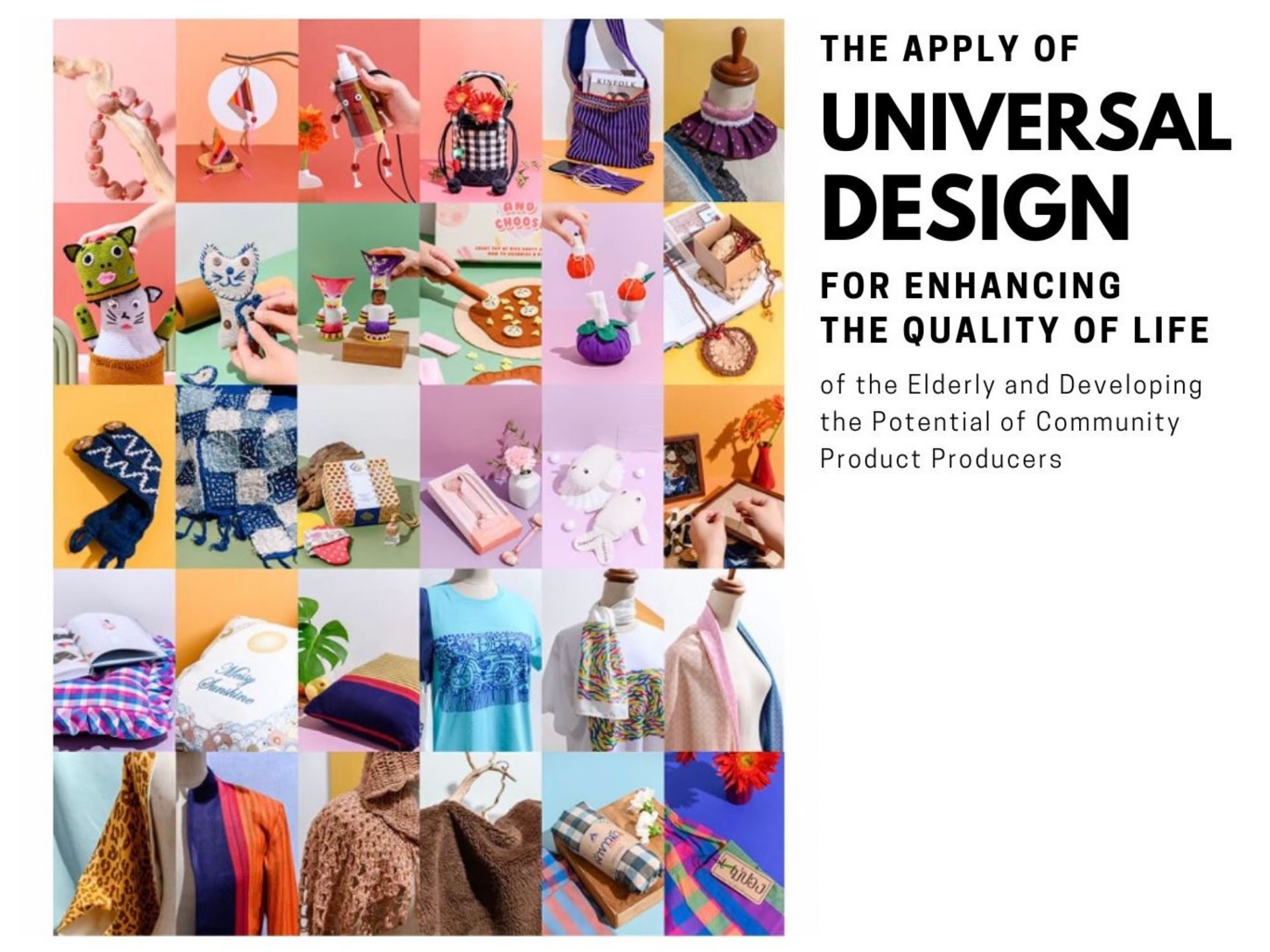
Results: Applying universal design approach in product development can significantly improve the quality of life for the elderly. The most favored products included crayon coloring sets (39.84%), fabric bags (17.96%), and fabric hats (14.84%). The elderly selected products based on physical limitations e.g., vision and mobility, time required to complete tasks, and personal preferences. As for the community product producers, the research led to the development of 30 prototype products, six of which successfully passed product standard certification. Moreover, the research team produced 12 educational video clips shared via YouTube and Facebook, promoting accessible and continuous learning. From the findings, it can be concluded that universal design can be effectively applied to enhance the quality of life of the elderly and the potential of community product producers. Future development should focus on designing the products that address physical limitations of the elderly while promoting sustainable community economies.
Application of this study: For applying universal design concepts in community contexts, 1) there should be a development of training programs to enable the elderly to learn new skills and apply them in establishing careers, such as designing products that can be used in daily life or developing online platforms to assist the elderly in selling their own products. 2) There should also be more designed products suitable for the elderly with specific limitations, such as products for the elderly with severe physical limitations, including medical assistive devices or furniture designed to accommodate the use of those with osteoarthritis. The use of lightweight materials, ergonomic designs, and colors that enhance visibility is also essential. Community products should be linked to online markets and distribution channels that can directly reach target consumers, such as e-commerce platforms specifically designed to support products made by older adults.
Conclusions: This research focuses on the application of universal design concepts to enhance the quality of life for the elderly and to develop the potential of community product producers. Specifically, the community product manufacturers understand the importance of products for the elderly and have gained insight into developing new health-promoting products. The research found that the design guidelines derived from this study can boost the self-confidence of elderly individuals in product design and development. Furthermore, it was found that developing community products using this concept can enhance their competitiveness and create economic opportunities for household and community producers, leading to improved quality of life.
Downloads
Article Details

This work is licensed under a Creative Commons Attribution-NonCommercial-NoDerivatives 4.0 International License.
References
Center for Universal Design. (1997). The Principles of Universal Design. Retrieved 3 March 2025, from https://www.ncsu.edu/ncsu/design/cud/about_ud/udprinciplestext.htm
Faster Capital. (2025). Elderly Empowerment Project: The Entrepreneurial Journey of Senior Citizens: Elderly Empowerment Through Startups. Retrieved 1 May 2025, from https://fastercapital.com/content/Elderly-empowerment-project--The-Entrepreneurial-Journey-of-Senior-Citizens--Elderly-Empowerment-through-Startups.html
Haenjohn, J., & Others. (2024). Best Practice of Healthy Aging: The Perspective of the Elderly who Possess Folk Handicraft Wisdom in Phanat Nikhom Community. Journal of Royal Thai Army Nurses. 25(3), 451-459.
Imrie, R. (2012). Universalism, Universal Design and Equitable Access to the Built Environment. Disability and Rehabilitation, 34(10), 873–882. https://doi.org/10.3109/09638288.2011.624250
Kotler, P., & Keller, K.L. (2012). Marketing Management. 14th ed. Upper Saddle River, NJ: Prentice Hall.
Maslow, A. H. (1943). A Theory of Human Motivation. Psychological Review, 50(4), 370–396. https://doi.org/10.1037/h0054346
Ministry of Health, Labour and Welfare of Japan (2021). Silver Human Resources Centers: A Model for Elderly. Retrieved 1 May 2025, from https://www.mhlw.go.jp/english/policy/older_workers/index.html
National Statistical Office. (2021). Thailand Population Situation Report 2021. Retrieved 3 March 2025, from https://www.nso.go.th/sites/2014/Pages/report2564.aspx
Na Nongkai, N. (2021). Universal Design to Enhance the Quality of Life for the Elderly and Develop the Potential of Local Community Producers. Nakornratchasima: The Thailand Research Fund (TRF).
Palee, P. (2024). The Development of a Community-Based Health Promotion Model for the Elderly Towards Enhancing Well-Being Through Local Lifestyles. MCU Philosophy Review & Public Health, 7(2), 482–502.
Porter, M. E. (1998). Clusters and the New Economics of Competition. Harvard Business Review, 76(6), 77–90.
Smith, J., & Victor, C. (2019). Social Isolation and Loneliness in Older Adults: Opportunities for Intervention. The Lancet Public Health, 4(2), e86–e87. https://doi.org/10.1016/S2468-2667(18)30267-6
Steinfeld, E., & Maisel, J. L. (2012). Universal Design, Creating Inclusive Environments. Hoboken, NJ: John Wiley & Sons.
World Health Organization. (2007). Global Age-Friendly Cities: A Guide. Retrieved 12 March 2025, from https://iris.who.int/handle/10665/43758
World Health Organization. (2020). Decade of Healthy Ageing: Baseline Report. Retrieved 12 March 2025, from https://iris.who.int/handle/10665/338677
World Health Organization. (2021). Global Report on Ageism. Retrieved 12 March 2025, from https://www.who.int/publications/i/item/9789240016866
Wilson, J. D. (2001). Lifelong Learning in Japan – A Lifeline for a ‘Maturing’ Society? International Journal of Lifelong Education, 20(4), 297–313. https://doi.org/10.1080/02601370110048818
