
Comparing the Syntax of the Verb /lên/ in Thai and /wán/ in Mandarin: Structural Patterns and Structural Constraints
Article Sidebar
Main Article Content
Abstract
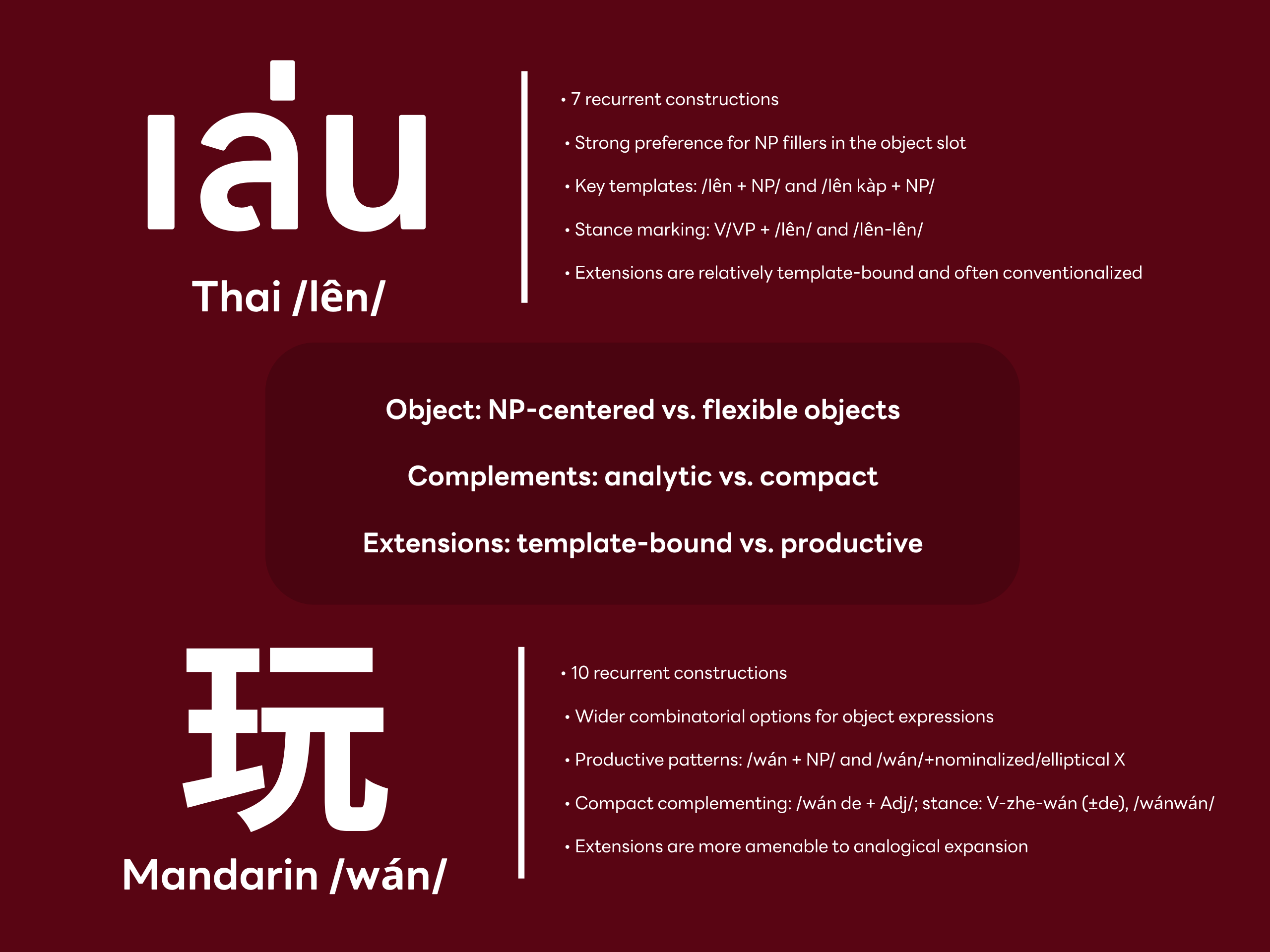
Background and Objectives: Although Thai /lên and Mandarin /wán/ are commonly glossed as ‘play’, they diverge in how meanings are distributed across constructions, so lexical equivalence does not guarantee structural equivalence. In particular, they contrast in object realization, complement packaging (Thai more analytic vs. Mandarin more compact patterns), and the licensing of figurative and stance readings (Thai more template-bound vs. Mandarin more productive /wán/+X frames). This study aims to identify and compare the core construction types of /lên/ and /wán/, specify where functional equivalence holds, and show that cross-linguistic substitutability is construction-dependent rather than word-to-word.
Methods: A qualitative, corpus-based comparison employed Tagmemic slot–filler analysis for structural classification and Construction Grammar for construction-specific interpretations and constraints. The Thai data were drawn from the Thai National Corpus (TNC) and Thairath Online (2021–2023), with reference to the Royal Institute Dictionary (2011) and Khlang Kham; the Mandarin data were drawn from the CCL corpus (1990s–2020s). After screening and deduplication within construction types, the observation set contains 977 Thai and 885 Mandarin instances.
Results: Thai /lên/ clusters into seven recurrent patterns, with a strong preference for nominal fillers in the
object slot; extended readings were typically licensed by specific templates such as /lên kàp/ + NP (co-participation/interaction targets and conventional figurative uses), V/VP + /lên/ and /lên-lên/ (stance marking and mitigating seriousness), and clause-linked complements. Mandarin /wán/ showed ten recurrent patterns with greater flexibility, including nominalized/elliptical object expressions, compact complements (e.g., V-de-Adj), stance templates (V-zhe-/wán/), and reduplication (/wánwán/). Overall, the similarities between the two languages are most evident in literal “play” contexts, while notable differences emerge in object patterns, complement encoding, and the licensing of figurative/stance meanings.
Application of this study: The findings support teaching, bilingual lexicography, and translation by turning recurrent patterns into practical templates and mapping rules. For pedagogy and dictionaries, senses can be presented by construction and idioms treated as fixed form–meaning pairings with usage constraints. For translation, the construction inventory helps select structure-level equivalents when direct verb substitution fails, especially in figurative uses, stance-marking constructions, and complement constructions.
Conclusions: This research aimed to study and compare the use of the verbs /len/ (“play”) in Thai and /wan/ (玩) in Mandarin Chinese in order to explain the relationship between meaning and linguistic structure that governs their usage. Drawing on corpus-based data and employing a combination of Tagmemic analysis and Construction Grammar, the study found that although both verbs share the basic meaning of “play,” they differ significantly in terms of object patterns, complement encoding, and the extension of metaphorical and attitudinal meanings. The equivalence between “เล่น” and “玩” is therefore structural rather than word-for-word. Thai exhibits extended meanings that are tied to specific constructional patterns, whereas Chinese shows greater flexibility and is more conducive to semantic extension through the “玩 + X” framework. The findings can be applied to language teaching, bilingual lexicography, and cross-linguistic translation. Future studies should incorporate spoken language data and quantitative analysis to more comprehensively examine differences across idiomatic expressions and text types.
Downloads
Article Details

This work is licensed under a Creative Commons Attribution-NonCommercial-NoDerivatives 4.0 International License.
References
Center for Chinese Linguistics (CCL). (n.d.). CCL Corpus Retrieval System. [Database]. Retrieved 25 March 2023, from http://ccl.pku.edu.cn:8080/ccl_corpus
Faculty of Arts, Chulalongkorn University. (n.d.). Thai National Corpus (TNC), Third Edition. [Database]. Retrieved 25 March 2023, from https://www.arts.chula.ac.th/ling/tnc/
Fu, J. (2007). HSK Duoyici Yixiang De Tongji Fenxi Ji Liuxuesheng Yixiang Shiyong Qingkuang Diaocha [Statistic and Analysis on Senses of Chinese Polysemes in HSK and the Survey on Sense Use by L2 Learners]. Master’s thesis, M.A. in Linguistics and Applied Linguistics, Beijing Language and Culture University, China. (In Chinese)
Gao, Y. A. (2008). Cong Duoyici Ciyi Xitong Kan Hanyu Xuexi Cidian De Shiyi Yaoqiu [Requirements for Definitions in Chinese Learners’ Dictionaries From the Perspective of Polysemy Sense Systems]. Cishu Yanjiu [Lexicographical Studies], (4), 45–51. (In Chinese)
Goldberg, A. E. (1995). Constructions: A Construction Grammar Approach to Argument Structure. Chicago: University of Chicago Press.
Han, K. Y. (2012). Jiyu Yuliaoku De “v ge x” Yanjiu [Corpus-Based Study on “v + ge + x”: The Case of “wan ge x”]. Master’s thesis, M.A. in Linguistics and Applied Linguistics, Jilin University, China. (In Chinese)
Heine, B., Claudi, U., & Hünnemeyer, F. (1991). Grammaticalization: A Conceptual Framework. Chicago: University of Chicago Press.
Iwasaki, S., & Ingkaphirom, P. (2005). A Reference Grammar of Thai. Cambridge: Cambridge University Press.
Jia, B. S. (2002). Cidian Bianzuan Zhong De “Yishi Tongming” Yu Yici Duoyi [“Different Referents With the Same Name” and Polysemy in Dictionary Compilation]. Cishu Yanjiu [Lexicographical Studies], (1), 69–76. (In Chinese)
Jiang, L. (2020). Xiandai Hanyu “wan + binyu” Xingshi Danwei De Renzhi Yuyi Yanjiu [A Cognitive Semantic Study of The Chinese “wan + object” Construction]. Master’s thesis, M.A. in English Linguistics, Hunan Normal University, China. (In Chinese)
Kitprapasiri, P. (2021). A Comparative Study of Chinese Words and Expressions Containing the Term “DA” With Their Thai Equivalents Containing the Term “TI”. Master’s thesis, M.A. in Chinese Language, Chulalongkorn University, Thailand. (In Thai)
Khamsuwan, P., Tansiri, K., & Sungkaman, U. (2019). A Study of /taam/ in Thai. Vannavidas, 19(2), 179–207. (In Thai)
Li, A. H. (2006). Yinyu Jizhi Xia Duoyici De Yixiang Jian Lianxi Ji Qi Cidian Biaozheng Fangshi [A Metaphor-Based Study of the Relationships Among Senses of Polysemous Words and Their Representation in Dictionaries]. Xibei Nonglin Keji Daxue Xuebao (Shehui Kexueban) [Journal of Northwest A&F University (Social Science Edition)], (1), 132–136. (In Chinese)
Li, X. Y. (2002). Shuo “wan” [On the Verb wan]. Liuzhou Zhiye Jishu Xueyuan Xuebao [Journal of Liuzhou Vocational & Technical College], (1), 21–23. (In Chinese)
Liu, F. (2023). Hanyu Weicixing Chengfen Lianyong De Canzhao Moshi Xintan—Yi “v zhe wan” Wei Li [The Point-Of-View (POV) Patterns of Predicate Series in Mandarin: A Case Study of “v-zhe-wan”]. Hanyu Xuexi [Chinese Language Learning], (6), 57–65. (In Chinese)
Liu, X. M. (2000). Duoyici Yufa Shuxing De Diwei Yu Zuoyong—Jian Lun Fenli Yixiang De Yufa Biaozhun [The Status and Role of Grammatical Attributes of Polysemous Words: On the Grammatical Criteria for Distinguishing Word Senses]. In Academic Committee of the Chinese Lexicographical Society (Ed.), Zhongguo Cishu Lunji 2000 [Studies in Chinese Lexicography 2000], (pp. 90–105). China Encyclopedia Publishing House. (In Chinese)
Liu, Z. X. (2001). Hanyu Duoyi Dongci De Yixiang Xide Guocheng Yanjiu [A Study on the Acquisition Process of Senses of Chinese Polysemous Verbs]. Master’s thesis, M.A. in Curriculum and Instruction, Beijing Language and Culture University, China. (In Chinese)
Lu, X. H. (2022). Meaning Extension of The Motion Verb “/phàan/ ‘pass’” in Thai: A Study on Cognitive Semantics. Journal of Liberal Arts, Rangsit University, 17(2), 7–22. (In Thai)
Panthumetha, N. (2005). Khlang Kham. [A Treasury of Words]. Bangkok: Amarin Publishing. (In Thai)
Royal Institute. (2011). Royal Institute Dictionary, B.E. 2554 [Thai–Thai dictionary]. Bangkok: Royal Institute.
Somphetch, S. (2020). The Semantic Extension of /kàt/ In Thai: A Cognitive Semantic Study. Thai Language and Literature, 37(2), 1–20. (In Thai)
Sun, J. Y. (2012). Xiandai Hanyu Daji Lei Dongci Yanjiu [On Striking-Category Verbs in Modern Chinese]. Master’s thesis, M.A. in English Linguistics, Hunan University, China. (In Chinese)
Thairath Online. (n.d.). Thairath Online. Retrieved 13 March 2024, from https://www.thairath.co.th
Tian, Y. (2007). Hanyu “shuo” Lei Dongci Yanjiu [A Study of the “shuo” Verb Group in Chinese]. Master’s thesis, M.A. in English Linguistics, Central China Normal University, China. (In Chinese)
Tong, Q. M. (2005). Xuzhou Fangyan Zhong De Fanyi Dongci “wan” [The General-Meaning Verb “wan” in Xuzhou Dialect]. Guangxi Jiaoyu Xueyuan Xuebao [Journal of Guangxi Institute of Education], (1), 106–108. (In Chinese)
Traugott, E. C., & Dasher, R. B. (2002). Regularity in Semantic Change. Cambridge: Cambridge University Press.
Wang, Y. N. (1982). Duoyici Yixiang De Gaikuo Yu Qufen [Generalization and Differentiation of Senses of Polysemous Words]. Cishu Yanjiu [Lexicographical Studies], (2), 99–106. (In Chinese)
Wichayapreechar, K. (2013). A Comparative Study of Verb Kan in Mandarin Chinese and Duu in Thai. Master’s thesis, M.A. in Chinese Language, Chulalongkorn University, Thailand. (In Thai)
Yeekaphaet, R. (2014). Chap: A Polysemous Word in Thai. Master’s thesis, M.A. in Thai Language, Chiang Mai University, Thailand. (In Thai)
Zhao, C. (2008). “Wan” Zai Xiandai Hanyu Zhong De Yiyi Kaocha [A Study of the Semantic Meanings of “Wan” in Modern Chinese]. Master’s thesis, M.A. in Chinese Linguistics, Beijing Language and Culture University. (In Chinese)
Zhou, Y. M. (1998). Beijing Kouyu Yufa (Cifa Juan) [Grammar of Beijing Spoken Chinese: Morphology Volume]. Beijing: Language & Culture Press. (In Chinese)
