
Health Demography of the Elderly in Northeastern Thailand: Lessons for Sustainable Practice
Article Sidebar
Main Article Content
Abstract
Background and Objectives: Perceptions of well-being among older adults must be understood within the context of rapidly changing social, cultural, and family structures. In response to these transformations, preparations have been undertaken in terms of financial planning and welfare provisions for the elderly in order to accommodate emerging social changes and to reduce potential inequalities in quality of life. This research aims to analyze the ontological meaning of elderly well-being, extract lessons from best practices in successful local contexts, and develop policy recommendations to guide the sustainable management of elderly well-being in Northeastern Thailand, a region that is rapidly transitioning into a fully aged society.
Methods: The research employed a qualitative design grounded in phenomenology to capture the lived experiences of older adults, families, communities, local administrative units, public-health personnel, civil-society actors, and policy makers. A total of 120 participants across four provinces Buriram, Surin, Sisaket, and Ubon Ratchathani were engaged through in-depth interviews, focus-group discussions, and non-participant observation. Secondary data related to the ontology of well-being, holistic health frameworks, health-service systems, and local wisdom were also reviewed. All data were systematically examined using content analysis and pattern analysis to identify shared meanings and systemic patterns affecting older adults’ well-being in the area.
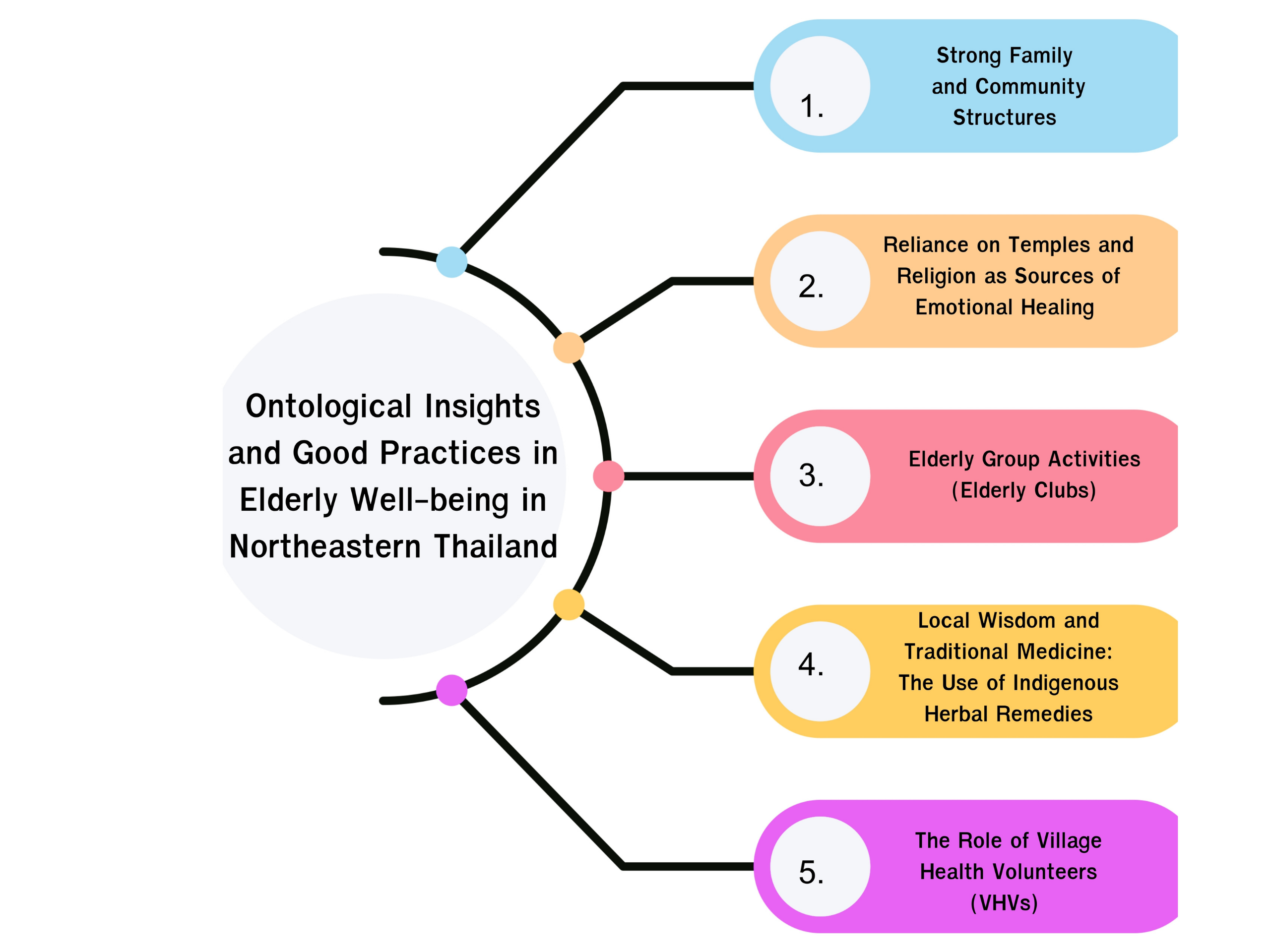
Results: The findings reveal that elderly well-being in Northeastern Thailand constitutes a multi-layered state of being encompassing physical, psychological, social, and spiritual dimensions. Five interrelated themes emerged: 1) Family and kinship networks remain the primary caregiving structure. Despite outward labor migration, cross-locality care via remittances, phone communication, and ritualized homecoming during festivals preserves intergenerational bonds and the dignity of older adults. 2) Buddhist temples and religious institutions continue to serve as centers of emotional renewal. They function as spiritual anchors that mitigate loneliness and create new meaning in later life. 3) Elderly clubs and community-based social activities generate “social energy.” These collective spaces foster a sense of value, recognition, and participation, aligning with the World Health Organization’s framework on active aging. 4) Local healing traditions and herbal medicine constitute a culturally meaningful parallel health system. These practices help bridge structural gaps in access to modern healthcare. 5) Village health volunteers (VHVs) serve as “state intermediaries in caring for older adults’ everyday lives,” linking public health services with local contexts. They play a vital role in enabling close and continuous care for older adults.
Application of this study: From the findings, the older adults in Northeastern Thailand require supportive physical and social environments such as safe walkways, communal activity spaces, life-quality improvement centers and an integrated care system that connects families, communities, local authorities, and health care facilities. Strengthening social capital through VHVs, religious institutions, and community leaders can enhance both the meaningfulness and sustainability of elder care systems. The key policy recommendations include 1) establishing subdistrict-level life-quality development centers for older adults as integrated hubs for physical, mental, and social well-being, 2) implementing community-managed transport services for older adults, 3) developing short-course training programs for VHVs focused on holistic elderly care, 4) integrating local wisdom with modern medicine to build culturally appropriate health systems and 5) urban and community planning based on the age-friendly environment approach to support the long-term needs of an aging population structure.
Conclusions: This research studied the ontological meaning of well-being among the older adults in Northeastern Thailand through the perspectives of older persons, families, communities, and relevant stakeholders, employing a phenomenological approach to gain an in-depth understanding of their lived experiences. The findings revealed that elderly well-being is a complex and multidimensional phenomenon encompassing physical, psychological, social, and spiritual dimensions. Families, kinship networks, temples, elderly clubs, local wisdom, and village health volunteers play significant roles in fostering security, a sense of self-worth, and community participation among older adults. The findings indicate that promoting elderly well-being requires collaborative efforts among families, communities, and government agencies, together with the development of supportive environments and service systems that are responsive to local sociocultural contexts. These findings provide a foundation for policy formulation and the design of integrated elderly care systems to support a high-quality and sustainable ageing society in the future.
Downloads
Article Details

This work is licensed under a Creative Commons Attribution-NonCommercial-NoDerivatives 4.0 International License.
References
Bledsoe, L. K., Moore, S. E., & Collins, W. L. (2010). Long Distance Caregiving: An Evaluative Review of the Literature. Ageing International, 35, 293-310.
Bloom, S. L. (2013). Creating Sanctuary: Toward the Evolution of Sane Societies. Retrieved 2 June 2025, from https://cdn.ahpweb.org/AHPb/self-and-society/26_06/RSEL_A_11085912_O.pdf.
Bratsis, P. (2016). Everyday Life and the State. Retrieved 4 June 2025, from https://www.routledge.com/Everyday-Life-and-theState/Bratsis/p/book/9781594512193
Brickell, K., & Datta, A. (Eds.). (2011). Translocal Geographies. Retrieved 20 July 2025, from https://www.routledge.com/Translocal-Geographies-Spaces-Places-Connections/Datta-Brickell/p/book/9781138272699
Chatterjee, I., Kunwar, J., & den Hond, F. (2019). Anthony Giddens and Structuration Theory. In Management, Organizations and Contemporary Social Theory, (pp. 60-79). Retrieved 6 June 2025, from https://research.vu.nl/ws/portalfiles/portal/269854181/Anthony_Giddens_and_structuration_theory.pdf
Department of Economic. (2022). World Population Prospects 2024: Summary of Results. Retrieved 24 September 2025, from https://www.un.org/development/desa/pd/content/World-Population-Prospects-2022
Department of Older Persons, Ministry of Social Development and Human Security. (2025). Sathiti Phu Sung ayu Kanyayon B.E. 2568. [Statics of Older Persons: September 2025]. Retrieved 8 2026, from https://www.dop.go.th/th/statistics_page?cat=1&id=2578. (In Thai)
Galvin, K., & Todres, L. (2013). Caring and Well-Being: A Lifeworld Approach. Retrieved 10 June 2025, from https://www.routledge.com/Caring-and-Well-being-A-Lifeworld-Approach/Galvin-Todres/p/book/9781138809246
Guillory, J. (2023). Cultural Capital: The Problem of Literary Canon Formation. Retrieved 2 June 2025, from https://press.uchicago.edu/ucp/books/book/chicago/C/bo209142619.html
Hocking, C., & Meltzer, P. (2016). Theoretical Models Relevant to Gerontological Occupational Therapy Practice. In K. F. Barney & M. A. Perkinson (Eds.), Occupational Therapy With Aging Adults: Promoting Quality of Life Through Collaborative Practice, (pp. 41-51). Retrieved 6 June 2025, from https://www.researchgate.net/publication/303415960_Theoretical_models_relevant_to_gerontological_occupational_therapy_practice
Huppert, F. A., Baylis, N., & Keverne, B. (Eds.). (2005). The Science of Well-Being. Retrieved 13 June 2025, from https://global.oup.com/academic/product/the-science-of-well-being-9780198567523?cc=th&lang=en&
Jewell, A. J. (2014). Tornstam’s Notion of Gerotranscendence: Re-Examining and Questioning the Theory. Journal of Aging Studies, 30, 112-120.
Levin, J. (2007). God, Faith, and Health: Exploring the Spirituality-Healing Connection. Retrieved 10 June 2025, from https://www.amazon.com/God-Faith-Health-Spirituality-Healing-Connection/dp/0471218936
Muenkaew, K., & Bunyabandhur, P. (2020). The Formation of Elderly Social Policy in Thailand: A Case Study of the Twelfth National Economic and Social Development Plan. Thai Research and Management Journal, 1(3), 89–106. (In Thai)
Nanthamongkolchai, S., & Others. (2009). Factors Influencing the Participation of the Elderly in Strong Elderly Club, Nakhon Ratchasima Province, Thailand. Thai Journal of Public Health, 39(3), 322-331. (In Thai)
National Statistical Office of Thailand. (2024). Samruat Prachakon Sung ayu Nai Prathet Thai B.E. 2567 [The Survey of the Aging Population in Thailand, B.E. 2567 (2024)]. Bangkok: Ministry of Digital Economy and Society. (In Thai)
Office of the National Economic and Social Development Council. (2024). Raingan Sarup Phon Kan Damnoenngan Tam Yutthasat Chat Pi Ngoppraman 2567 [Summary Report on the Implementation of the National Strategy, Fiscal Year 2024] Bangkok: Office of the National Economic and Social Development Council. (In Thai)
Office of the National Economic and Social Development Council. (2023). Phaen Phatthana Setthakit Lae Sangkhom Haeng Chat Chabap Thi 13 Phoso 2566–2570 [Supporting Document for the Thirteenth National Economic and Social Development Plan (2023–2027)]. Bangkok: Office of the National Economic and Social Development Council. (In Thai)
Painter, C. V. (2013). Sense of Belonging: Literature Review. Retrieved 21 June 2025, from https://www.canada.ca/content/dam/ircc/migration/ircc/english/pdf/research-stats/r48a-2012belonging-eng.pdf
Phothiarunphat, K., & Saengnont, K. (2022). Innovation in Teaching and Learning Thai Traditional Medicine in New Normal. ASEAN Journal of Religious and Cultural Research, 5(1), 62-69.
Qureshi, N. A., Khalil, A. A., & Alsanad, S. M. (2020). Spiritual and Religious Healing Practices: Some Reflections From Saudi National Center for Complementary and Alternative Medicine, Riyadh. Journal of Religion and Health, 59(2), 845-869.
Reiman, A., & Väyrynen, S. (2018). Holistic Well-Being and Sustainable Organisations–a Review and Argumentative Propositions. International Journal of Sustainable Engineering, 11(5), 321-329.
Ritchie, H., & Rodés-Guirao, L. (2024). Peak Global Population and Other Key Findings From the 2024 Un World Population Prospects. Retrieved 20 June 2025, from https://www.sciencedirect.com/science/article/pii/S0890406514000310
Ruger, J. P., & Yach, D. (2009). The Global Role of the World Health Organization. Global Health Governance: The Scholarly Journal for the New Health Security Paradigm, 2(2), 1.
Tejativaddhana, P., & Others. (2020). The Roles of Village Health Volunteers: COVID-19 Prevention and Control in Thailand. Asia Pacific Journal of Health Management, 15(3), 18-22. (In Thai)
Tahom, U. (2026). Figure 1 Ontological Insights and Good Practices in Elderly Well-Being in Northeastern Thailand.
Torut, B., & Pongquan, S. (2012). Impact of the Elderly Club on the Social Well-Being of the Rural Elderly in the Northeastern Region of Thailand. Poverty & Public Policy, 4(3), 58-78. (In Thai)
Visanuyothin, S., & Others. (2015). Health Literacy of Village Health Volunteers in Municipalitiy, Nakhon Ratchasima, Thailand. Journal of Public Health and Development, 13(1), 37-54. (In Thai)
Wongrith, P., & Others. (2024). Self-Protective Behaviors of Thai Village Health Volunteers in Community Engagement During a COVID-19 Outbreak: Interpretation Using the Health Belief Model. BMC Primary Care, 25(1), 102.
Wootvatansa, N., & Klompun, U. S. (2020). Culture of Healthcare Using Local Wisdom in Traditional Medicine of Thai Kui Ethnic Group in Banprasat Yoe, Prasat Yoe Sub–District, Praibung District, Sisaket Province. Journal of Human and Society, Sisaket Rajabhat University, 4(1), 150-167. (In Thai)
