
Repair Strategies in the Conversations of Korean Travel YouTubers Using Thai
Article Sidebar
Main Article Content
Abstract
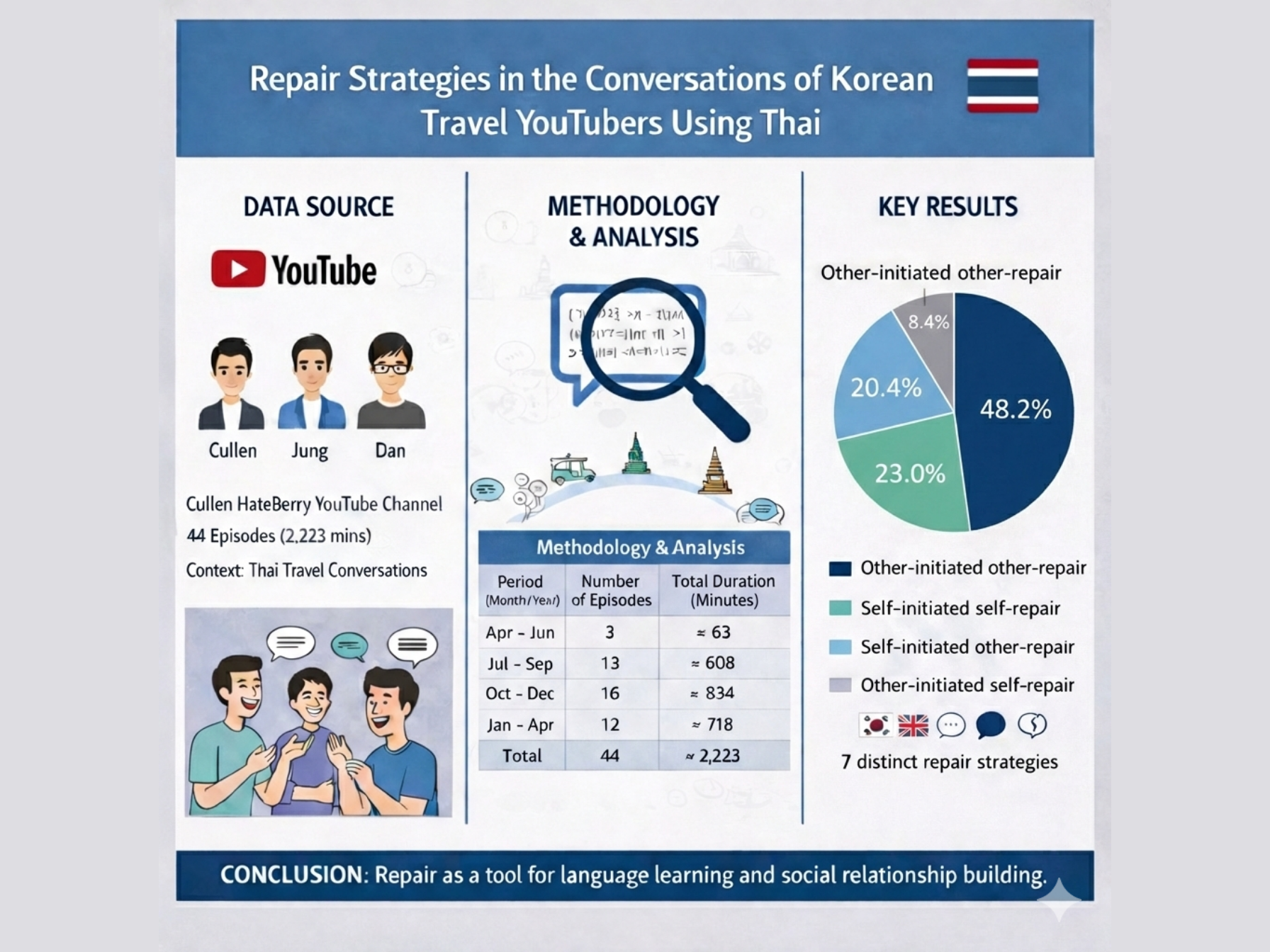
Background and Objectives: In the digital era, online platforms like YouTube have become significant spaces for cross-cultural communication and language learning. This research focuses on the phenomenon of “repair” a conversational mechanism used to address errors or impediments in communication within the context of learning Thai as a foreign language. While repair strategies have been extensively studied in English and other major languages under the frameworks of conversation analysis (CA) and interlanguage pragmatics (ILP), research regarding Thai as a second language (TSL) in real-world and informal contexts remains limited. The primary objective of this study was to investigate the types and strategies of repair employed by Korean travel YouTubers who use Thai to communicate with locals. The study aimed to understand how these learners manage linguistic limitations and negotiate meaning to achieve mutual understanding in authentic situations.
Methods: This is qualitative research and the data were collected from the popular YouTube travel channel “Cullen HateBerry,” featuring Korean content creators (Cullen, Jung, and Dan) traveling in Thailand. The dataset consists of 44 episodes broadcast between April 14, 2023, and April 7, 2024, totaling approximately 2,223 minutes of footage. Data selection focused on segments where Korean speakers communicated primarily in Thai and repair sequences occurred. The conversations were transcribed using Jefferson’s (1979) phonetic notation. The analysis integrated Sacks, Schegloff, & Jefferson’s (1974) turn-taking rules, Schegloff, Jefferson, & Sacks’s (1977) concepts of repair and correction, and Kasper & Blum-Kulka’s (1993) framework of interlanguage pragmatics to categorize repair types and strategies.
Results: The study identified 641 instances of repair, categorized into four types based on initiation and execution. The most frequent type was 1) other-initiated other-repair (48.2%), where the interlocutor (often a Thai native) identified and corrected the error. This was followed by 2) self-initiated self-repair (23.0%), 3) self-initiated other-repair (20.4%), and 4) other-initiated self-repair (8.4%). Furthermore, the analysis revealed seven distinct repair strategies used to manage linguistic challenges: 1) repair through the use of Korean, English, and communication aids (34.7% - most common), 2) incorrect repair that the speaker assumes to be correct, 3) unsuccessful repair that is eventually abandoned, 4) repairing from Korean or English back into Thai, 5) repairing a correct form into an incorrect one, 6) correct repair that the speaker fails to understand and 7) correction from misunderstanding to correctness, respectively.
Application of this study: The findings of this study can be applied to the design of Thai language instruction for foreign learners, with an emphasis on the development of pragmatic competence and communication in real-life situations. The results indicate that instructors should encourage learners to understand the processes of seeking assistance and responding to corrections from native speakers, which are essential components of interaction-based learning. Furthermore, an understanding of learners’strategies enables instructors to design learning activities that align with the developmental stages of interlanguage. This approach can help learners move beyond grammatical limitations toward effective social communicative competence.
Conclusions: Repair in the conversations of Korean YouTubers is a collaborative process essential for maintaining the flow of communication. The dominance of “other-initiated other-repair” reflects a supportive communicative environment where Thai interlocutors and Koreans themselves play an active role in facilitating understanding. In addition, the diverse strategies employed demonstrate the learners’ efforts to overcome linguistic deficits using all available resources, including code-switching and non-verbal cues. Ultimately, this study illustrates that repair is not merely about error correction but is an important social mechanism that reflects a commitment to language learning and the development of cross-cultural relationships.
Downloads
Article Details

This work is licensed under a Creative Commons Attribution-NonCommercial-NoDerivatives 4.0 International License.
References
Bardovi-Harlig, K. (2013). Developing L2 Pragmatics. Language Learning, 63(S1), 68–86.
Bardovi-Harlig, K., & Dörnyei, Z. (1998). Do Language Learners Recognize Pragmatic Violations? Pragmatic Versus Grammatical Awareness in Instructed L2 Learning. TESOL Quarterly, 32(2), 233–262.
Bell, A. (1984). Language Style as Audience Design. Language in Society, 13(2), 145-204.
Bolden, G. B., Mandelbaum, J., & Wilkinson, S. (2012). Pursuing Clarification and Confirmation: Practices for Resolving Problems of Understanding in Conversation. Journal of Pragmatics, 44(13), 1454–1471.
Cullen Hateberry. (2023). Bangkok Jungle Kayaking: A Hidden Gem for Travelers | Bangkachao island. Retrieved 9 May 2024, from https://www.youtube.com/watch?v=t-_BMmCMDro
Cullen Hateberry. (2023). [Eng] Is Phuket or Chiang Mai Boring? Let's go to Khao Yai. Retrieved 9 May 2024, from https://www.youtube.com/watch?v=Fn6wDzwA_nc
Cullen Hateberry. (2023). [Eng] Korean's One-day Hill Tribe Experience in Chiang Mai | Ep.3. Retrieved 9 May 2024, from https://www.youtube.com/watch?v=YNr5k-N3T2k
Cullen Hateberry. (2023). [Eng] My First Camping Trip By Renting A Car In Thailand. Retrieved 9 May 2024, from https://www.youtube.com/watch?v=llZRaDcf3AQ
Egbert, M. (1996). Context-Sensitive Organization of Repair: A Study in Two Contexts of Talk. In E. Ochs, E. Schegloff, & S. Thompson (Eds.), Interaction and Grammar, (pp. 611–635). Cambridge: Cambridge University Press.
Egbert, M. (2004). Other-Initiated Repair and Membership Categorization in a Specific Type of Conversational Sequence. Journal of Pragmatics, 36(9), 1467–1498.
Fox, B. A., Hayashi, M., & Jasperson, R. (1996). Resources and Repair: A Cross-Linguistic Study of Syntax and Repair. In E. Ochs, E. Schegloff, & S. Thompson (Eds.), Interaction and Grammar, (pp. 185–237). Cambridge: Cambridge University Press.
Fox, B. A., & Others. (2010). A Cross-Linguistic Investigation of the Site of Initiation in Same-Turn Self-Repair. In J. Sidnell (Ed.), Conversation Analysis: Comparative Perspectives, (pp. 60–103). Cambridge: Cambridge University Press.
Guimaraes, E. (2007). Repair in Brazilian Portuguese Conversation. Journal of Pragmatics, 39(10), 1805–1827.
Hayashi, M. (2003). Joint Utterance Construction in Japanese Conversation. Amsterdam: John Benjamins Publishing Company.
Jefferson, G. (1979). A Technique for Inviting Laughter and Its Subsequent Acceptance/Declination. In G. Psathas (Ed.), Everyday Language: Studies in Ethnomethodology, (pp. 79–96). New York: Irvington.
Kasper, G. (2006a). Beyond Repair: Conversation Analysis as an Approach to SLA. AILA Review, 19(1), 83–99.
Kasper, G. (2006b). Politeness in Interaction: Introduction to the Special Issue. Multilingua, 25(3), 243–248.
Kasper, G., & Blum-Kulka, S. (Eds.). (1993). Interlanguage Pragmatics. Oxford: Oxford University Press.
Kasper, G., & Roever, C. (2005). Pragmatics in Second Language Learning. In E. Hinkel (Ed.), Handbook of Research in Second Language Teaching and Learning, (pp. 317–334). Mahwah: Lawrence Erlbaum Associates.
Kasper, G., & Rose, K. R. (2002). Pragmatic Development in a Second Language. Malden: Blackwell.
Kasper, G., & Wagner, J. (2011). A Conversation-Analytic Approach to Second Language Acquisition. In D. Atkinson (Ed.), Alternative Approaches to Second Language Acquisition, (pp. 117-142). New York: Routledge.
Kim, H. (1993). Repair Sequences in Korean Conversation. Korean Linguistics, 7, 1–22.
Kim, H. (2001). Interactional and Sequential Aspects of Repair in Korean Conversation. Discourse Studies, 3(2), 193–219.
Krisathian, W. (2012). The Occurrence of Repairs in Burmese Telephone Conversations Between Thai Call Center Operators and Burmese Customers. Journal of Language and Culture, 31(2), 93-121.
Laakso, M., & Sorjonen, M. L. (2010). Cut-off or Particle: Devices for Initiating Self-Repair in Finnish. Journal of Pragmatics, 42(5), 1151–1172.
Leech, G. (1983). Principles of Pragmatics. London: Longman.
Lincoln, Y. S., & Guba, E. G. (1985). Naturalistic inquiry. Beverly Hills: Sage.
Maheux-Pelletier, G., & Golato, A. (2008). Repair and the Achievement of Intersubjectivity in French Conversation. Discourse Studies, 10(6), 715–736.
Paicharoen, N. (2020). Conversational Repairs in Thai Textbooks for Non-Native Learners. VANNAVIDAS, 20(1), 114–139. (In Thai)
Pankaew, N. (2025). Conversational Structure and Interruption in the News Interview Program. Doctoral Dissertation, Ph.D. in Thai, Khon Kaen University, Thailand. (In Thai)
Sacks, H., Schegloff, E. A., & Jefferson, G. (1974). A Simplest Systematics for the Organization of Turn-Taking for Conversation. Language, 50(4), 696–735.
Schegloff, E. A. (2007). Sequence Organization in Interaction: A Primer in Conversation Analysis (Vol. 1). Cambridge: Cambridge University Press.
Schegloff, E. A., Jefferson, G., & Sacks, H. (1977). The Preference for Self-Correction in the Organization of Repair in Conversation. Language, 53(2), 361–382.
Selinker, L. (1972). Interlanguage. IRAL - International Review of Applied Linguistics in Language Teaching, 10(1-4), 209–231.
Sidnell, J. (2008). Failing to Get the Point: Repair Sequences in Talk-In-Interaction. Linguistics and Education, 19(4), 366–388.
Spencer-Oatey, H. (2008). Culturally Speaking: Culture, Communication and Politeness Theory. 2nd ed. London: Continuum.
Spradley, J. P. (1980). Participant Observation. New York: Holt, Rinehart and Winston.
Svennevig, J. (2008). Trying the Easiest Solution First in Other-Initiation of Repair. Journal of Pragmatics, 40(2), 333–348.
Taguchi, N. (2011). Pragmatic Development as a Dynamic, Complex Process: Reinterpreting the Evidence. The Modern Language Journal, 95(4), 605-627.
Taguchi, N. (2011). Teaching Pragmatics: Trends and Issues. Annual Review of Applied Linguistics, 31, 289–310.
Wongkhat, P. (2014). Repair in Thai Conversation: A Case Study of the 94.0 EFM Radio Hosts. Journal of Language and Culture, 31(2), 67. (In Thai)
Wouk, F. (2005). The Syntax of Repair in Indonesian Conversation. Studies in Language, 29(2), 403–440.
Wu, R. J. R. (2006). Initiating Repair and Beyond: The Use of Two Repeat-Formatted Repair Initiations in Mandarin Conversation. Discourse Processes, 41(1), 67–109.
Wutthichamnong, W. (2023). Repair Mechanisms in GMMTV Co., Ltd.’s Series Shootings: A Conversation Analysis. Journal of Thai Language and Thai Culture, 9(2), 108–130. (In Thai)
