
Multilingual Signs in a Multicultural and Economic Space, Kim Yong Market, Hat Yai District, Songkhla Province
Article Sidebar
Main Article Content
Abstract
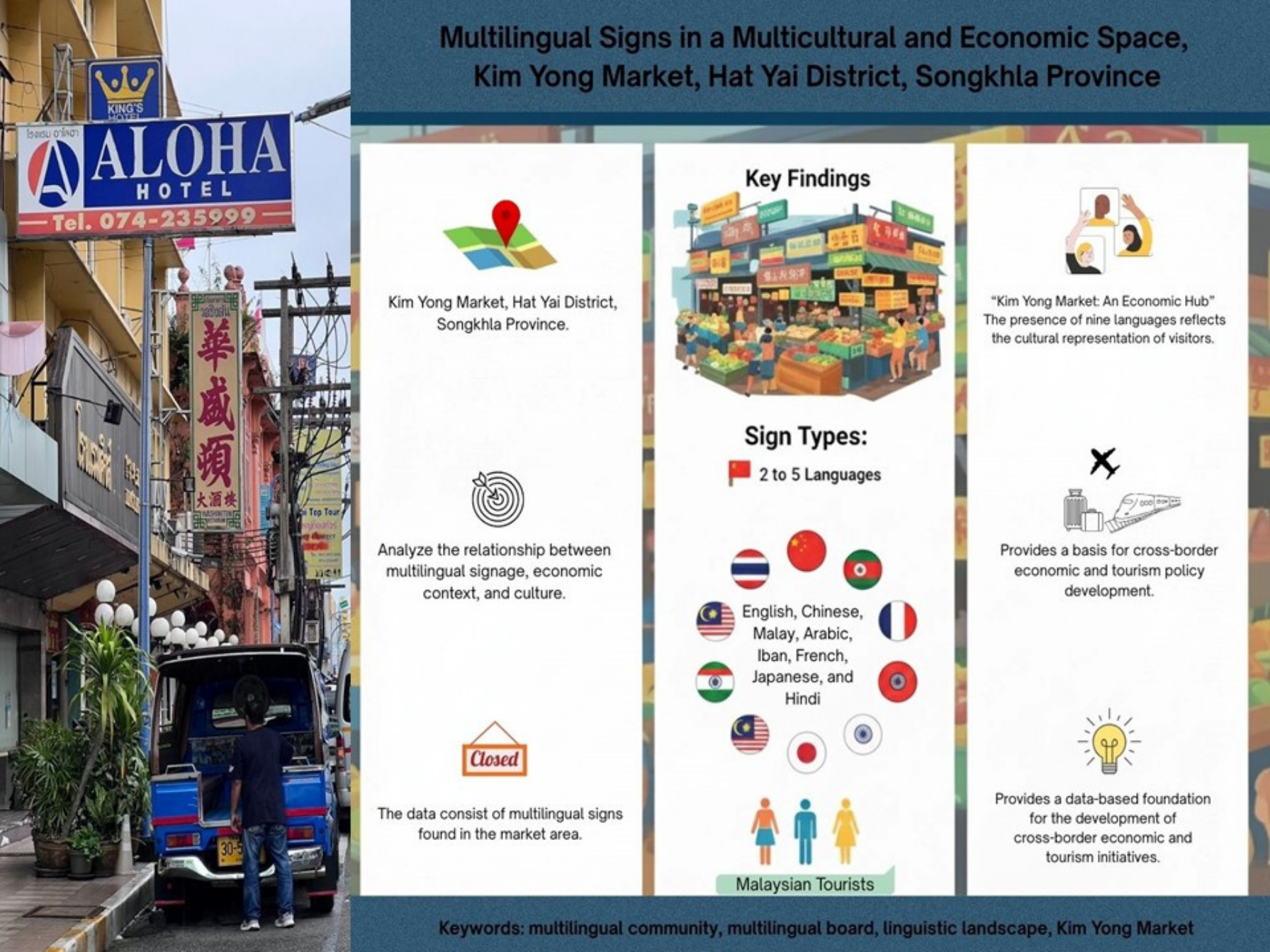
Background and Objectives: Kim Yong Market, located in Hat Yai, Songkhla, is a major economic hub in southern Thailand and is well known to both Thai and Malaysian visitors. The traditional community in the Kim Yong Market area continues to coexist with commercial urban development, transforming this economic space into a linguistically complex, multilingual community. This research aims to analyze multilingual signs in the economic space of Kim Yong Market and its cultural diversity in order to reveal the relationship between multilingual signs and the economic spatial context as well as cultural diversity.
Methods: This research employs a qualitative linguistic landscape research approach. The data consist of multilingual signs found in the market area, and collected through non-participant observation. In addition, in-depth interviews were conducted with 10 key informants who work as traders or service providers in the market, selected through purposive sampling.
Results: The results show that multilingual signs can be categorized into four types: bilingual, trilingual, quadrilingual, and pentalingual signs. A total of nine languages appear on the signs: Thai, English, Chinese, Malay, Arabic, Iban, French, Japanese, and Hindi. These findings highlight Kim Yong Market as a multilingual community within the context of a large economic area engaged in international trade. The multilingual signs are found across all types of businesses and corresponds to the diverse linguistic backgrounds of people in the market area, particularly Malaysians, Chinese, and Indians. This reflects a strong relationship between the economic space and multilingualism, multiculturalism, and tourism as expressed through multilingual signs.
Application of this study: The findings demonstrate how the multilingual signs in Kim Yong Market reflect its multilingual community and provide a basis for extending research on multilingual signs to other multilingual communities associated with urban economic spaces. This contributes to a deeper understanding of the relationship between language, society, and the economy. Moreover, the results can help tourism policy development for international economic tourism cities, especially those connected to neighboring countries, by promoting awareness of multilingualism among visitors to Hat Yai.
Conclusions: Kim Yong Market is a multilingual space, as evidenced by the presence of the multilingual signs. The languages displayed on the signs reflect the people who trade, travel, and reside in and around the market area. As a result, Kim Yong Market stands out as a nationally important economic area characterized by rich linguistic diversity, clearly reflecting the economic, social, and cultural features of the Kim Yong market area.
Downloads
Article Details

This work is licensed under a Creative Commons Attribution-NonCommercial-NoDerivatives 4.0 International License.
References
Backhaus, P. (2007). Linguistic Landscapes: A Comparative Study of Urban Multilingualism in Tokyo. Tokyo: Multilingual Matters.
Blommaert, J. (2013). Ethnography, Superdiversity and Linguistic Landscapes: Chronicles of Complexity. Bristol: Multilingual Matters.
Boonyarasri, R., & Chanthao, R. (2024a). Figure 3 (a) Bilingual Sign (Thai-Chinese); (b) Bilingual Sign (Thai-English); (c) Trilingual Sign (Thai-English-Chinese).
Boonyarasri, R., & Chanthao, R. (2024b). Figure 4 (a) Bilingual Sign (Thai-English); (b) Bilingual Sign (English-Arabic);
(c) Trilingual Sign (Thai-English-Chinese); (d) Trilingual Sign (Thai-English-Arabic); (e) Quadrilingual Sign (Malay-English-Chinese- Arabic); (f) Quadrilingual Sign (Thai- Chinese-English-Japanese).
Boonyarasri, R., & Chanthao, R. (2024c). Figure 5 (a) Bilingual Sign (English-Iban); (b) Trilingual Sign (Thai-English-Arabic); (c) Trilingual Sign (Thai-English-Chinese); (d) Trilingual Sign (Thai-English-Chinese).
Boonyarasri, R., & Chanthao, R. (2024d). Figure 6 (a) Trilingual Sign (Thai-Chinese-English); (b) Quinquelingual Sign (Thai-English-Chinese-Arabic-Hindi).
Boonyarasri, R., & Chanthao, R. (2024e). Figure 8 (a) Bilingual Sign (Thai-English); (b) Trilingual Sign (Thai-English-Chinese).
Boonyarasri, R., & Chanthao, R. (2024f). Figure 9 (a) Bilingual Sign (Thai-Chinese); (b) Trilingual Sign (Thai-English-Chinese).
Boonyarasri, R., & Chanthao, R. (2025a). Figure 2 Types of Multilingual Signs.
Boonyarasri, R., & Chanthao, R. (2025b). Figure 7 (a) Bilingual Sign (Thai-English); (b) Trilingual Sign (Thai-English-Chinese).
Choeirod, R., & Chanthao, R. (2021). Linguistic Landscape at Patong, Phuket, Thailand: Language Perception on Public Signs. NeuroQuantology, 21(1), 250–261.
Choosuk, C., Thitinanthakorn, J., & Rattanaphithakchon, J. (2014). Urbanization Process of Hat Yai City. Final Report. Asian Cities Climate Change Resilience Network (ACCCRN) Project, Supported by the International Institute for Environment and Development (IIIED). Retrieved 10 January 10 2024, from https://www.tei.or.th/thaicityclimate/public/work-17.pdf. (In Thai)
Department of Business Development. (n.d.). List of Business Type Codes Classified by Business Categories. Retrieved 1 November 2024, from https://tsic.dbd.go.th/index. (In Thai)
Forbes Thailand. (2025). Best Budget Travel: “Hat Yai” Rises as One of the Top Three Cheapest Destinations in Asia, With an Average Room Rate of Only 1,308 Baht per Night. Retrieved 12 August 2025, from https://www.forbesthailand.com/news/travel/agoda-hat-yai-top-destination-asia-summer-2025
Google Maps. (2025). Google Maps [Map]. Retrieved 12 September 2025, from https://www.google.com/maps
Gorter, D. (2006). Introduction: The Study of the Linguistic Landscape as a New Approach to Multilingualism. International Journal of Multilingualism, 3(1), 1–6.
Hat Yai District, Songkhla Province. (2020). Southern Regional Data Repository. Retrieved 10 January 2024, from https://clib.psu.ac.th/southerninfo/content/1/719939e5?utm_source=chatgpt.com
Hat Yai Focus. (2018). Yon Roi Chut Kamnoet Mueang Hat Yai. [Traveling Back Nearly Two Centuries: From “Thung Hat Yai” to “Hat Yai City”]. Retrieved 26 March 2025, https://www.hatyaifocus.com/บทความ/873-เรื่องราวหาดใหญ่-หาดใหญ่ (In Thai)
Henriksen, S. (2015). Globalization, Multilingualism and Multiculturalism in Mozambique. In Proceedings of CS-DC’15 World e-conference, September, 2015. Tempe, United States. Retrieved 23 June 2025, from https://hal.science/hal-01291121.
Huebner, T. (2006). Bangkok’s Linguistic Landscapes: Environmental Print, Codemixing and Language Change. In D. Gorter (Ed.), Linguistic Landscape: New Approaches to Multilingualism, (pp. 31–51). Clevedon: Multilingual Matters.
Jones, B., & Heller, M. (2004). The Linguistic Landscape as a Marker of Language Ideology. International Journal of Multilingualism, 1(1), 29–49.
Kavilanan, S. (2024). The Linguistic Landscape of Business Signage at 'KAD KONG TA' Market in Lampang Province: A Reflection of Lost Cultural Diversity. Humanity and Social Science Journal Ubon Ratchathani University, 15(1), 257–283. (In Thai)
Landry, R., & Bourhis, R. Y. (1997). Linguistic Landscape and Ethnolinguistic Vitality. Journal of Language and Social Psychology, 16(1), 23–49. https://doi.org/10.1177/0261927X970161002
Meemongkol, G. (2020). Linguistic Landscape of a University in Thailand. Journal of Liberal Arts Rangsit University, 15(2), 165–186. (In Thai)
Mu, Y., & Rungruang, A. (2013). Chiang Mai’s Linguistic Landscape in the Tourist Attraction Areas: A Study on the English Language Use on Signs. The Golden Teak: Humanity and Social Science Journal, 19(2), 59–70.
Phromyaem, K. (2022). The Study of Linguistic Landscape of Chinese Languageand the Translation Methods of Business Names in Tourism Areas of Chiang Mai. Journal of Human Sciences, 23(1), 209–230. (In Thai)
Pikulthong, S. (2011). Languages on Commercial Signs Along Phra Athit Road. Master’s thesis, M.A. inLanguage and Intercultural Communication, Silpakorn University, Thailand. (In Thai)
PPTV Online. (2025). Chin Khrong Chaemp Thiao Thai Hat Yai Khuen Thaen Chutmai Yot Niyom. [Chinese Tourists Remain the Top Visitors to Thailand, While Hat Yai Becomes a Leading Popular Destination]. Retrieved 21 August 2025, from https://www.pptvhd36.com/news/Wealth/252741 (In Thai)
Rhekhalilit, K. (2020). Language Choice of Public Signage in Thai Universities a Case Study of Chulalongkorn University and Kasetsart University. Manutsayasat Wichakan, 27(2), 310–341. (In Thai)
Ruzaitė, J. (2017). The Linguistic Landscape of Tourism: Multilingual Signs in Lithuanian and Polish Resorts. The Journal of Estonian and Finno-Ugric Linguistics, 8(1), 197–220. https://doi.org/10.12697/jeful.2017.8.1.11
Sarot, T., & Kraisame, S. (2019). Urban Multilingualism: A Case Study of the Relationship Between Linguistic Landscape and Business in North Nana. Journal of Language and Culture, 38(1), 24–40. (In Thai)
Savski, K. (2021). Language Policy and Linguistic Landscape: Identity and Struggle in Two Southern Thai Spaces. Retrieved 23 June 2021, from https://www.researchgate.net/publication/349428640_Language_policy_and_linguistic_landscape_Identity_and_struggle_in_two_southern_Thai_spaces
Songkhla Focus. (2025). Hat Yai Tourism Grows by 20%; Malaysia Remains the Main Market While Indonesia Is Emerging Strongly. Retrieved 21 August 2025, from https://songkhlafocus.com/economy/26907/06/
Vivas-Peraza, A. C. (2020). English in the Linguistic Landscape of Thailand: A Case Study of Public Signs in Hat Yai. Language Value, 13(1), 23–57. https://doi.org/10.6035/LanguageV.2020.13
