
Representations of Thai Children Conveyed Through Linguistic Strategies in Primary School Textbooks for “Civic Duty, Cultures and Lifestyles in Society, Economics, and Geography” Subject
Article Sidebar
Main Article Content
Abstract
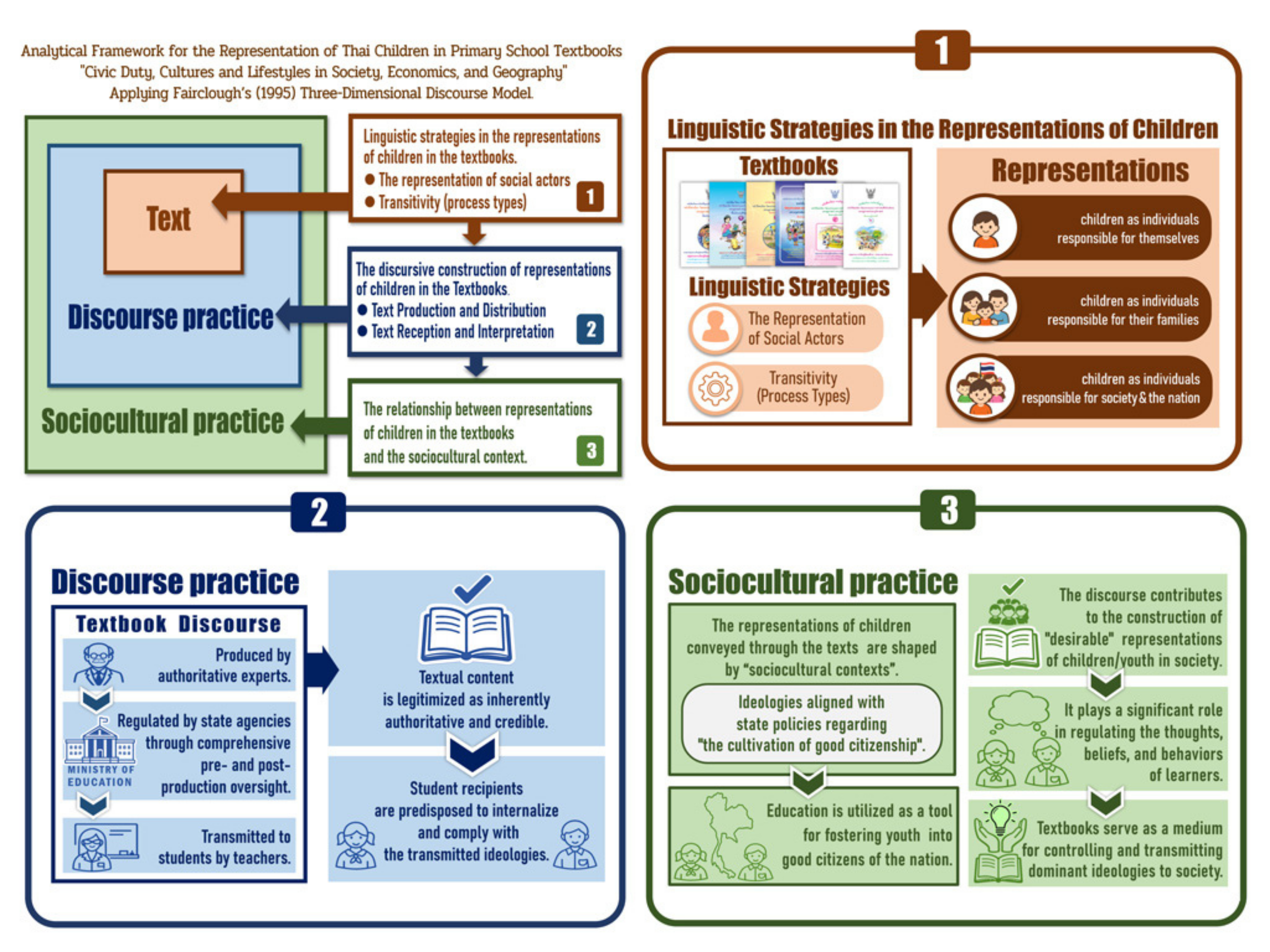
Background and Objectives: Textbooks constitute a form of print media with wide circulation, as they are materials used in teaching and learning within formal education systems. Beyond their function of conveying knowledge content, they also serve as discursive instruments for instilling particular ideologies, beliefs, and values among learners. This research aims to study the linguistic strategies employed in constructing representations of children in primary school textbooks, and to analyze the discourse practices and sociocultural practices based on the framework of critical discourse analysis.
Methods: The data were collected from six primary school textbooks covering grades 1–6 for the subject “Civic Duty, Cultures and Lifestyles in Society, Economics, and Geography.” The data were analyzed using Fairclough’s (1995) framework of Critical Discourse Analysis.
Results: The research findings revealed 1) Text Analysis (Linguistic Strategies): Textbooks employ linguistic strategies, including the use of representation of social actors and transitivity, to present three main representations of children: children as individuals responsible for themselves, children as individuals responsible for their families, and children as individuals responsible for society and the nation. 2) Discourse Practice Analysis: Textbooks constitute discourse produced by authoritative experts under the supervision and guidance of state agencies both prior to and after the production of the text, with teachers transmitting this to students. The content presented in the text is acknowledged to be accurate and trustworthy, making students ready to learn, understand, and willingly comply. 3) Sociocultural Practice Analysis: The representations of children portrayed through the text are shaped by sociocultural contexts relevant to key ideologies aligned with state policies regarding the cultivation of good citizenship to utilize education as a tool for fostering youth to become good citizens of the nation. Simultaneously, such discourse contributes to the construction of representations of children or youth deemed “desirable” by society, which play a role in guiding the thoughts, beliefs, and behaviors of learners. This demonstrates that textbooks play a role in controlling and transmitting societal ideologies among individuals.
Application of this study: This study’s findings may serve as a framework for research on discourse and representation, or for comparative analyses of how children and individuals across different age groups are portrayed in textbooks across various subjects. Furthermore, they may be utilized as preliminary data for curriculum development to present lesson content in a more diverse and comprehensive manner.
Conclusions: The findings of this research reveal how certain ideologies and beliefs are subtly embedded within the text, with language serving as a crucial tool in constructing representations of children presented in textbooks to shape them into desirable future citizens or members of society. Beyond serving instructional purposes and conveying academic content in accordance with the curriculum, textbooks are also created to instill certain thoughts, beliefs, and values that the state deems correct, appropriate, or necessary for learners to adopt.
Downloads
Article Details

This work is licensed under a Creative Commons Attribution-NonCommercial-NoDerivatives 4.0 International License.
References
Bureau of Academic Affairs and Educational Standards. (2008). Tua Chi wat Lae Sara Kan Rianru Kaenklang Khong Klum Sara Kan Rianru Sangkhom Sueksa, Satsana Lae Watthanatham. [Indicators and Core Learning Content for the Social Studies, Religion, and Culture Learning Area]. Bangkok: Ministry of Education. (In Thai)
Bureau of Academic Affairs and Educational Standards. (2014). Naeothang Kanchatkan Rianru Raiwicha Phoemtoem Nathi Phonlamueang. [Guidelines for Learning Management for the Additional Course on Civic Duty]. Bangkok: Ministry of Education. (In Thai)
Butsabokkaew, T. (2019). Representations of Thai Eldery People Through Linguistic Devices in Mass Media Discourses. Doctoral Dissertation, Ph.D. in Thai, Chulalongkorn University, Thailand. (In Thai)
Chechang, U. (2012). The Relationship Between Language and Ideologies in Narratives for Children in National Children’ s Day Books Published During 1980 - 2010. Master’s thesis, M.A. in Thai, Chulalongkorn University, Thailand. (In Thai)
Chuakul, S. (2020). Representations of Vocational Students Linguistically Constructed in Mass Media Discourse and Government Media Discourse: A Critical Discourse Analysis. Doctoral Dissertation, Ph.D. in Thai, Chulalongkorn University, Thailand. (In Thai)
Duanprakhon, P. (2012). Critical Discourse Analysis of News Headlines: A Case of Youth Crime in Thailand. Master’s thesis, M.A. in Language and Communication, National Institute of Development Administration, Thailand.
Durmuş, G. (2019). Construction of Childhood and Child Participation in the Turkish Language Textbooks. Master’s thesis, M.A. in Cultural Studies, Istanbul Bilgi University, Turkey.
Fairclough, N. (1989). Language and Power. London: Longman.
Fairclough, N. (1995). Critical Discourse Analysis: The Critical Study of Language. London: Longman.
Hall, S. (1997). Representation: Cultural Representations and Signifying Practices. London: Sage.
Halliday, M. A. K. (1985). An Introduction to Functional Grammar. London: Edward Arnold.
Kaewphat, S. (2016). The Relationship Between Language and Representations of Isan People in National and Local Newspapers: A Critical Discourse Analysis. Doctoral Dissertation, Ph.D. in Thai, Chulalongkorn University, Thailand. (In Thai)
Liu, Y. (2005). The Construction of Cultural Values and Beliefs in Chinese Language Textbooks: A Critical Discourse Analysis. Discourse: Studies in the Cultural Politics of Education, 26(1), 15-30.
Monwiset, S. (2020). The Relationship Between Language and Representations of Offenders in Thai Laws. Doctoral Dissertation, Ph.D. in Thai, Chulalongkorn University, Thailand. (In Thai)
Niranthawee, S. (2006). Raingan Kan Wichai Ekasan Kan chat kan Rianru Phuea Phatthana Phurian Hai Pen Phonlamueang Di [Documentary Research Report on Learning Management for Developing Learners into Good Citizens]. Bangkok: Office of the Education Council, Ministry of Education. (In Thai)
Office of the Basic Education Commission. (2010). Nang Sue Rian, Rai Wicha Phuen Than, Nathi Phonlamueang, Watthanatham Lae Kan Damnoen Chiwit Nai Sangkhom, Setthasat Lae Phumisat, Chan Prathom Sueksa Pi Thi 6. [Fundamental Subject Textbook: Civic Duty, Cultures and Lifestyles in Society, Economics, and Geography, Primary 6]. Bangkok: The Printing House of the Business Organization of OTEP. (In Thai)
Office of the Basic Education Commission. (2014). Nang Sue Rian, Rai Wicha Phuen Than, Nathi Phonlamueang, Watthanatham Lae Kan Damnoen Chiwit Nai Sangkhom, Setthasat Lae Phumisat, Chan Prathom Sueksa Pi Thi 3. [Fundamental Subject Textbook: Civic Duty, Cultures and Lifestyles in Society, Economics, and Geography, Primary 3]. 4th ed. Bangkok: The Printing House of the Business Organization of OTEP. (In Thai)
Office of the Basic Education Commission. (2016a). Nang Sue Rian, Rai Wicha Phuen Than, Nathi Phonlamueang, Watthanatham Lae Kan Damnoen Chiwit Nai Sangkhom, Setthasat Lae Phumisat, Chan Prathom Sueksa Pi Thi 1. [Fundamental Subject Textbook: Civic Duty, Cultures and Lifestyles in Society, Economics, and Geography, Primary 1]. 8th ed. Bangkok: The Printing House of the Business Organization of OTEP. (In Thai)
Office of the Basic Education Commission. (2016b). Nang Sue Rian, Rai Wicha Phuen Than, Nathi Phonlamueang, Watthanatham Lae Kan Damnoen Chiwit Nai Sangkhom, Setthasat Lae Phumisat, Chan Prathom Sueksa Pi Thi 2. [Fundamental Subject Textbook: Civic Duty, Cultures and Lifestyles in Society, Economics, and Geography, Primary 2]. 5th ed. Bangkok: The Printing House of the Business Organization of OTEP. (In Thai)
Office of the Basic Education Commission. (2016c). Nang Sue Rian, Rai Wicha Phuen Than, Nathi Phonlamueang, Watthanatham Lae Kan Damnoen Chiwit Nai Sangkhom, Setthasat Lae Phumisat, Chan Prathom Sueksa Pi Thi 5. [Fundamental Subject Textbook: Civic Duty, Cultures and Lifestyles in Society, Economics, and Geography, Primary 5]. 6th ed. Bangkok: The Printing House of the Business Organization of OTEP. (In Thai)
Office of the Basic Education Commission. (2018). Nang Sue Rian, Rai Wicha Phuen Than, Nathi Phonlamueang, Watthanatham Lae Kan Damnoen Chiwit Nai Sangkhom, Setthasat Lae Phumisat, Chan Prathom Sueksa Pi Thi 4. [Fundamental Subject Textbook: Civic Duty, Cultures and Lifestyles in Society, Economics, and Geography, Primary 4]. Bangkok: The Printing House of the Business Organization of OTEP. (In Thai)
Paksasuk, A. (2019). Discourse about “PUÑÑA” in Public Media. Doctoral Dissertation, Ph.D. in Thai, Silpakorn University, Thailand. (In Thai)
Pandhiani, S. M., & Others. (2016). Construction of Cultural values and Ideology in Social Studies Textbooks: A Critical Discourse Analytical Perspective. The Women- Annual Research Journal of Gender Studies, 8, 26-39.
Panpothong, N. (2013). Linguistically Oriented CDA: Concepts and their Application to Study of Thai Discourse. Bangkok: Faculty of Arts, Chulalongkorn University, Thailand. (In Thai)
Panpothong, N. (2015). Thai Primary School History Textbooks: A Textually-oriented Critical Discourse Analysis. Journal of Language and Linguistic, 34(1), 66-93.
Phakdeephasook, S. (2018). The Relationship between Language and Identity and Approaches to Analyzing in Thai. Bangkok: Faculty of Arts, Chulalongkorn University. (In Thai)
Rattanadilok Na Phuket, W. (2017). Power Relations between Adulthood-Childhood in the Book Series “Muea Khunta Khunjaj Yang Dek. Journal of the Faculty of Arts, Silpakorn University, 39(2), 104-126. (In Thai)
Rochanahasdin, S., Choosuwan, R., & Sungtong, E. (2017). Significant Principles of Educational Management for Citizenship. Academic Services Journal, Prince of Songkla University, 28(1), 207-217. (In Thai)
Sae-Lim, S. (2018). Representations of Political Protesters in Political Protest During B.E. 2549-2557 in Headline News in Thai Newspaper : A Critical Discourse Analysis. Doctoral Dissertation, Ph.D. in Thai, Chulalongkorn University, Thailand. (In Thai)
Sampaopon, N. (2019). The Relationship Between Language and Representations of Ex-Convicts in Supportive Media Discourse. Master’s thesis, M.A. in Thai, Chulalongkorn University, Thailand. (In Thai)
Siridhrungsri, P. (2017). Civic Education Development. Suthiparithat, 31(100), 100-113. (In Thai)
Sukwisith, W. (2011). The Relationship Between Language and Ideologies in the Thai Language Textbooks for the Elementary School Curriculum B.E. 2503-2544 a Critical Discourse Analysis. Doctoral Dissertation, Ph.D. in Thai, Chulalongkorn University, Thailand. (In Thai)
Suriya, T. (2011). The Relationship Between Language and Representations of Death-Row Inmates and Executions in Thai Newspapers. Master’s thesis, M.A. in Thai, Chulalongkorn University, Thailand. (In Thai)
Suriya, T. (2017). The Relationship Between Linguistic Devices and Representations of Rohingyas in Thai Online Media : A Critical Discourse Analysis. Doctoral Dissertation, Ph.D. in Thai, Chulalongkorn University, Thailand. (In Thai)
van Dijk, T. A. (1989). Structures of Discourse and Structures of Power. In J. A. Anderson, (Ed.), Communication Yearbook 12, (pp. 18-59). London: Sage.
van Leeuwen, T. (1996). The Representation of Social Actors in Discourse. In C. R. Caldas-Coulthard, & M. Coulthard, (Eds.), Texts and Practices: Readings in Critical Discourse Analysis, (pp. 32-70). London: Routledge.
Wongbiasaj, S., Chantaramungkorn, H., & Piangbunta, S. (2004). Award-Winning Thai Chiidren’s Picturebooks: A Literary and Discourse Analysis. Chiangmai: Faculty of Humanities, Chiang Mai University. (In Thai)
Wu, L., & Wu, L. (2025). Values Education in China: A Critical Discourse Analysis of the People’s Education Press’s Seventh Grade English Textbook. JOLLT Journal of Languages and Language Teaching, 13(2), 632-647.
