
Enjoyment, Anxiety, and Boredom in Learning Chinese as a Foreign Language: Their Predictive Roles in Academic Achievement
Article Sidebar
Main Article Content
Abstract
Background and Objectives: Emotion research in L2 acquisition has shifted from solely focusing on foreign language anxiety (FLA) to exploring a range of emotions, including foreign language enjoyment (FLE) and foreign language boredom (FLB). Studies, mainly with L2 English learners, consistently show FLE positively and FLA/FLB negatively predicting academic achievement. However, research on the learning emotions of Chinese as a foreign language (CFL) learners remains limited, particularly concerning emotions beyond anxiety among Thai learners. Thailand is a key context for CFL, and its trilingual university students are the main learning group. This gap in knowledge, especially regarding FLE and FLB, hinders effective teaching interventions. This research aims to investigate the status of the three core emotions (FLE, FLA, and FLB) among Thai trilingual CFL learners and their predictive effects on overall academic achievement in their Chinese Comprehensive course. The goal is to expand the research base and provide insights for improving CFL teaching effectiveness in Thailand.
Methods: Eighty Thai trilingual learners of CFL in their Advanced Chinese course were surveyed using adapted scales for FLE, FLA, and FLB. SPSS 23 and SPSSPRO were used for reliability, validity, descriptive, and correlation analysis. Stepwise linear regression assessed the emotions’ predictive effect on the students’ overall academic achievement.
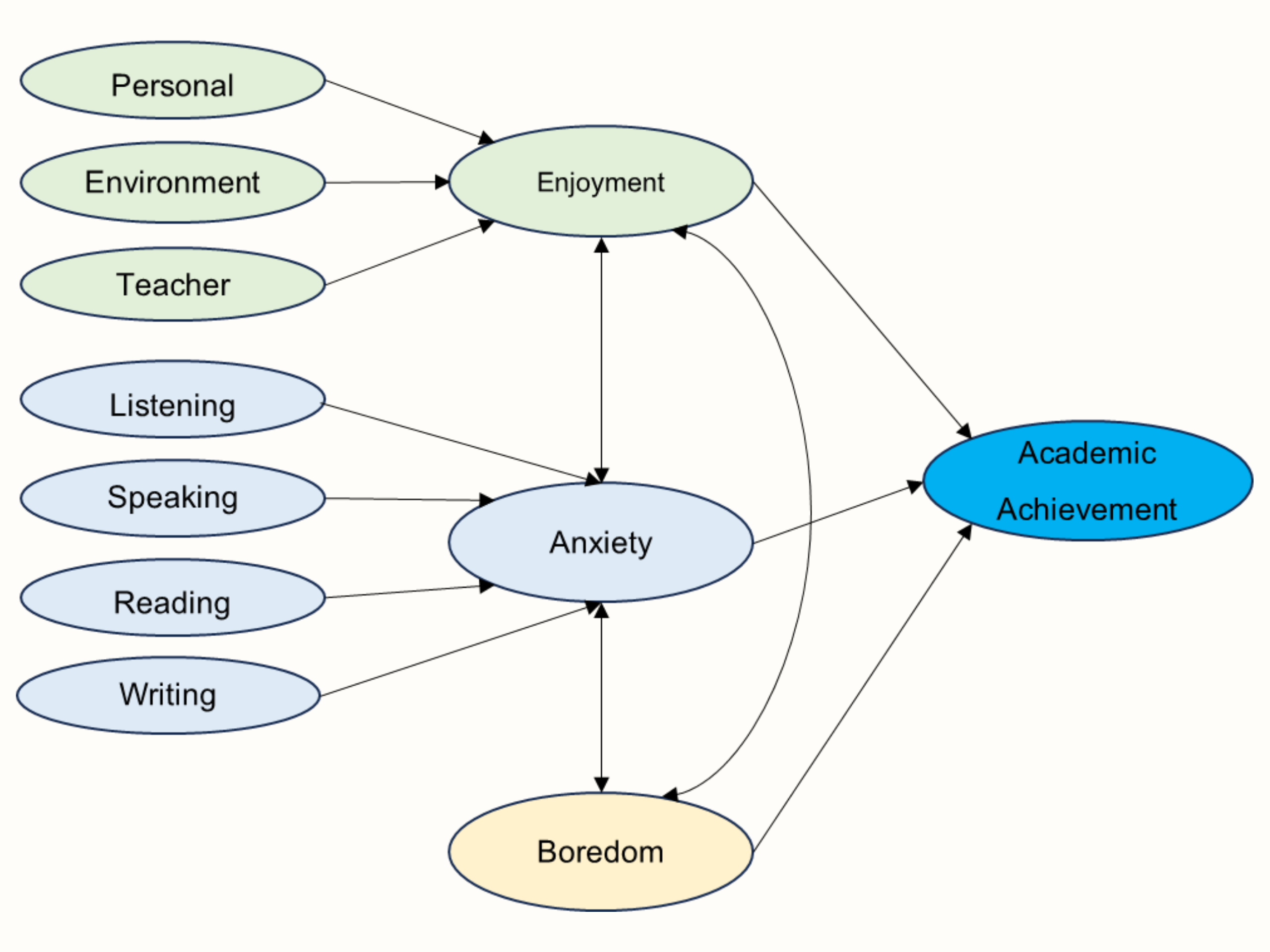
Results: The learners reported relatively high enjoyment alongside moderate anxiety and boredom, with positive emotions generally outweighing negative ones. Enjoyment was mainly influenced by teachers, while anxiety was most evident in reading and writing tasks. Enjoyment showed a weak positive relationship with academic achievement, whereas anxiety had a moderate negative relationship and boredom a weak negative one. Enjoyment was weakly negatively related to both anxiety and boredom, while anxiety was moderately positively related to boredom. In terms of prediction, enjoyment had a small-to-moderate positive effect on achievement, anxiety had a moderate negative effect, and boredom showed no significant effect.
Application of this study: The findings validate the Control-Value and Broaden-and-Build theories, offering two key applications for teaching advanced Thai CFL learners. Teachers should enhance emotional support and foster a positive classroom climate through affective engagement, positive feedback, and interactive teaching to increase enjoyment and reduce anxiety and boredom. In addition, instructional design should aim to reduce anxiety in order to prevent boredom, through approaches such as sequencing learning activities, providing clear guidance, promoting collaborative learning, and incorporating varied activities. These should be implemented alongside the integration of emotion regulation and authentic assessment, which can help reduce test-related stress, maintain continuity in learning, and promote both language development and emotional well-being.
Conclusions: This research demonstrates that emotions play a significant role in the Chinese language learning achievement of Thai trilingual learners. The participants reported relatively high levels of FLE, while FLA and FLB remained at moderate levels. The findings indicate that enjoyment serves as a facilitating factor in language learning, whereas anxiety exerts a substantial negative influence on academic achievement and is associated with increased levels of boredom. These results reflect that positive and negative emotions do not operate independently but interact dynamically in shaping learners’ language learning experiences. Therefore, Chinese language instruction should place greater emphasis on fostering an emotionally supportive learning environment that enhances enjoyment, reduces anxiety, and encourages active learner engagement. Such an approach can contribute not only to improved language achievement but also to the long-term emotional well-being of learners.
Downloads
Article Details

This work is licensed under a Creative Commons Attribution-NonCommercial-NoDerivatives 4.0 International License.
References
Botes, E., Dewaele, J-M., & Greiff, S. (2020). The Foreign Language Classroom Anxiety Scale and Academic Achievement: An Overview of the Prevailing Literature and a Meta-Analysis. Journal for the Psychology of Language Learning, 2(1), 26-56. https://doi.org/10.52598/jpll/2/1/3
Botes, E., & Others. (2022). Validating the short-form Foreign Language Classroom Anxiety Scale. Applied Linguistics, 43(5), 1006–1033. https://doi.org/10.1093/applin/amac018.
Chen, W., Liu, J. Q., & Li, J. F. (2021). An Empirical Study of Chinese L2 Learners’ Foreign Language Enjoyment and Anxiety. Journal of Yunan Normal University, 19(1), 44-53. https://doi.org/10.16802/j.cnki.ynsddw.2021.01.006. (In Chinese)
Cohen, J. (1988). Statistical Power Analysis for the Behavioral Sciences. 2nd ed. Hillsdale, NJ: Lawrence Erlbaum Associates.
Cui, Y., & Meng, Y. R. (2023). The Relationship Between Self-efficacy, Foreign Language Enjoyment and English Proficiency from the Perspective of Positive Psychology. Foreign Languages Research, 40(1), 75-80. https://doi.org/10.13978/j.cnki.wyyj.2023.01.005. (In Chinese)
De Smet, A., & Others. (2018). Classroom Anxiety and Enjoyment in CLIL and non-CLIL: Does the Target Language Matter? Studies in Second Language Learning and Teaching, 8(1), 47-71. https://doi.org/10.14746/ssllt.2018.8.1.3
Dewaele, J.-M., & Alfawzan, M. (2018). Does the Effect of Enjoyment Outweigh That of Anxiety in Foreign Language Performance? Studies in Second Language Learning and Teaching, 8(1), 21–45. https://doi.org/10.14746/ssllt.2018.8.1.2
Dewaele, J.-M., & Li, C. (2020). Emotions in Second Language Acquisition: A Critical Review and Research Agenda. Foreign Language World, 196, 34-49. https://eprints.bbk.ac.uk/id/eprint/32797
Dewaele, J.-M., & Others. (2019). The Flowering of Positive Psychology in Foreign Language Teaching and Acquisition Research. Frontiers in Psychology, 10, 1-13. https://doi.org/10.3389/fpsyg.2019.02128
Dewaele, J.-M., & Li, C. (2022). Foreign Language Enjoyment and Anxiety: Associations with General and Domain-specific English Achievement. Chinese Journal of Applied Linguistics, 45(1), 32-48. https://doi.org/10.1515/CJAL-2022-0104
Dewaele, J. -M., & MacIntyre, P. D. (2014). The Two Faces of Janus? Anxiety and Enjoyment in the Foreign Language Classroom. Studies in Second Language Learning and Teaching, 2, 237-274. https://doi.org/10.14746/ssllt.2014.4.2.5
Dong, L. Q. (2021). The Relationship Between Foreign Language Anxiety and Academic Achievement Among Chinese English Learners: A Meta-Analytic Evidence. Foreign Languages World, 1, 54-61. (In Chinese)
Fredrickson, B. L. (2003). The Value of Positive Emotions: The Emerging Science of Positive Psychology is Coming to Understand Why It's Good to Feel Good. American Scientist, 91(4), 330-335. https://doi.org/10.1511/2003.4.330
Jin, Y., & Zhang, L. J. (2021). The Dimensions of Foreign Language Classroom Enjoyment and Their Effect on Foreign Language Achievement. International Journal of Bilingual Education and Bilingualism, 24(7), 948–962. https://doi.org/10.1080/13670050.2018.1526253. (In Chinese)
Koh, S. Y., Hoon, C. Y., & Haji-Othman, N. A. (2021). “Mandarin Fever” and Chinese Language Learning in Brunei’s Middle Schools: Discrepant Discourses, Multifaceted Realities and Institutional Barriers. Asian Studies Review, 45(2), 325-344. https://doi.org/10.1080/10357823.2020.1801577
Li, C., Dewaele, J. -M., & Jiang, G. (2020). The Complex Relationship Between Classroom Emotions and EFL Achievement in China. Applied Linguistics Review, 3, 485-510. https://doi.org/10.1515/applirev-2018-0043
Li, C., J. -M. Dewaele & Hu, Y. (2021). Foreign Language Learning Boredom: Conceptualization and Measurement. Applied Linguistics Review, 14(2), 223-249. https://doi.org/10.1515/applirev-2020-0124
Li, C. C. (2018). A Positive Psychology Perspective on Chinese Students' Emotional Intelligence, Classroom Emotions, and EFL Learning Achievement. Doctoral Dissertation, Ph.D. in Foreign Language, Xiamen University, China. (In Chinese)
Li, C. C., & Han, Y. (2022). The Predictive Effects of Foreign Language Enjoyment, Anxiety, and Boredom on Learning Outcomes in Online English Classrooms. Modern Foreign Languages, 45(2), 207-219. (In Chinese)
Li, C., & Li, W. (2023). Anxiety, Enjoyment, and Boredom in Language Learning amongst Junior Secondary Students in Rural China: How do They Contribute to L2 Achievement? Studies in Second Language Acquisition, 45(1), 93-108. https://doi.org/10.1017/S0272263122000031. (In Chinese)
Li, D. W. (2015). Research on Problems and Countermeasures in the Professional Development of International Chinese Teachers. Heilongjiang Researches on Higher Education, 7, 79-81. (In Chinese)
Lin, C. J. (2024). Learning Anxiety in Advanced Chinese Intensive Reading Course among Thai Local University Students: Take MFU as an Example. Journal of Sinology and Chinese Language Education, 6(1), 58-72. (In Chinese)
Luo, H. (2014). A Measure of Chinese Language Learning Anxiety: Scale Development and Preliminary Validation. De Gruyter Mouton, 3(2), 147–174. https://doi.org/10.1515/caslar-2014-0009.
MacIntyre, P. D., & Gregersen. T. (2012). Emotions that Facilitate Language Learning: The Positive Broadening Power of the Imagination. Studies in Second Language Learning and Teaching, 2(2), 193-213. https://doi.org/10.14746/ssllt.2012.2.2.4
Ning, L. J., & Noparat, T. (2024). A Study of Thai Undergraduate Students’ Chinese Language Learning Anxiety, Achievement, and Their Anxiety Coping Strategies. Journal of Innovation in Educational Management and Research, 6(1), 1-16. (In Thai)
Pekrun, R. (2006). The Control-value Theory of Achievement Emotions: Assumptions, Corollaries, and Implications for Educational Research and Practice. Educational Psychology Review, 18(4), 315-341. https://doi.org/10.1007/s10648-006-9029-9
Qian, X. J. (1999). Foreign Language Anxiety in Non-Native Speakers of Chinese. Language Teaching and Linguistic Studies, 2, 144-154. (In Chinese)
Saito, K., & Others. (2018). Motivation, Emotion, Learning Experience, and Second Language Comprehensibility Development in Classroom Settings: A Cross-Sectional and Longitudinal Study. Language Learning, 68(3), 709-743. https://doi.org/10.1111/lang.12297
Teimouri, Y., Goetze, J., & Plonsky, L. (2019). Second Language Anxiety and Achievement: A Meta Analysis. Studies in Second Language Acquisition, 41(2), 363-387. https://doi.org/10.1017/S0272263118000311
Wang, G. P. (2023). The Predictive Role of Foreign Language Achievement on Foreign Language Enjoyment under the Control-Value Theory. Second Language Learning Research, 17, 29-39. https://doi.org/10.20054/j.cnki.sllr.2023.17.003. (In Chinese)
Wang, X. Q., & Others. (2024). A Meta-Analysis of the Effectiveness of Boredom on Foreign Language Achievement. Modern Foreign Languages (Bimonthly), 47(4), 490-502. https://doi.org/10.20071/j.cnki.xdwy.20240523.005. (In Chinese)
Wu, J. (2011). A Study of the Listening Anxiety of the Chinese-learning Thai Students. Journal of Yunan Normal University, 9(3), 76-81. https://doi.org/10.16802/j.cnki.ynsddw.2011.03.013. (In Chinese)
Xu, T. T. (2018). A Review of Research on Chinese Language Learning Anxiety in the Last Decade. Journal of Chongqing University of Education, 31(5), 113-117. (In Chinese)
Yang, L. J. (2010). A Study on Chinese Learning Anxiety among Thai International Students. Master’s thesis, M. A., in Teaching Chinese as a Foreign Language, Southwest University, China. (In Chinese)
Yu, H. J., Peng, H. Y., Huang, T., & Zheng, Y. Y. (2024). A Longitudinal Study on the Development of Foreign Language Enjoyment and Engagement. Modern Foreign Languages, 1, 101-113. https://doi.org/10.20071/j.cnki.xdwy.20231027.004. (In Chinese)
Zhang, J., & Wu, Y. H. (2024). Present Situation of 21st Century Chinese Language Education in Thailand and Its “Three-Element” Driving Mechanism. Journal of Research on Education for Ethnic Minorities, 4, 168-176. https://doi.org/10.15946/j.cnki.1001-7178.20240914.002. (In Chinese)
Zhang, L. (2001). A Preliminary Study on the Relationship between Chinese Learning Anxiety and Oral Fluency among International Students. Applied Linguistics, 3, 44-49. (In Chinese)
Zhang, L., & Wang, B. (2002). Analysis of the Correlation Between Chinese Language Anxiety and Academic Achievement Among International Students, and Corresponding Pedagogical Strategies. Language Teaching and Linguistic Studies, 1, 36-42. (In Chinese)
Zhang, R. F., & Yang, Y. S. (2011). Correlation Analysis of Chinese Language Learning Anxiety and HSK Test Scores Among International Students. Journal of Inner Mongolia Normal University, 2, 212-216. (In Chinese)
Zhang, X. (2019). Foreign Language Anxiety and Foreign Language Performance: A Meta Analysis. The Modern Language Journal, 103(4), 763-781. http://www.jstor.org/stable/45286636. (In Chinese)
Zhao, P. F. (2022). Sources of Thai College Students’ Enjoyment and Anxiety in Chinese Classroom. Frontiers of International Chinese Language Education, 1, 95-109+218-219. (In Chinese)
