
How Does Nāgasena Argue? Buddhist Dialectical Logic in the Milindapañha as a Form of Non-Adversarial Reasoning
Article Sidebar
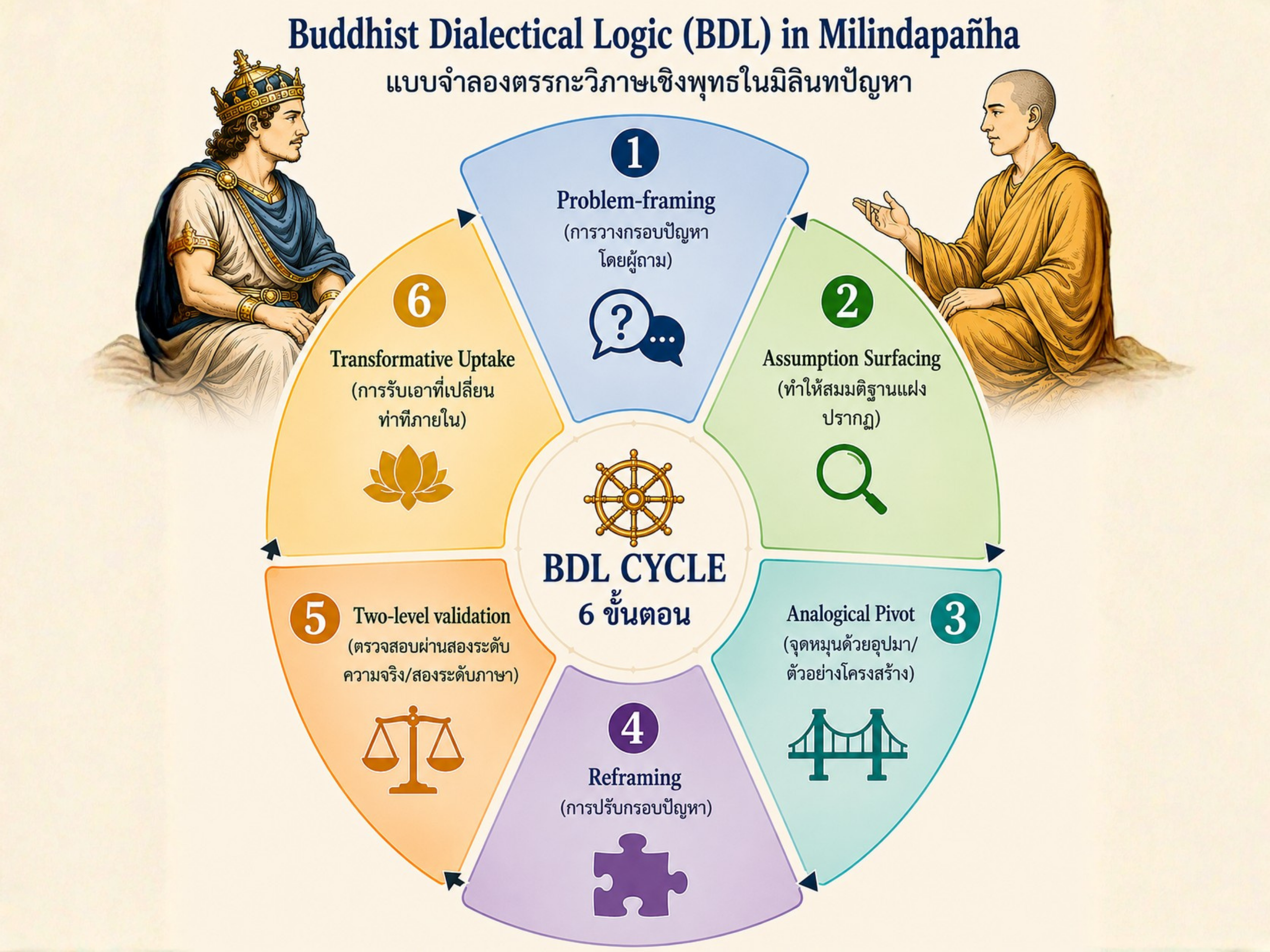
Main Article Content
Abstract
Background and Objectives: When listening to another begins to mean searching for points to counter rather than seeking understanding, reasoning ceases to function as a bridge and becomes instead an instrument for claiming intellectual ground. This condition is not confined to the seminar room. It pervades the political, religious, and moral debates of the modern world, where rhetorical victory is valued more highly than the shared dissolution of ignorance. The article begins from the observation that the problem lies not in the use of reasoning itself, but in the form of reasoning that contemporary societies tirelessly reproduce. The question that follows is whether other forms exist — forms not built, from the outset, upon the assumption of victory.
Methods: This study employs theoretical and textual analysis by reading the Milindapañha as a process of dialogue and reasoning rather than as a repository of doctrinal answers. The analytical framework is inspired by argumentation theory, dialogical logic, and the sociology of reason, in order to examine how questions, analogies, and rebuttals work together as mechanisms for reframing understanding.
Results: The central argument of this article is that the Milindapañha presents such a form of reasoning through the dialogue between Nāgasena and King Menander, which unfolds according to a distinctive dialectical logic—what the author terms “Buddhist dialectical logic.” The five key episodes analyzed in this study are the chariot analogy, the lamp-flame analogy, the mango-seed analogy, the analogy of salt in the sea, and the location of nibbāna. All of these episodes systematically reveal a shared structure. The analysis shows that Nāgasena does not employ reasoning in order to refute his interlocutor; rather, he uses it to bring hidden assumptions to light. Analogy functions as an epistemological pivot, opening up a new conceptual framework without destroying the dignity of the person who holds the previous one. This logic is grounded in four implicit norms: not identifying the conclusion with the self, preserving the intellectual dignity of the interlocutor, refraining from prematurely closing the question, and connecting reasoning with an inner transformation of attitude.
Application of this study: The model of Buddhist dialectical logic thus carries significant implications for the sociology of religion, discourse ethics, and the design of dialogical cultures in an era of sharpening conflict.
Conclusions: This study demonstrates that the Milindapañha should be understood not merely as a repository of Buddhist doctrinal answers, but also as a distinctive model of reasoning that differs fundamentally from adversarial forms of argumentation aimed at defeating an opponent. The dialogues between Nāgasena and King Menander reveal what this study terms Buddhist Dialectical Logic, a mode of reasoning that employs argumentation and analogy to uncover implicit assumptions, broaden interpretive horizons, and facilitate intellectual transformation without undermining the dignity of the interlocutor. The analysis identifies several underlying normative principles, including non-attachment to conclusions, openness to unresolved questions, and the integration of reasoning with the learner’s internal transformation. The author proposes that this form of reasoning can be distilled into a six-stage theoretical model that is open to further discussion in international academic contexts, without exoticizing it as uniquely Buddhist or claiming it as an exclusive feature of Buddhism. Rather, it invites comparison with other dialogical and argumentative traditions, such as the Socratic Elenchus, Rabbinic Disputation, aesthetic dialogue traditions, and the dialogues of the Bhagavad Gītā's, as parallel forms of reasoning.
Downloads
Article Details

This work is licensed under a Creative Commons Attribution-NonCommercial-NoDerivatives 4.0 International License.
References
Alexander, J. C. (2011). Performance and Power. Cambridge, UK: Polity Press.
Asad, T. (1993). Genealogies of Religion: Discipline and Reasons of Power in Christianity and Islam. Baltimore, MD, USA: Johns Hopkins University Press.
Bourdieu, P. (1977). Outline of a Theory of Practice. Nice, R. (Trans.). Cambridge, UK: Cambridge University Press. (Original work published 1972).
Brandom, R. B. (1994). Making It Explicit: Reasoning, Representing, and Discursive Commitment. Cambridge, MA, USA: Harvard University Press.
Chan, J., & Guilfoyle, L. (2023). Argumentation and Religious Education. In L. P. Barnes (Ed.), Debates in religious education. 2nd ed. (pp. 190–198). London, UK: Routledge. https://doi.org/10.4324/9781003406280-19
Fricker, M. (2007). Epistemic Injustice: Power and the Ethics of Knowing. Oxford, UK: Oxford University Press.
Ganeri, J. (2001). Philosophy in Classical India: The Proper Work of Reason. London, UK: Routledge.
Garfield, J. L. (2002). Empty Words: Buddhist Philosophy and Cross-Cultural Interpretation. New York, USA: Oxford University Press.
Gentner, D. (1983). Structure-Mapping: A Theoretical Framework for Analogy. Cognitive Science, 7(2), 155–170. https://doi.org/10.1207/s15516709cog0702_3
Gombrich, R. (2009). What the Buddha Thought. London, UK: Equinox.
Habermas, J. (1984). The Theory of Communicative Action, Volume 1: Reason and the Rationalization of Society. McCarthy, T. (Trans.). Boston, MA, USA: Beacon Press.
Habermas, J. (1990). Moral Consciousness and Communicative Action. Lenhardt, C. & Nicholsen, S. W. (Trans.). Cambridge, MA, USA: MIT Press.
Holyoak, K. J., & Thagard, P. (1995). Mental Leaps: Analogy in Creative Thought. Cambridge, MA, USA: MIT Press.
Kubica, O. (2014). Beyond Influence: A Reflection on the History of Research on the Milindapañha With a Comparison of the Text to the Kitab Al Khazari. Eos, 101, 187–206.
Medina, J. (2013). The Epistemology of Resistance: Gender and Racial Oppression, Epistemic Injustice, and Resistant Imaginations. New York, USA: Oxford University Press.
Mercier, H., & Sperber, D. (2017). The Enigma of Reason. Cambridge, MA, USA: Harvard University Press.
Mouffe, C. (2005). On the Political. London, UK: Routledge.
Peuchthonglang, P. (2026). Figure 1 Buddhist Dialectical Logic in the Milindapañha.
Peuchthonglang, P., & Peuchthonglang , Y. (2026). Logic without losers: Buddhist dialectical reasoning and the transformation of understanding in the Milindapañha. Journal of Buddhist Anthropology, 11(2), 260–273.
Rhys Davids, T. W. (Trans.). (1890). The Questions of King Milinda (Sacred Books of the East, Vols. 35–36). Oxford, UK: Clarendon Press.
Rhys Davids, T. W. (Trans.). (1963). The Questions of King Milinda (2 Vols.). New York, USA: Dover Publications. (Original work published 1890–1894)
Siderits, M. (2003). Personal identity and Buddhist philosophy: Empty persons. Aldershot, UK: Ashgate.
Smith, C. (2003). Moral, Believing Animals: Human Personhood and Culture. New York, USA: Oxford University Press.
Sunstein, C. R. (2009). Republic.com 2.0. Princeton, NJ, USA: Princeton University Press.
Toulmin, S. (2003). The Uses of Argument. Cambridge, UK: Cambridge University Press.
Trenckner, V. (Ed.). (1880). The Milindapañho: Being Dialogues Between King Milinda and the Buddhist Sage NāGasena (PāLi Text). London, UK: Williams & Norgate.
van Eemeren, F. H., & Grootendorst, R. (2004). A Systematic Theory of Argumentation: The Pragma-Dialectical Approach. Cambridge, UK: Cambridge University Press.
von Hinüber, O. (1987). The Oldest Dated Manuscript of the Milindapañha. Journal of the Pali Text Society, 11, 112–118.
Walton, D. (1998). The New Dialectic: Conversational Contexts of Argument. Toronto, Canada: University of Toronto Press.
Walton, D. (2007). Media Argumentation: Dialectic, Persuasion, and Rhetoric. Cambridge, UK: Cambridge University Press.
Walton, D., & Krabbe, E. C. W. (1995). Commitment in Dialogue: Basic Concepts of Interpersonal Reasoning. Albany, NY, USA: State University of New York Press.
Williams, P. (2009). Mahayana Buddhism: The Doctrinal Foundations. 2nd ed. London, UK: Routledge.
