
Death Preparation in Thai Sociocultural Contexts: A Reconsideration of the Conceptual Framework Through Max Weber’s Theory of Social Action and Rationality
Article Sidebar
Main Article Content
Abstract
Background and Objectives: Death and death preparation are deeply embedded in the cultural structures, beliefs, and way of life of Thai society. However, in recent decades, demographic, social, and institutional changes have defined and managed death preparation through public health and legal frameworks. Most related studies explain preparedness behavior by psychological theory emphasizing individual decision-making and instrumental rationality, which cannot fully account for social and cultural meanings of death in the context of Thailand. This article aims to argue that in Thai society, death preparation may be understood as social action driven by multiple rationalities, using Max Weber’s conceptual framework as an analytical foundation to broaden the scope of death studies within the sociocultural dimensions of Thai society.
Methods: This article uses conceptual review and literature synthesis. It reviews Weber’s social action and multiple rationalities framework, including theoretical interpretations to explain relationships among formal rationality, value rationality, tradition, and emotion. The conceptual framework is then compared with findings from studies on preparation for death in the Thai social context, in order to develop theoretical propositions for understanding Thai sociocultural perspectives on death.
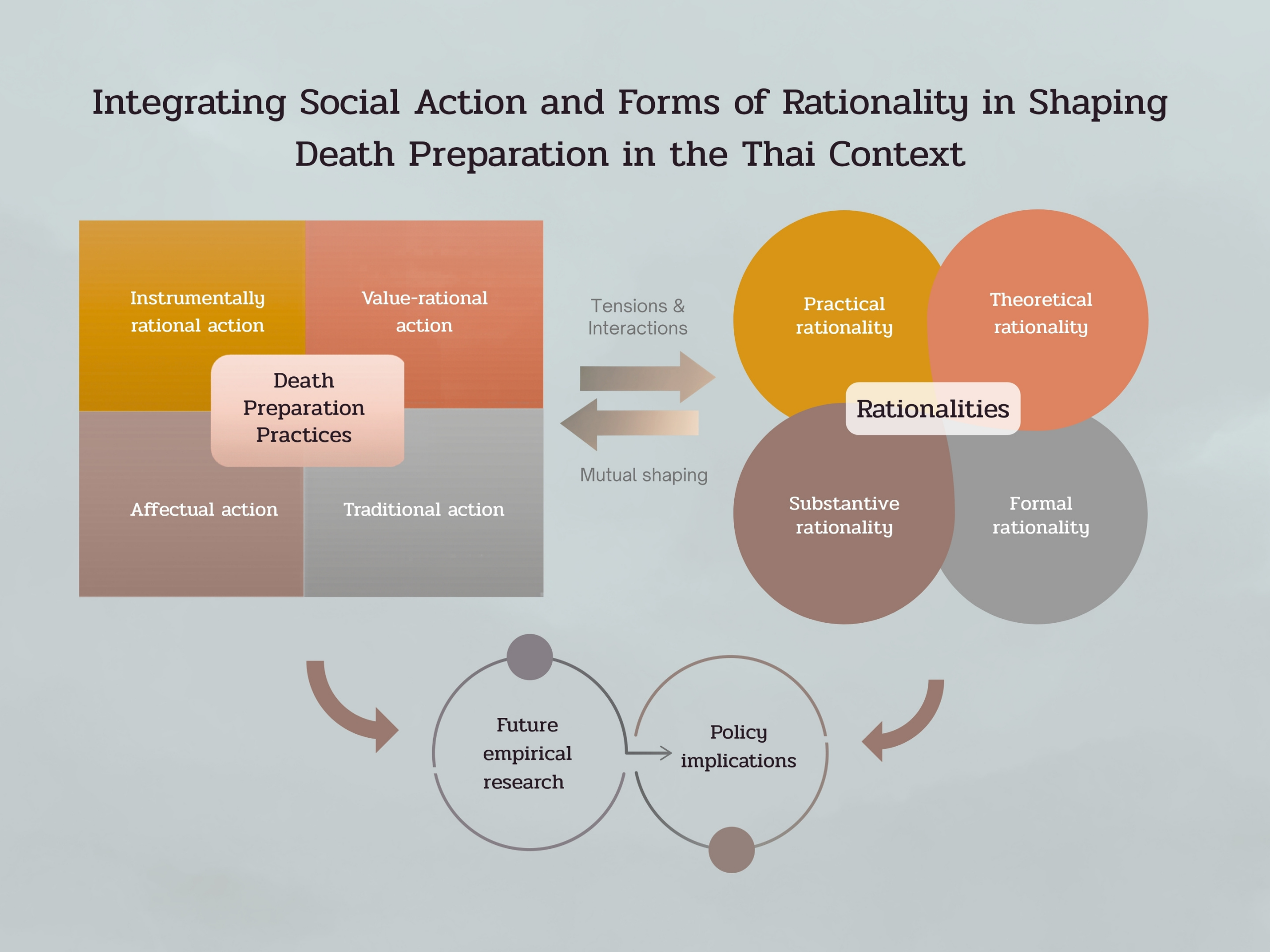
Results: This article puts forward the main argument that death preparation in Thai society may be understood as social action driven by several types of rationality operating jointly, contradictorily, and hierarchically according to context and life course trajectory. The discussion indicates that 1) death preparation is a venue where instrumental, value, affectual, and traditional rationalities converge intricately; 2) its systematization by public health policy and medical institutions reflects a formal rationalization process counterbalanced by substantive rationality and tradition rooted in religion, family, and community; 3) non-preparedness for death may be a socially rational action rather than behavioral failure; and 4) rationalities driving death preparation are dynamic, changing across the stages of an individual’s life.
Application of this study: The proposed framework may be a basis for future empirical research to understand subjective meanings that individuals ascribe to preparation and non-preparation for death across diverse population groups. It also has policy implications, suggesting that promoting death preparation should fit diverse pathways and not restrict assessment of success solely to formal public health system indicators.
Conclusions: This study demonstrates that preparation for death in Thai society should be understood as a complex form of “social action” driven by multiple forms of rationality, including instrumental, value-based, affective, and traditional rationality, which operate together within the life context of each individual. The analysis reveals that death is not merely a medical or legal issue, but also a domain connected to religion, family, community, and the meaning of life. A lack of preparation for death should therefore not always be regarded as a failure of behavior; rather, it may represent a rationally grounded choice under specific sociocultural conditions. Weber’s conceptual framework opens up a new perspective for understanding the dynamics of preparation for death and supports the development of research and policy that more comprehensively recognizes the diversity of life experiences and cultural contexts in Thai society.
Downloads
Article Details

This work is licensed under a Creative Commons Attribution-NonCommercial-NoDerivatives 4.0 International License.
References
Ahmed, O. S., & Others. (2022). The Social and Cultural Dimensions Associated with Death in Muslim Communities, a Case Study Khartoum City. Social Sciences, 11(9), 410.
Ajzen, I. (1991). The Theory of Planned Behavior. Organizational Behavior and Human Decision Processes, 50(2), 179–211. https://doi.org/10.1016/0749-5978(91)90020-T
Aredes, J. S., Giacomin, K. C., & Firmo, J. O. A. (2018). The Physician in the Face of Death in the Emergency Room.Revista de Saúde Pública, 52, 42. https://doi.org/10.11606/s1518-8787.2018052000296
Burke, B. L., Martens, A., & Faucher, E. H. (2010). Two Decades of Terror Management Theory: A Meta-Analysis of Mortality Salience Research. Personality and Social Psychology Review, 14(2), 155–195. https://doi.org/10.1177/1088868309352321
Carr, D., & Luth, E. A. (2019). Well-Being at the End of Life. Annual Review of Sociology, 45, 515–534. https://doi.org/10.1146/annurev-soc-073018-022524
Chan, H. H., & Thang, L. L. (2022). Active Aging through Later Life and Afterlife Planning: Shūkatsu in a Super-Aged Japan. Social Sciences, 11(1), 3. https://doi.org/10.3390/socsci11010003
Chan, T. H. Y., & Others. (2007). Death Preparation and Anxiety: A Survey in Hong Kong. OMEGA - Journal of Death and Dying, 54(1), 67–78. https://doi.org/10.2190/6478-6572-V704-1545
Chandoevwit, W., Kunakornwong, W., & Ngaosri, K. (2020). Setthasat Waduai Sangkhom Ayu Yuen [The Economics of an Aging Society]. Bangkok: Thailand Development Research Institute Foundation. (In Thai)
Cockerham, W. C. (2015). Max Weber: Bureaucracy, Formal Rationality and the Modern Hospital. In F. Collyer (Ed.), The Palgrave Handbook of Social Theory in Health, Illness and Medicine (pp. 124–138). London: Palgrave Macmillan UK.
Costeira, C., & Others. (2024). Death Unpreparedness Due to the COVID-19 Pandemic: A Concept Analysis. Healthcare, 12(2), 188.
Department of Health and Social Care. (2025). Palliative and End of Life Care Profiles: January 2025 Update — Statistical Commentary. Retrieved 15 February 2026, from https://www.gov.uk/government/statistics/palliative-and-end-of-life-care-profiles-january-2025-update/palliative-and-end-of-life-care-profiles-january-2025-update-statistical-commentary
Fischhoff, B., & Barnato, A. E. (2019). Value Awareness: A New Goal for End-of-life Decision Making. MDM Policy & Practice, 4(1), 2381468318817523. https://doi.org/10.1177/2381468318817523
Ghaffari, M., & Others. (2018). Using the Theory of Planned Behavior Framework for Designing Interventions Related to Organ Donation. Irish Journal of Medical Science, 187(3), 609–613. https://doi.org/10.1007/s11845-017-1698-5
Greenberg, J., Pyszczynski, T., & Solomon, S. (1986). The Causes and Consequences of a Need for Self-Esteem: A Terror Management Theory. In R. F. Baumeister (Ed.), Public Self and Private Self (pp. 189–212). New York, NY: Springer New York.
Hanemaayer, A. (2021). The Ethic of Responsibility: Max Weber’s Verstehen and Shared Decision-Making in Patient-Centred Care. Journal of Medical Humanities, 42(1), 179–193. https://doi.org/10.1007/s10912-019-09577-7
Hyde, M. K., & White, K. M. (2009). To Be a Donor or Not to Be? Applying an Extended Theory of Planned Behavior to Predict Posthumous Organ Donation Intentions. Journal of Applied Social Psychology, 39(4), 880–900. https://doi.org/10.1111/j.1559-1816.2009.00464.x
Institute for Population and Social Research Mahidol University. (2016). Thai Health 2016: A Good Death: Alternative Option. K. Churnrurtai, (Ed.) Nakhon Pathom: Institute for Population and Social Research, Mahidol University, Thai Health Promotion Foundation, and The National Health Commission Office.
Jeamteerasakul, S., & Sinthuphan, J. (2024). Communication of Thai Elderly’s Death Preparation. Journal of Siam Communication Arts Review, 23(2), 8–25. (In Thai)
Jiraphan, A., & Pitanupong, J. (2022). General Population-Based Study on Preferences Towards End-Of-Life Care in Southern Thailand: A Cross-Sectional Survey. BMC Palliative Care, 21(1), 36. https://doi.org/10.1186/s12904-022-00926-3
Kalberg, S. (1980). Max Weber's Types of Rationality: Cornerstones for the Analysis of Rationalization Processes in History. American Journal of Sociology, 85(5), 1145–1179.
Katan, M., & Others. (2019). Certainty of Death and Early Preparation: Intention to Purchase Islamic Pre-Need Funeral Plan. Science International (Lahore), 31(2), 225–228.
Kemp, E., & Kopp, S. W. (2010). Have You Made Plans for That Big Day? Predicting Intentions to Engage in Funeral Planning. Journal of Marketing Theory and Practice, 18(1), 81–90.
Kerdpon, A. (2020). Phinit Khwam Tai Nai Thana Prakotkan Thang Watthanatham. [Scrutinize “Death” as a Cultural Phenomenon]. Thammasat Journal, 39(1), 183–201. (In Thai)
Kim, H. (2023). Everyday Rehearsal of Death and the Dilemmas of Dying in Super-Ageing Japan. Modern Asian Studies, 57(1), 32–52. https://doi.org/10.1017/S0026749X21000445
Koyama, T., & Others. (2020). Trends in Place of Death in a Super-Aged Society: A Population-Based Study, 1998–2017. Journal of Palliative Medicine, 23(7), 950–956. https://doi.org/10.1089/jpm.2019.0445
Kunakornvong, W., & Ngaosri, K. (2020). Public Awareness and Attitude toward Palliative Care in Thailand. Siriraj Medical Journal, 72(5), 424–430. https://doi.org/10.33192/Smj.2020.57
Lesthaeghe, R. (2010). The Unfolding Story of the Second Demographic Transition. Population Development Review, 36(2), 211–251. https://doi.org/10.1111/j.1728-4457.2010.00328.x
Lesthaeghe, R. (2022). The Second Demographic Transition: Also a 21st Century Asian Challenge?. China Population and Development Studies, 6(3), 228–236. https://doi.org/10.1007/s42379-022-00119-8
Lin, M. H., Chen, T. J., & Chou, Y. J. (2023). Changes in the Place of Death and Implications for End-of-Life Care Policy: A Population-Based Observational Study. Journal of Palliative Medicine, 26(10), 1340–1347. https://doi.org/10.1089/jpm.2022.0567
McAfee, C. A., & Others. (2022). COVID-19 Brings a New Urgency for Advance Care Planning: Implications of Death Education. Death Studies, 46(1), 91–96. https://doi.org/10.1080/07481187.2020.1821262
McLeod-Sordjan, R. (2014). Death Preparedness: A Concept Analysis. Journal of Advanced Nursing, 70(5), 1008–1019. https://doi.org/10.1111/jan.12252
McMahan, R. D., Hickman, S. E., & Sudore, R. L. (2024). What Clinicians and Researchers Should Know About the Evolving Field of Advance Care Planning: A Narrative Review. Journal of General Internal Medicine, 39(4), 652–660. https://doi.org/10.1007/s11606-023-08579-5
Morren, M., & Grinstein, A. (2021). The Cross-Cultural Challenges of Integrating Personal Norms Into the Theory of Planned Behavior: A Meta-Analytic Structural Equation Modeling (MASEM) Approach. Journal of Environmental Psychology, 75, 101593. https://doi.org/10.1016/j.jenvp.2021.101593
National Health Commission of Thailand. (2025). Sitthi Nathi Dan Sukkhaphap Mattra 12 e–Living will Khue Arai Lae Samkhan Yangrai. [Health Rights and Duties, Sect. 12: What Is an E-Living Will and Why Is It Important?]. Retrieved 15 February 2026, from https://www.nationalhealth.or.th/elivingwill . (In Thai)
Orsini, A. (2024). Max Weber. In A. Orsini (Ed.), Sociological Theory: From Comte to Postcolonialism (pp. 157–204). Cham: Springer Nature Switzerland.
Pewnil, T., (2026). Figure 1 Integrating Social Action and Types of Rationality in Shaping Death Preparation in the Thai Context.
Pewnil, T., Pothisiri, W., & Sriratanaban, P. (2026). A Scoping Review of Death Preparation Practices and Sociocultural Determinants in Thai Society. Discover Social Science and Health, 6(1), 13. https://doi.org/10.1007/s44155-025-00346-7
Pyszczynski, T., Solomon, S., & Greenberg, J. (2015). Chapter One - Thirty Years of Terror Management Theory: From Genesis to Revelation. In J. M. Olson & M. P. Zanna (Eds.), Advances in Experimental Social Psychology (Vol. 52, pp. 1–70). San Diego, CA: Academic Press.
Ritzer, G., & Stepnisky, J. (2014). Sociological Theory. 9th ed. Singapore: McGraw-Hill Education.
Sallnow, L., & Others. (2022). Report of the Lancet Commission on the Value of Death: Bringing Death Back Into Life. The Lancet, 399(10327), 837–884. https://doi.org/10.1016/S0140-6736(21)02314-X
Schwarz, B., & Benson, J. J. (2018). The “Medicalized Death”: Dying in the Hospital. Journal of Housing for the Elderly, 32(3-4), 379–430. https://doi.org/10.1080/02763893.2018.1505462
Scott, J. F. (1981). Preparation for Death. Canadian Family Physician, 27, 1817–1822.
Seale, C. (2000). Changing Patterns of Death and Dying. Social Science & Medicine, 51(6), 917–930. https://doi.org/10.1016/S0277-9536(00)00071-X
Shibata, M., & Others. (2024). Changes in the Place of Death Before and During the COVID-19 Pandemic in Japan. PLOS ONE, 19(2), e0299700. https://doi.org/10.1371/journal.pone.0299700
Sniehotta, F. F., Presseau, J., & Araújo-Soares, V. (2014). Time to Retire the Theory of Planned Behaviour. Health Psychology Review, 8(1), 1–7. https://doi.org/10.1080/17437199.2013.869710
Sriakkpokin, P. (2022). Basic Understanding of the Law that Allows the End of the Patient's Life. Thammasat Law Journal, 51(4), 961–981. (In Thai)
Walter, T. (2012). Why Different Countries Manage Death Differently: A Comparative Analysis of Modern Urban Societies. The British Journal of Sociology, 63(1), 123–145. https://doi.org/10.1111/j.1468-4446.2011.01396.x
Walter, T. (2020). Death in the Modern World. London: Sage.
Weber, M. (1978). Economy and Society: An Outline of Interpretive Sociology. Vols. 1–2. G. Roth & C. Wittich, (Eds.). Fischoff, E. et al., (Trans.). Berkeley, CA: University of California Press. (Original work published 1921–1922).
Weber, M. (2001). The Protestant Ethic and the Spirit of Capitalism. Parsons, T. (Trans.). London, UK: Routledge. (Original work published 1905).
Witvorapong, N. (2021). Khwam Khatwang Tor Khwam Yuen Yao Khong Chiwit Khwam Kangwon Tor Khwam Tai Lae Pharuetikam Khong Phuboriphok: Korani Sueksa Phuenthi Krungthepmahanakhon. [Longevity Expectations, Death Anxiety and Consumer Behaviors: A Case Study of Bangkok]. Retrieved 13 March 2025, from https://www.khonthai4-0.net/system/resource/file/kpfgo_content_attach_file_312_1.pdf?date=2022-02-22%2016:22:54.1 (In Thai)
Worasiangsuk, J. (2015). Thruesadi Sangkhomwitthaya Yuk Khlassik. [Classical Sociological Theory]. 2nd ed. Bangkok: M & M Laser Print Limited Partnership. (In Thai)
Xu, J., He, L., & Chen, H. (2020). Balancing Instrumental Rationality With Value Rationality: Towards Avoiding the Pitfalls of the Productivist Ageing Policy in the EU and the UK. European Journal of Ageing, 17(2), 251–257. https://doi.org/10.1007/s10433-019-00527-9
Yoong, S. Q., Goh, H. S., & Zhang, H. (2022). Death Doulas as Supportive Companions in End-Of-Life Care: A Scoping Review. Palliative Medicine, 36(5), 795–809. https://doi.org/10.1177/02692163221080659
