พัฒนาการของพรรคการเมืองฝ่ายค้านในสิงคโปร์
คำสำคัญ:
สิงคโปร์, พรรคฝ่ายค้าน, พรรคบารีซันโซเชียลิส, พรรคแรงงาน, พรรคประชาธิปัตย์สิงคโปร์บทคัดย่อ
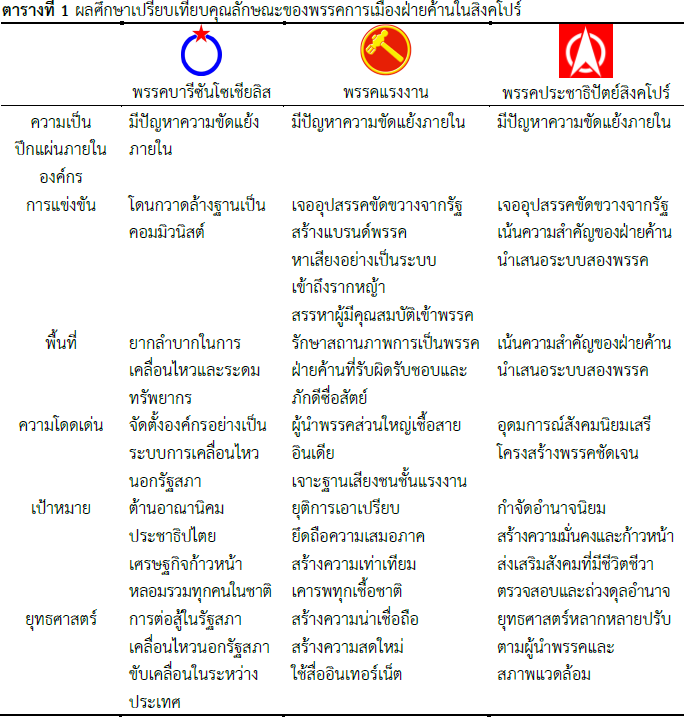
บทความวิจัยนี้มีวัตถุประสงค์เพื่อศึกษาพัฒนาการของพรรคการเมืองฝ่ายค้านที่มีบทบาทต่อการเมืองของสิงคโปร์ อันประกอบไปด้วยพรรคบารีซันโซเชียลิส พรรคแรงงาน และพรรคประชาธิปัตย์สิงคโปร์ ด้วยการวิเคราะห์เปรียบเทียบรูปแบบลักษณะของทั้ง 3 พรรคผ่านกรอบการวิจัยของ Robert Dahl ซึ่งครอบคลุม 6 ประเด็นหลัก คือ 1. ความสามัคคีหรือความเหนียวแน่นเป็นปึกแผ่นภายในองค์กร 2. การแข่งขัน 3. พื้นที่ 4. ความแตกต่างโดดเด่นหรือการบ่งบอกตัวตนลักษณะ 5. เป้าหมาย รวมถึง และ 6. ยุทธศาสตร์ โดยเป็นการวิจัยเชิงคุณภาพที่ใช้วิธีวิจัยเอกสารเป็นหลัก
ผลการวิจัยพบว่า พรรคฝ่ายค้านทั้ง 3 พรรคมีความคล้ายคลึงใกล้เคียงกันในบางประการ โดยเฉพาะอย่างยิ่งปัญหาความขัดแย้งภายใน รวมถึงสภาพแวดล้อมทางการเมืองที่เข้มงวดและจำกัด แต่ทั้ง 3 พรรค ก็มีพัฒนาการที่แตกต่างกันไป โดยพรรคบารีซันโซเชียลิสเริ่มต้นจากการเป็นคู่แข่งที่สูสีคู่คี่กับพรรคกิจประชาชนสู่พรรคการเมืองที่สิ้นอิทธิพลและหยุดเคลื่อนไหวทางการเมือง ส่วนพรรคแรงงานคือพรรคที่เริ่มต้นจากความล้มเหลวในการเลือกตั้งครั้งแรก ๆ แต่ค่อย ๆ ยกระดับสู่พรรคฝ่ายค้านอันดับหนึ่งของประเทศ ขณะที่พรรคประชาธิปัตย์สิงคโปร์ถือเป็นพรรคฝ่ายค้านที่ประสบความสำเร็จอย่างรวดเร็ว แต่ไม่เคยได้รับเลือกตั้งอีกเลยในรอบเกือบ 3 ทศวรรษ ผลศึกษาพัฒนาการของพรรคฝ่ายค้านในสิงคโปร์ยังสะท้อนให้เห็นด้วยว่า การเป็นฝ่ายค้านที่รับผิดรับชอบและซื่อสัตย์ภักดี รวมถึงการโน้มน้าวให้รัฐบาลและผู้มีสิทธิเลือกตั้งตระหนักถึงความสำคัญของการมีฝ่ายค้านในรัฐสภา ถือเป็นแนวทางสำคัญต่อความอยู่รอดในระบบการเมืองแบบพรรคเด่นพรรคเดียวในสิงคโปร์
เอกสารอ้างอิง
โคริน เฟื่องเกษม. (2554). สิงคโปร์ภายใต้สามผู้นำ. กรุงเทพฯ: โรงพิมพ์เดือนตุลาฯ จำกัด.
โตมร ศุขปรีชา. (2569). กับดัก ‘อยากเป็นรัฐบาล’ จนเผลอด้อยค่า ‘ความเป็นฝ่ายค้าน’ โดยไม่รู้ตัว. สืบค้นเมื่อ 6 มกราคม 2569 จาก https://www.the101.world/government-trap-devalue-opposition/.
Ang, M. (2024). PM Lee's View of the Opposition over the Years, 2 He Praised. Mothership. Retrieved January 15, 2026, from https://mothership.sg/2024/05/pm-lee-view-of-opposition/.
ASEAN Parliamentarian for Human Rights. (2024). Parliamentarians at Risk: Reprisals against MPs in Southeast Asia in 2023. Retrieved October 1, 2025, from https://shorturl.asia/KQZSc.
Barr, M. D. (2003). J.B. Jeyaretnam: Three Decades as Lee Kuan Yew's Bête Noir. Journal of Contemporary Asia, 33(3), 299-317.
Blondel, J. (1997). Political Opposition in the Contemporary World. Government and Opposition, 32(4), 462-486.
Chan, H. C. (1976). The Dynamics of One-Party Dominance the PAP at the Grass-roots. Singapore: Singapore University Press.
Chin, N. C. (2015). Analysts Divided on SDP’s Makeover Efforts. Today. Retrieved December 15, 2025, from https://shorturl.asia/dFaP4.
Dahl, R. A. (1966). Political Oppositions in Western Democracies. New Haven and London: Yale University Press.
Devaraj, S. (2025). S’pore Govt Asks Inactive Political Parties Including Barisan Sosialis for Proof of Existence. Retrieved January 10, 2026, from https://shorturl.asia/7lieK.
Freedom House. (n.d.). Singapore. Retrieved January 10, 2026, from https://shorturl.asia/94mJ7.
International IDEA. (2025). The Global State of Democracy 2025: Democracy on the Move. Retrieved March 26, 2026, from https://www.idea.int/sites/default/files/2025-09/global-state-of-democracy-2025-democracy-on-the-move_0.pdf.
Kaiser, A. (2008). Parliamentary Opposition in Westminster Democracies: Britain, Canada, Australia and New Zealand. The Journal of Legislative Studies, 14(1-2), 20-45.
Mauzy, D. K. & Milne, R. S. (2002). Singapore Politics under the People's Action. London and New York: Cambridge University Press.
Mutalib, H. (2004). Parties and Politics: A Atudy of Opposition Parties and the PAP in Singapore. Singapore: Marshall Cavendish Academic.
_____. (2000). Illiberal Democracy and the Future of Opposition in Singapore. Third World Quarterly, 21(2), 313-342.
Ng, T. (2020). Political Foes with 'a Few things in Common': ESM Goh Chok Tong Pens Tribute to WP Chief Low Thia Khiang. Retrieved December 18, 2025, from https://www.asiaone.com/singapore/political-foes-few-things-common-esm-goh-chok-tong-penstributewp-chief-low-thia-khiang.
Ong, E. & Tim, M. H. (2014). Singapore’s 2011 General Elections and Beyond Beating the PAP at Its Own Game. Asian Survey, 54(4), 749-772.
Ong, E. (2025). Valence Rules: Explaining Opposition Party Performance in Singapore's 2025 General Elections. Pacific Affairs, 98(4), 801-813.
Ostwald, K. (2024). Regime Resilience in Malaysia and Singapore Revisited: Ideologically-Bounded Democracies?. Retrieved March 25, 2026, from https://shorturl.asia/Npj1z.
Rodan, G. (1996). Political Oppositions in Industrializing Asia. London: RoutledgeSingapore Democratic Party. (n.d.). Organisation & Leadership. Retrieved December 14, 2025, from https://www.yoursdp.org/organisation.
Singh, B. (2017). Understanding Singapore Politics. Singapore: World Scientific.
Tan, N. (2020). Minimal Factionalism in Singapore’s People’s Action Party. Journal of Current Southeast Asian Affairs, 39(1), 124-143.
The Straits Times. (1961). Barisan Socialis Adopts Red Star Symbol. Retrieved December 10, 2025, from https://shorturl.asia/3calo.
Workers’ Party. (n.d.). Our Constitution. Retrieved January 5, 2026, from https://www.wp.sg/constitution.
Yeo, Z. (2018). Singapore Democratic Party. Retrieved January 10, 2026, from https://www.nlb.gov.sg/main/article-detail?cmsuuid=73514f30-ecb9-4ea1-a220-66d1972a5312.
Yeong, L. H. (2019).The First Wave: JBJ, Chiam & the Opposition in Singapore. Singapore: Epigram Books.
ดาวน์โหลด
เผยแพร่แล้ว
รูปแบบการอ้างอิง
ฉบับ
ประเภทบทความ
หมวดหมู่
สัญญาอนุญาต
ลิขสิทธิ์ (c) 2026 วารสารวิชาการรัฐศาสตร์และรัฐประศาสนศาสตร์

อนุญาตภายใต้เงื่อนไข Creative Commons Attribution-NonCommercial-NoDerivatives 4.0 International License.