EVOLUTION OF OPPOSITION PARTIES IN SINGAPORE
Keywords:
Singapore, Opposition Parties, Barisan Sosialis, Workers’ Party, Singapore Democratic PartyAbstract
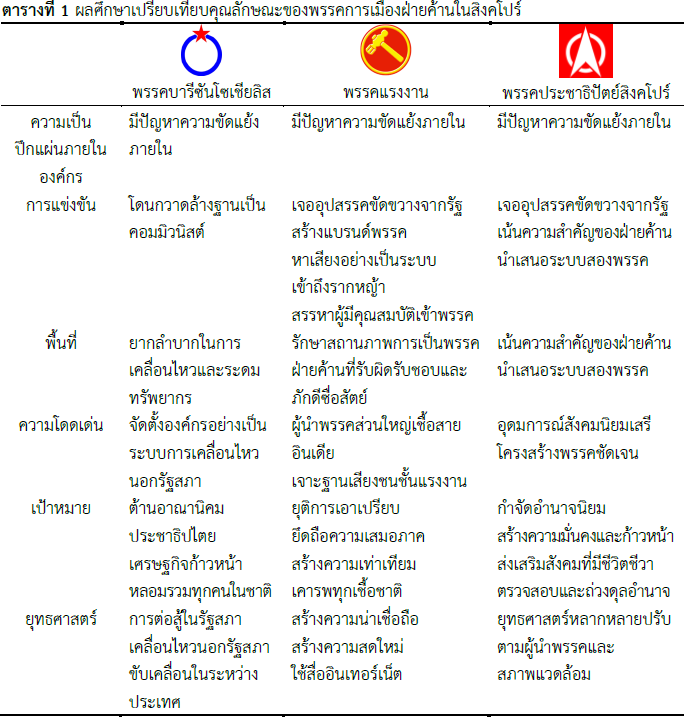
This research article aims to study the evolution of Singapore’ s main opposition parties - Barisan Sosialis, the Workers’ Party, and the Singapore Democratic Party. It compares key characteristics of these three parties using Robert Dahl’s classic framework, drawing on documentary research.
The finding shows that the three parties share certain similarities, especially internal rifts and restrict political landscape. However, their developmental trajectories differ significantly. Barisan Sosialis evolved from being a major competitor to the ruling People’s Action Party (PAP) to becoming a defunct political party. The Workers’ Party, by contrast, experienced repeated failures in its early elections but has since risen to become the first-tier of opposition party in Singapore. The Singapore Democratic Party was initially a rapidly successful party but has failed to secure any parliamentary seat for nearly three decades. This divergent evolution suggests that maintaining a responsible and loyal opposition stance, while persuading both the government and voters of the importance of opposition parties, is crucial for political survival within Singapore’s one-party–dominant system.
References
โคริน เฟื่องเกษม. (2554). สิงคโปร์ภายใต้สามผู้นำ. กรุงเทพฯ: โรงพิมพ์เดือนตุลาฯ จำกัด.
โตมร ศุขปรีชา. (2569). กับดัก ‘อยากเป็นรัฐบาล’ จนเผลอด้อยค่า ‘ความเป็นฝ่ายค้าน’ โดยไม่รู้ตัว. สืบค้นเมื่อ 6 มกราคม 2569 จาก https://www.the101.world/government-trap-devalue-opposition/.
Ang, M. (2024). PM Lee's View of the Opposition over the Years, 2 He Praised. Mothership. Retrieved January 15, 2026, from https://mothership.sg/2024/05/pm-lee-view-of-opposition/.
ASEAN Parliamentarian for Human Rights. (2024). Parliamentarians at Risk: Reprisals against MPs in Southeast Asia in 2023. Retrieved October 1, 2025, from https://shorturl.asia/KQZSc.
Barr, M. D. (2003). J.B. Jeyaretnam: Three Decades as Lee Kuan Yew's Bête Noir. Journal of Contemporary Asia, 33(3), 299-317.
Blondel, J. (1997). Political Opposition in the Contemporary World. Government and Opposition, 32(4), 462-486.
Chan, H. C. (1976). The Dynamics of One-Party Dominance the PAP at the Grass-roots. Singapore: Singapore University Press.
Chin, N. C. (2015). Analysts Divided on SDP’s Makeover Efforts. Today. Retrieved December 15, 2025, from https://shorturl.asia/dFaP4.
Dahl, R. A. (1966). Political Oppositions in Western Democracies. New Haven and London: Yale University Press.
Devaraj, S. (2025). S’pore Govt Asks Inactive Political Parties Including Barisan Sosialis for Proof of Existence. Retrieved January 10, 2026, from https://shorturl.asia/7lieK.
Freedom House. (n.d.). Singapore. Retrieved January 10, 2026, from https://shorturl.asia/94mJ7.
International IDEA. (2025). The Global State of Democracy 2025: Democracy on the Move. Retrieved March 26, 2026, from https://www.idea.int/sites/default/files/2025-09/global-state-of-democracy-2025-democracy-on-the-move_0.pdf.
Kaiser, A. (2008). Parliamentary Opposition in Westminster Democracies: Britain, Canada, Australia and New Zealand. The Journal of Legislative Studies, 14(1-2), 20-45.
Mauzy, D. K. & Milne, R. S. (2002). Singapore Politics under the People's Action. London and New York: Cambridge University Press.
Mutalib, H. (2004). Parties and Politics: A Atudy of Opposition Parties and the PAP in Singapore. Singapore: Marshall Cavendish Academic.
_____. (2000). Illiberal Democracy and the Future of Opposition in Singapore. Third World Quarterly, 21(2), 313-342.
Ng, T. (2020). Political Foes with 'a Few things in Common': ESM Goh Chok Tong Pens Tribute to WP Chief Low Thia Khiang. Retrieved December 18, 2025, from https://www.asiaone.com/singapore/political-foes-few-things-common-esm-goh-chok-tong-penstributewp-chief-low-thia-khiang.
Ong, E. & Tim, M. H. (2014). Singapore’s 2011 General Elections and Beyond Beating the PAP at Its Own Game. Asian Survey, 54(4), 749-772.
Ong, E. (2025). Valence Rules: Explaining Opposition Party Performance in Singapore's 2025 General Elections. Pacific Affairs, 98(4), 801-813.
Ostwald, K. (2024). Regime Resilience in Malaysia and Singapore Revisited: Ideologically-Bounded Democracies?. Retrieved March 25, 2026, from https://shorturl.asia/Npj1z.
Rodan, G. (1996). Political Oppositions in Industrializing Asia. London: RoutledgeSingapore Democratic Party. (n.d.). Organisation & Leadership. Retrieved December 14, 2025, from https://www.yoursdp.org/organisation.
Singh, B. (2017). Understanding Singapore Politics. Singapore: World Scientific.
Tan, N. (2020). Minimal Factionalism in Singapore’s People’s Action Party. Journal of Current Southeast Asian Affairs, 39(1), 124-143.
The Straits Times. (1961). Barisan Socialis Adopts Red Star Symbol. Retrieved December 10, 2025, from https://shorturl.asia/3calo.
Workers’ Party. (n.d.). Our Constitution. Retrieved January 5, 2026, from https://www.wp.sg/constitution.
Yeo, Z. (2018). Singapore Democratic Party. Retrieved January 10, 2026, from https://www.nlb.gov.sg/main/article-detail?cmsuuid=73514f30-ecb9-4ea1-a220-66d1972a5312.
Yeong, L. H. (2019).The First Wave: JBJ, Chiam & the Opposition in Singapore. Singapore: Epigram Books.
Downloads
Published
How to Cite
Issue
Section
Categories
License
Copyright (c) 2026 Academic Journal of Political Science and Public Administration

This work is licensed under a Creative Commons Attribution-NonCommercial-NoDerivatives 4.0 International License.