THE THREE FUNDAMENTAL WISDOM PRINCIPLES AND KNOWLEDGE INTEGRATION IN POLICY DECISION-MAKING
Keywords:
Three Wisdoms, Knowledge Integration, Policy Decision MakingAbstract
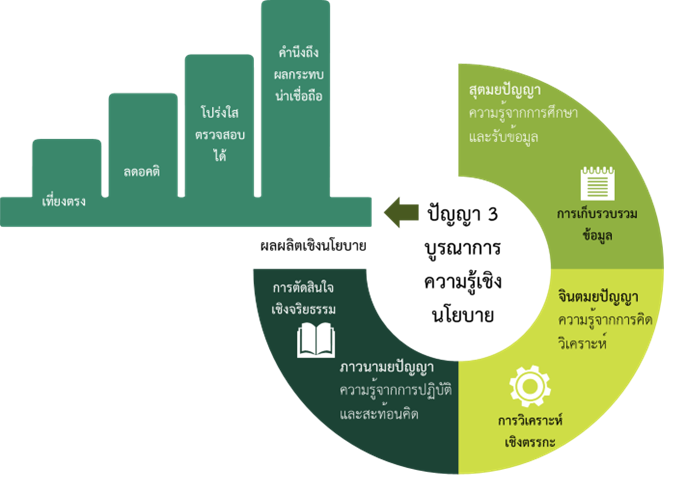
This academic article aimed to examine the application of the “Three Wisdom Principles”, Pañña 3 from Buddhism to contemporary policy decision-making processes. Current policy decision-making faces challenges of information abundance but lacks appropriate frameworks for knowledge utilization. This study proposed the application of the Three Wisdom Principles from Buddhism, namely, Sutamaya-pañña, wisdom from earning/studying, Cintamaya-pañña, wisdom from learning/study, and Bhavanamaya-pañña, wisdom from practice/meditation, as a conceptual framework for enhancing the quality of policy decision-making. Knowledge integration requires connecting knowledge from multiple sources, including academic knowledge, experiential knowledge, and local wisdom, through processes of information gathering, synthesis, analysis, and ethical decision - making. The application of the Three Wisdom Principles facilitated comprehensive decision-making through: studying data and listening to stakeholders, Sutamaya-pañña, reducing bias and systematic thinking, Cintamaya-pañña, and fostering ethical leadership through reflection on consequences, Bhavanamaya-pañña. The study found that quality knowledge must be integrated with ethics, and effective decision-making cannot emerge from data alone without deep consideration and mindful awareness. Therefore, developing quality policy decision-making systems should employ the Three Wisdom Principles as a foundational framework alongside establishing information systems, participatory mechanisms, and good governance.
References
พุทธทาสภิกขุ. (2546). พุทธธรรม ฉบับปรับขยาย. กรุงเทพฯ: สำนักพิมพ์ธรรมสภา.
มหาจุฬาลงกรณราชวิทยาลัย. (2539). พระไตรปิฎกภาษาไทย ฉบับมหาจุฬาลงกรณราชวิทยาลัย. กรุงเทพฯ: โรงพิมพ์มหาจุฬาลงกรณราชวิทยาลัย.
สถาบันพระปกเกล้า. (2564). รายงานสถานการณ์ธรรมาภิบาลของประเทศไทย ปี 2563 – 2564. กรุงเทพฯ: สถาบันพระปกเกล้า.
Anderson, J. E. (2015). Public policymaking (8th ed.). Boston, MA: Cengage Learning.
Arnstein, S. R. (1969). A ladder of citizen participation. Journal of the American Institute of Planners, 35(4), 216–224. https://doi.org/10.1080/01944366908977225
Clark, W. C., & Holmes, J. (2010). Knowledge systems for sustainable development. PNAS, 100(14), 8086–8091. https://doi.org/10.1073/pnas.1231332100
Clark, W. C., et al. (2016). Crafting usable knowledge for sustainable development. Proceedings of the National Academy of Sciences, 113(17), 4570–4578. https://doi.org/10.1073/pnas.1601266113
Greer, S. L., et al. (2020). Civil society and health: Contributions and potential. Copenhagen: WHO Regional Office for Europe.
Dye, T. R. (2013). Understanding public policy (14th ed.). Boston, MA: Pearson.
Etzioni, A. (1967). Mixed - scanning: A “third” approach to decision-making. Public Administration Review, 27(5), 385–392. https://doi.org/10.2307/973394
Heifetz, R. A., et al. (2009). The practice of adaptive leadership: Tools and tactics for changing your organization and the world. Boston: Harvard Business Press.
Head, B. W. (2010). Reconsidering evidence-based policy: Key issues and challenges. Policy and Society, 29(2), 77–94.
Howlett, M., & Cashore, B. (2014). Conceptualizing public policy. In I. Engeli & C. R. Allison (Eds.), Comparative policy studies: Conceptual and methodological challenges (pp. 17–33). Palgrave Macmillan.
Mitchell, M., et al. (2015). Beginning at the end: The outcome spaces framework to guide purposive transdisciplinary research. Futures, 65(1), 86–96. https://doi.org/10.1016/j.futures.2014.10.007
Newell, W. H. (2001). A theory of interdisciplinary studies. Issues in Integrative Studies, 19, 1–25.
Nutley, S. M., Powell, A., & Davies, H. T. O. (2013). What counts as good evidence? London: Alliance for Useful Evidence.
Pahl-Wostl, C., et al. (2007). Managing change toward adaptive water management through social learning. Ecology and Society, 12(2), 30. https://doi.org/10.5751/ ES-02147-120230
Repko, A. F., & Szostak, R. (2020). Interdisciplinary research: Process and theory (3rd ed.). Thousand Oaks, CA: Sage.
Schoon, M. L., et al. (2015). What do we mean by social-ecological systems? A framework and lexicon. Ecology and Society, 20(4), 27. https://doi.org/10.5751/ES-07990-200427
Simon, H. A. (1957). Administrative behavior (2nd ed.). New York: Free Press.
Stone, D. (2012). Policy paradox: The art of political decision making (3rd ed.). New York: W.W. Norton & Company.
Downloads
Published
How to Cite
Issue
Section
Categories
License
Copyright (c) 2026 Academic Journal of Political Science and Public Administration

This work is licensed under a Creative Commons Attribution-NonCommercial-NoDerivatives 4.0 International License.