PUBLIC SECTOR MANAGEMENT TO ADDRESS CORRUPTION PROBLEMS
Keywords:
Management, Government Organization, Corruption Problems, EthicsAbstract
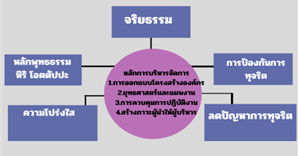
This article was a study to find out the current state of corruption problems and situations in Thailand. Under the scope of research, articles, or surveys of the corruption perception index, which has a decreasing transparency score, which is caused by problems with morality, ethics, and sense of responsibility of government officials, lack of shame and fear, and social sanctions are not effective enough because people do not give enough importance to the values of Buddhist principles in terms of morality and ethics. Although government organizations can apply Buddhist ethics to their administration according to modern management principles to create tangible results in promoting honesty, transparency, and responsibility in the personnel systematically at the organizational level and in their own practice. The research results were found that solving corruption problems should use ethics with Buddhist principles as a guideline for managing government organizations to solve corruption problems in the long term by instilling morality and ethics in government officials as a tool for managing government organizations to create attitudes in government officials to consider that corruption is a sin and a path to deterioration. It can be applied to modern management principles, which will result in government organizations becoming more transparent, stronger in morality and ethics, and able to perform their duties in accordance with the organization’s objectives or goals effectively and raise the level of transparency further.
References
คจรศักดิ์ สิงหันต์ และบุญเลิศ โพธิ์ขา. (2561). คู่มือมาตรการทางกฎหมายในการป้องกันและปราบปรามการทุจริตคอร์รัปชันในมหาวิทยาลัย. นครพนม: มหาวิทยาลัยนครพนม.
จุรี วิจิตรวาทการ. (2559). ดัชนีชี้วัดภาพลักษณ์คอร์รัปชันโลก ปี 2558. สืบค้น 8 เมษายน 2568, จาก http://thaipublica.org/2016/01/corruption-perceptions-index-2015-thailand/.
พระพรหมคุณาภรณ์ (ป. อ. ปยุตฺโต). (2554). พจนานุกรมพุทธศาสตร์ ฉบับประมวลธรรม (พิมพ์ครั้งที่ 34). นนทบุรี: เอส.อาร์ พริ้นติ้ง แมสโปรดักส์.
พระเมธีธรรมาภรณ์ (ประยูร ธมมจิตโต). (2534). ความรู้คู่คุณธรรม รวมบทความเกี่ยวกับคุณธรรมจริยธรรมและการศึกษา. กรุงเทพฯ: โรงพิมพ์จุฬาลงกรณ์มหาวิทยาลัย.
พระเมธีธรรมาภรณ์. (2544). ความสัมพันธ์ระหว่างจริยธรรม จริยศาสตร์และจริยศึกษา ความรู้คู่คุณธรรม. กรุงเทพฯ: โรงพิมพ์จุฬาลงกรณ์มหาวิทยาลัย.
พิเชษฐ์ ทั่งโต. (2559). พุทธธรรมกับการป้องกันปัญหาการทุจริตคอร์รัปชันในสังคมไทย. วารสารจันทรเกษมสาร, 22(43), 1-15.
ราชบัณฑิตยสถาน. (2554). พจนานุกรม ฉบับราชบัณฑิตยสถาน พ.ศ. 2554. สืบค้น 8 เมษายน 2568, จาก https://dictionary.orst.go.th/lookup_domain.php
วศิน อินทสระ. (2555). พุทธจริยศาสตร์. กรุงเทพฯ: สำนักพิมพ์ธรรมดา.
วิเชียร วิทยอุดม (2554). การจัดการสมัยใหม่. กรุงเทพฯ: บริษัท ธนธัช การพิมพ์ จำกัด.
ศิวกร อินภูษา และคณะ. (2567). การบูรณาการพุทธธรรมกับแนวคิดทฤษฎีกระบวนการและหน้าที่ในการบริหารสถานศึกษา. วารสารมณีเชษฐาราม วัดจอมมณี, 7(2), 562-579.
สิริพรรณ นกสวน สวัสดี และคณะ (2557). คำและแนวคิดในประชาธิปไตยสมัยใหม่.กรุงเทพฯ: มูลนิธิฟรีดริค เอแบร์ท.
สำนักงานคณะกรรมการข้าราชการพลเรือน. (2561). คู่มือการพัฒนาและส่งเสริมการปฏิบัติตามมาตรฐานทางจริยธรรมข้าราชการพลเรือน. สืบค้น 9 เมษายน 2568, จาก https://www.ocsc.go.th/?post_type=knowledge&p=15269
สำนักงานคณะกรรมการกำกับหลักทรัพย์และตลาดหลักทรัพย์. (2568). การทุจริตคอรัปชัน (Anti-corruption). สืบค้น 8 เมษายน 2568, จาก https://www.sec.or.th/cgthailand/TH/Pages/corruption.aspx
สำนักงานคณะกรรมการป้องกันและปราบปรามการทุจริตแห่งชาติ. (2567). สำนักงานคณะกรรมการป้องกันและปราบปรามการทุจริตแห่งชาติ ขับเคลื่อนและบูรณาการความร่วมมือทางศาสนา เพื่อส่งเสริมการมีส่วนร่วมการป้องกันและปราบปรามการทุจริต. สืบค้น 8 เมษายน 2568, จาก https://www.nacc.go.th/categorydetail/20180831184638361/20240306154022?
______. (2568). ดัชนีการรับรู้การทุจริตของประเทศไทย 2567. สืบค้น 8 เมษายน 2568, จาก https://www.nacc.go.th/categorydetail/20180831184638361/20250211151004
สำนักงานคณะกรรมการป้องกันและปราบปรามการทุจริตในภาครัฐ. (2568). รายงานผลการวิเคราะห์ดัชนีการรับรู้การทุจริต ประจำปี พ.ศ. 2567. สืบค้น 8 เมษายน 2568, จาก https://www.pacc.go.th/pacc_2015/cpi/assets/files/cpi-2024.pdf
Bartol, K.M. & Martin, D.C. (1997). Management. New York: McGraw-Hill.
Frederic, W.T. (1991). The Principles of Scientific Management. New York: Harper.
Gary, M. (2019). Power tends to corrupt, and absolute power corrupts absolutely. Retrieved April 9, 2025, from https://www.phrases.org.uk.
Herbert, A.S. (1947). Administrative Behavior. New York: Macmillan.
Kurian, G.T. (2011). The encyclopedia of political science. Washington: CQ Press.
Robbins, S.P. (1994). Essentials of Organization Behavior (4th ed.). Englewood Cliffs, New Jersey: Prentice-Hall.
Tavits, M. (2005). Causes of Corruption Testing Competing Hypotheses. Retrieved April 8, 2025, from https://www.nuffield.ox.ac.uk/Politics/papers/2005/Tavits%20Nuffield%20WP.pdf
Wallis, J.J. (2006). The Concept of Systematic Corruption in American History. Retrieved April 9, 2025, from https://www.nber.org/system/files/chapters/c9977/c9977.pdf
Wormuth, F.D. (1949). The origins of modern constitutionalism. New York: Harper & Brothers.
Downloads
Published
How to Cite
Issue
Section
Categories
License
Copyright (c) 2025 Academic Journal of Political Science and Public Administration

This work is licensed under a Creative Commons Attribution-NonCommercial-NoDerivatives 4.0 International License.