BUDDHADHAMMA APPLICATION FOR STRENGTHENING DEMOCRATIC CITIZENSHIP OF THE PEOPLE OF SAMUT SONGKHRAM PROVINCE
Keywords:
Buddhadhamma, Strengthening, Democratic Citizenship, Sappurisa DhammaAbstract
This research aimed: 1.To study the nature of democratic citizenship among people in Samut Songkhram Province, 2.To examine the factors influencing such citizenship, and 3.To propose Buddhadhamma application for strengthening democratic citizenship, conducted by the mixed-methods The qualitative research, data were collected by in-depth interviewing 18 key informants, purposively selected from scholars, government officers, politicians, and community leaders, along with focus group discussions with 9 participants to validate findings. The quantitative research and data were collected with questionnaire from 399 samples, who were eligible voters, derived from a population of 127,460 people, calculated using Yamane’s formula. Data were analyzed by descriptive statistics, including frequency, percentage, mean, standard deviation, and stepwise multiple regression analysis for quantitative results.
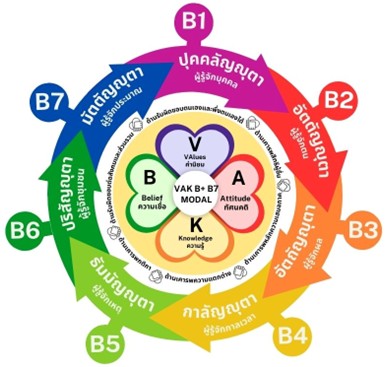
Findings showed that: 1. Democratic citizenship in Samut Songkhram comprised six essential characteristics: self-responsibility, respect for others' rights, acceptance of diversity, adherence to equality, rule compliance, and social responsibility-all of which supported stable and sustainable democracy. 2. Factors influencing citizenship were attitude, values, beliefs, and knowledge, significantly influenced citizenship with a combined prediction rate of 60.6%. Moreover, the Seven Sappurisadhamma, predicted citizenship by 77.7 % indicating that Suppurisadhamma 7 was important factor for citizenship fostering. 3. Applying the Sappurisadhamma 7, knowing causes, knowing effects, self-awareness,knowing moderation, knowing time, knowing community and knowing individual fostered critical thinking, cooperation and sustainable democratic citizenship in the community.
References
จารุวรรณ แก้วมะโน. (มปป.). พลเมือง (Citizenship). สืบค้น 8 มกราคม 2567, จาก https://shorturl.asia/dOhfG
ชนาธิป ศรีโท และคณะ. (2563). การบูรณาการหลักสัปปุริสธรรมเพื่อขับเคลื่อนความเป็นพลเมืองในระบอบประชาธิปไตย. วารสาร มจร อุบลปริทรรศน์, 5(1), 344-353.
ณฐมน หมวกฉิม. (2564). การตื่นตัวทางการเมืองของเยาวชนในระบอบประชาธิปไตยที่มีผลต่อการเลือกตั้งทั่วไปของไทย (ดุษฎีนิพนธ์ปรัชญาดุษฎีบันฑิต สาขาวิชารัฐศาสตร์). พระนครศรีอยุธยา: มหาวิทยาลัยมหาจุฬาลงกรณราชวิทยาลัย.
ประกาศราชกิจจานุเบกษา เรื่อง การมีส่วนร่วมทางการเมืองโดยตรงของประชาชน. (2550, 6 เมษายน). ราชกิจจานุเบกษา. เล่ม 124 ตอนที่ 47 ก. หน้า 61.
พระชาณรงค์ โชติธมฺโม. (2566). การบูรณาการหลักพุทธธรรมเพื่อส่งเสริมความเป็นพลเมืองในระบอบประชาธิปไตยของเยาวชนในกรุงเทพมหานคร (ดุษฎีนิพนธ์ปรัชญาดุษฎีบันฑิต สาขาวิชารัฐศาสตร์). พระนครศรีอยุธยา: มหาวิทยาลัยมหาจุฬาลงกรณราชวิทยาลัย.
สำนักบริหารการทะเบียน กรมการปกครอง. (2567). สถิติประชากรทางการทะเบียนราษฎร. สืบค้น 8 มกราคม 2567, จาก https://shorturl.asia/a6jQd
สุวรรณ์ แก้วนะ. (2564). การพัฒนาคุณลักษณะตามหลักสัปปุริสธรรมของผู้บริหารเทศบาลในจังหวัดสมุทรปราการ (ดุษฎีนิพนธ์ปรัชญาดุษฎีบันฑิต สาขาวิชารัฐศาสตร์). พระนครศรีอยุธยา: มหาวิทยาลัยมหาจุฬาลงกรณราชวิทยาลัย.
Galston, W. A. (1991). Liberal Purposes: Goods, Virtues, and Diversity in the Liberal State. UK: Cambridge University Press.
Westheimer, J. & Kahne, J. (2004). What Kind of Citizen? The Politics of Educating for Democracy. American Educational Research Journal, 41(2), 237-269.
Likert, R. (1967). The Method of Constructing and Attitude Scale. New York: Wiley & Son.
Yamane, T. (1973). Statistics: An Introductory Analysis. (3rd Ed.). NewYork: Harper and Row Publications.
Downloads
Published
How to Cite
Issue
Section
Categories
License
Copyright (c) 2025 Academic Journal of Political Science and Public Administration

This work is licensed under a Creative Commons Attribution-NonCommercial-NoDerivatives 4.0 International License.