SERVANT LEADERSHIP OF ORGANIZATION EXECUTIVES
Keywords:
Leadership, Servant Leadership, Organization ExecutivesAbstract
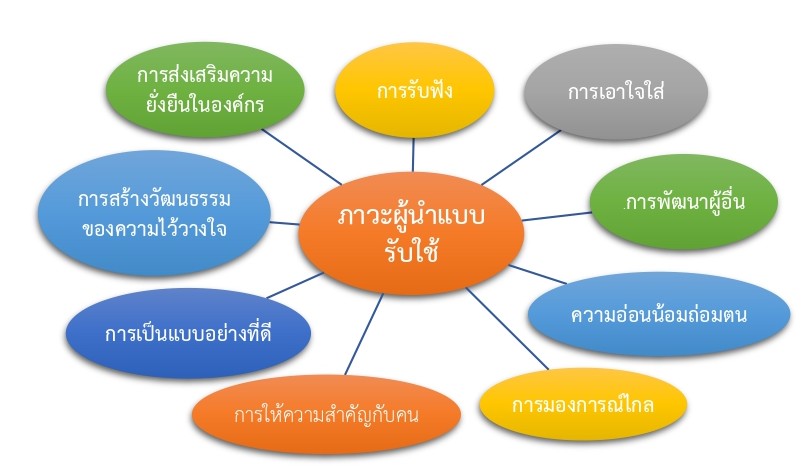
This article is an academic article. The purpose of this article is to study servant leadership, which emphasizes developing others before personal goals. The leader acts as a servant and supports the team to grow in terms of potential, success, and well-being. Unlike traditional leaders who emphasize power and control. Servant leaders aim to build trust, listen to opinions, empathize, and promote a culture of collaboration to develop the organization sustainably. The study was found that the important characteristics of servant leadership include listening attentively to build trust and strong relationships, caring, understanding, and being open to the feelings of the team, developing others, supporting potential through training and mentoring, being humble, open to opinions, accepting limitations, and sharing success, being foresight, anticipating the impact of decisions for sustainability, focusing on people, promoting team potential, creating work-life balance, being a good role model, demonstrating integrity, taking responsibility, and working with the team, building a culture of trust through open communication and responsibility, promoting sustainability in the organization, developing personnel and managing resources effectively. This approach helps build strong teams, motivating, and developing organizations for stable and sustainable growth.
References
จักรกฤษณ์ สงวนธรรม. (2561). วัฒนธรรมองค์กรที่สร้างความไว้วางใจและความมั่นคง. กรุงเทพฯ: สำนักพิมพ์ธุรกิจไทย.
นภดล ร่มโพธิ์. (2563). ภาวะผู้นำกับการบริหารองค์กรยุคใหม่. กรุงเทพฯ: สำนักพิมพ์วิชาการ.
พรศักดิ์ ผ่องแผ้ว. (2562). แนวทางการบริหารภายใต้ภาวะผู้นำแบบรับใช้. นนทบุรี: สถาบันการศึกษาเพื่อการพัฒนา.
พิชัย พิทักษ์สกุล. (2564). กลยุทธ์การบริหารองค์กรด้วยภาวะผู้นำแบบรับใช้. เชียงใหม่: มหาวิทยาลัยเชียงใหม่.
วิชัย แก้วกาญจน์. (2562). การสร้างแรงบันดาลใจผ่านภาวะผู้นำแบบรับใช้. สงขลา: มหาวิทยาลัยสงขลานครินทร์.
สุชาติ บุญเลิศ. (2560). การมองการณ์ไกลของผู้นำกับผลกระทบต่อองค์กร. กรุงเทพฯ: สถาบันบริหารธุรกิจแห่งประเทศไทย.
อารยา จันทร์สุข. (2563). ภาวะผู้นำที่เน้นความเป็นมนุษย์ในองค์กรยุคปัจจุบัน. นครปฐม: มหาวิทยาลัยศิลปากร.
Eva, N. et al. (2019). Servant Leadership: A systematic review and call for future research. The Leadership Quarterly, 30(1), 111-132.
Greenleaf, R.K. (1977). Servant Leadership: A journey into the nature of legitimate power and greatness. New Jersey: Paulist Press.
Hunter, E.M. et al. (2013). Servant Leadership: A meta-analytic examination of constructs and consequences. Academy of Management Journal, 56(6), 1516-1544.
Liden, R.C. et al. (2008). Servant leadership: Development of a multidimensional measure and multi-level assessment. The Leadership Quarterly, 19(2), 161-177.
Reed, L.L. et al. (2011). A new scale to measure executive servant leadership: Development, analysis, and implications for research. Journal of Business Ethics, 101(3), 415-434.
Sendjaya, S. et al. (2008). Defining and measuring servant leadership behaviour in organizations. Journal of Management Studies, 45(2), 402-424.
Downloads
Published
How to Cite
Issue
Section
Categories
License
Copyright (c) 2025 Academic Journal of Political Science and Public Administration

This work is licensed under a Creative Commons Attribution-NonCommercial-NoDerivatives 4.0 International License.