BUDDHADHAMMA INTEGRATION FOR PROMOTING CITIZENSHIP CONSCIENCE FOR POLITICAL PARTICIPATION OF PEOPLE IN SURAT THANI PROINCE
Keywords:
Political Participation, Civic Political Conscience, Buddhadhamma IntegrationAbstract
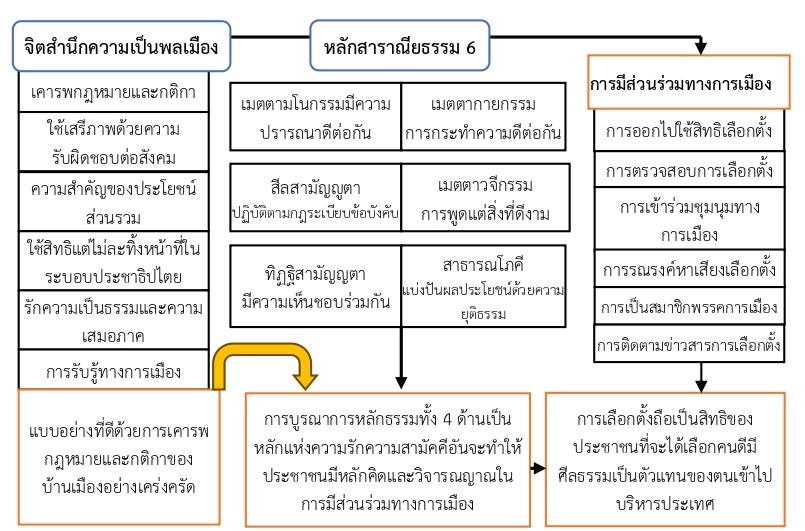
Objectives of this research were: 1. To study public political participation, 2. To examine the factors influencing political participation, and 3 To propose the Buddhadhamma integration for promoting civic conscionce for political participation in Surat Thani Province. A mixed-method approach was employed, including qualitative research through in-depth interviews with 18 key informants purposefully selected. Data were analyzed using content descriptive interpretation and a focus group discussion with nine participants to validate the findings. The quantitative research was conducted using a questionnaire distributed to eligible voters in Surat Thani’s seven electoral districts, totaling 830,182 individuals. The Taro Yamane formula was applied, resulting in a sample size of 400 respondents. Data was analyzed by frequency, percentage, mean, standard deviation, and stepwise multiple regression analysis.
The findings revealed that: 1. Public political participation encompassed six key aspects: campaigning, election news engagement, election monitoring, voting, political demonstrations, and political party membership, essential mechanisms for strengthening democracy. 2. Factors influencing participation included responsible use of freedom, prioritization of public interests, awareness of rights and duties, political awareness, commitment to justice and equality, and respect for laws and regulations. These factors predicted political participation by 83.1 percent, while the principle of Saraniyadhamma influenced civic conscience by 92.6 percent. 3. The integration of Buddhist principles, such as MettaKayakamma; compassionate actions, Mettavacikamma, compassionate speech, and Metta manokamma, compassionate thoughts, fostered civic awareness. Sadharanabhogi, equitable resource sharing, encouraged local wisdom and cultural preservation, Silasamaññata, observance of common moral discipline, promoted adherence to legal and ethical norms, and Ditthisamaññata, harmonious views, enhanced unity and constructive political participation.
References
จังหวัดสุราษฎร์ธานี. (2566). การเลือกตั้งสมาชิกสภาผู้แทนราษฎรไทยเป็นการทั่วไป พ.ศ.2566. สืบค้น 25 มกราคม 2567, จาก https://th.wikipedia.org/wiki
จิราภพ ทวีสูงส่ง. (2566). ทำไม ? “เรา” ต้องมีส่วนร่วมทางการเมือง ในระบอบประชาธิปไตย. สืบค้น 9 มกราคม 2567, จาก https://www.thaipbs.or.th/now/content/161
ดาวนภา เกตุทอง. (2565). การส่งเสริมการมีส่วนร่วมทางการเมืองตามระบอบประชาธิปไตยของนักศึกษาระดับมหาวิทยาลัยในจังหวัดพิษณุโลก (ดุษฎีนิพนธ์ปรัชญาดุษฎีบัณฑิต สาขาวิชารัฐศาสตร์). พระนครศรีอยุธยา: มหาวิทยาลัยมหาจุฬาลงกรณราชวิทยาลัย.
พระครูธรรมธรบุญเที่ยง พุทฺธสาวโก. (2564). การบูรณาการหลักพุทธธรรมกับการสื่อสารทางการเมืองเพื่อเสริมสร้างความสมานฉันท์ (ดุษฎีนิพนธ์ปรัชญาดุษฎีบัณฑิต สาขาวิชารัฐศาสตร์). พระนครศรีอยุธยา: มหาวิทยาลัยมหาจุฬาลงกรณราชวิทยาลัย.
พระประเสริฐ เตชโก. (2565). การสร้างจิตสำนึกของความเป็นพลเมืองในการตัดสินใจใช้สิทธิเลือกตั้งสมาชิกสภาผู้แทนราษฎรในจังหวัดพระนครศรีอยุธยา (ดุษฎีนิพนธ์ปรัชญาดุษฎีบัณฑิต สาขาวิชารัฐศาสตร์). พระนครศรีอยุธยา: มหาวิทยาลัยมหาจุฬาลงกรณราชวิทยาลัย.
พระพรหมคุณาภรณ์ (ป. อ. ปยุตฺโต). (2552). พุทธธรรม ฉบับปรับปรุงและขยายความ (พิมพ์ครั้งที่ 11). กรุงเทพฯ: โรงพิมพ์มหาจุฬาลงกรณราชวิทยาลัย.
Hoskins, B. (2006). Draft Framework on Indicators for Active Citizenship. Ispra: CRELL
Likert, R. (1967). The Method of Constructing and Attitude Scale. New York: Wiley & Son.
Yamane, T. (1973). Statistics and introductory analysis. (3rd ed.). New York: Harper & Row.
Downloads
Published
How to Cite
Issue
Section
Categories
License
Copyright (c) 2025 Academic Journal of Political Science and Public Administration

This work is licensed under a Creative Commons Attribution-NonCommercial-NoDerivatives 4.0 International License.