INTEGRATON OF MODERN ORGANIZATIONS BASED ON TI-SIKKHA
Keywords:
Integraton, Modern Organization, Threefold TrainingAbstract
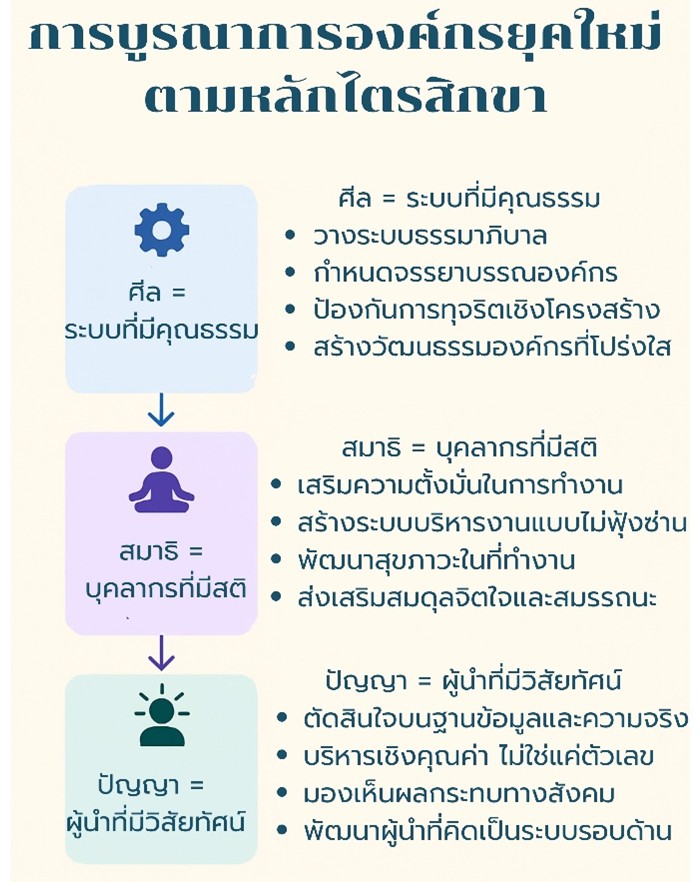
The potential of applying the Buddhist principle of Ti-Sikkha morality (Sila), concentration (Samadhi), and wisdom (Pañña) to the management of modern public sector organizations by focusing on the systemic integration between Buddhist ethics and contemporary public administration principles to enhance efficiency, sustainability, and ethical governance amid the increasing complexity of social change, technology, and public expectations. with a conceptual framework grounded in value-based administration and structural quality development. The findings indicated that Sila could be integrated into organizational governance to promote transparency, prevent corruption, and foster a culture of ethical conduct. Samadhi contributed to self-discipline among personnel, mindfulness in administrative processes, and improved quality of work life. Pañña supported systems thinking, value-based decision-making, and the cultivation of enlightened leadership within public agencies. Overall, the application of Ti-Sikkha as a foundational framework for public sector management bridges the gap between mechanical efficiency and ethical intention, while reinforcing public trust in state institutions. The proposed policy recommendation for the state to foster “organizations with moral consciousness” by implementing integrated training systems that combined Ti-Sikkha with human resource development in the bureaucracy. There should be further empirical research to assess the tangible outcomes of applying Buddhist principles in state administration, ultimately guiding the development of a new public administration paradigm that harmonizes human values with potentials in a holistic manner.
References
โครงการพัฒนานักบริหารระดับสูง ผู้บริหารส่วนราชการ (นบส.2) รุ่นที่ 12. (2563). แนวทางการบริหารหน่วยงานภาครัฐในยุค New Normal. กรุงเทพฯ: สถาบันพัฒนาข้าราชการพลเรือน(สพข.).
พระโกศล มณีรัตนา. (2560). การประยุกต์ใช้หลักไตรสิกขาในการพัฒนาพฤติกรรมด้านคุณธรรม. วารสาร มจร สังคมศาสตร์ปริทรรศน์, 6(1), 383-397.
พระพรหมคุณาภรณ์ (ป. อ. ปยุตฺโต). (2546). พจนานุกรมพุทธศาสตร์ ฉบับประมวลศัพท์. กรุงเทพฯ: มหาวิทยาลัยมหาจุฬาลงกรณราชวิทยาลัย.
พระพรหมคุณาภรณ์ (ป. อ. ปยุตฺโต). (2555). พุทธธรรม ฉบับปรับขยาย (พิมพ์ครั้งที่ 35). กรุงเทพฯ: บริษัท สำนักพิมพ์ผลิธัมม์.
มหาจุฬาลงกรณราชวิทยาลัย. (2539). พระไตรปิฎกฉบับภาษาไทย ฉบับมหาจุฬาลงกรณราชวิทยาลัย. กรุงเทพฯ: โรงพิมพ์มหาจุฬาลงกรณราชวิทยาลัย.
ศิริพงษ์ ฐานมั่น. (2562). การเสริมสร้างคุณธรรมจริยธรรมในศตวรรษที่ 21 เพื่อรองรับองค์การแห่งยุคเศรษฐกิจดิจิทัล. วารสารวไลยอลงกรณ์ปริทัศน์ (มนุษยศาสตร์และสังคมศาสตร์), 9(1), 146-163.
สำนักงานคณะกรรมการพัฒนาการเศรษฐกิจและสังคมแห่งชาติ. (2560). ยุทธศาสตร์ชาติ 20 ปี (พ.ศ. 2561-2580). กรุงเทพฯ: สำนักงานเลขานุการของคณะกรรมการยุทธศาสตร์ชาติ.
เสน่ห์ จุ้ยโต. (2551). องค์การสมัยใหม่ (พิมพ์ครั้งที่ 5). นนทบุรี: สำนักพิมพ์มหาวิทยาลัยสุโขทัยธรรมาธิราช.
Daft, R. L. (2010). Understanding The Theory and Design of Organization (10th ed.) China: South-Western, Cengage Learning.
Eriksson, Z. et al. (2011). Organization Theory: A Practice Based Approach. Italy: Oxford University Press.
Follet, P.M. (1924). Creative Experience. London: Longman and Green.
Gerloff, E.A. (1985). Organizational Theory and Design: A Strategic Approach for Management. Singapore: McGraw-Hill Companies, Inc.
Jaffee, D. (2001). Organization Theory: Tension and Change. New York: McGraw-Hill Companies, Inc.
Jones, G. R. (2001). Organizational Theory: Text and Cases (3rd ed.). Upper Saddle River, New Jersey: Prentice-Hall, Inc.
Simon Herbert A. (1987). Classic of Public Administration (2nd ed.). California: The Dorsey Press.
Downloads
Published
How to Cite
Issue
Section
Categories
License
Copyright (c) 2025 Academic Journal of Political Science and Public Administration

This work is licensed under a Creative Commons Attribution-NonCommercial-NoDerivatives 4.0 International License.