SYSTEMIC RISK MANAGEMENT AFTER EARTHQUAKES: PLANNING AND PREVENTIVE RESPONSE STRATEGIES IN THAILAND
Keywords:
Earthquake, Risk Management, Preventive Planning, Disaster Response, Systemic ManagementAbstract
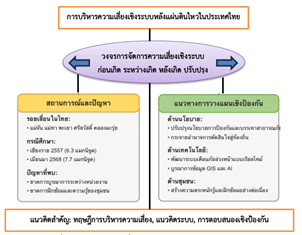
Earthquakes are natural disasters that occur without warning and cause severe impacts on lives, properties, and national infrastructure. Although Thailand is not located on a major tectonic plate boundary, the country has experienced significant impacts from earthquakes in neighboring countries over the past decade. Notably, the most recent earthquake on March 28, 2025, with a magnitude of 7.7 and an epicenter in Myanmar, was strongly felt in several provinces of Thailand, including Bangkok. This incident reaffirms Thailand’s vulnerability and underscores the need to develop an efficient and sustainable systemic risk management framework. This article aimed to examine systemic risk management models for post-earthquake scenarios in Thailand, focusing on planning and preventive response strategies. The study employed documentary research and content analysis methodologies, utilizing academic literature, research reports, and both domestic and international case studies. The findings revealed that Thailand’s current risk management practices lack systemic integration, particularly in inter-agency coordination, community engagement, and the application of information technology in disaster management. This article proposed a systems-based approach that emphasized preventive planning, capacity building at the local level, the development of effective early warning technologies, and the establishment of participatory collaboration networks. These measures aimed to enhance Thailand’s long-term resilience and preparedness for responding to future earthquake events.
References
กรมทรัพยากรธรณี. (2566). ประวัติแผ่นดินไหวในประเทศไทย. สืบค้น 30 มีนาคม 2568, จาก https://www.dmr.go.th
กรมอุตุนิยมวิทยา. (2567). รายงานสถานการณ์แผ่นดินไหวประจำปี. สืบค้น 30 มีนาคม 2568, จาก https://earthquake.tmd.go.th
กรมโยธาธิการและผังเมือง. (2565). ข้อบัญญัติควบคุมอาคารและมาตรฐานต้านแผ่นดินไหว. สืบค้น 31 มีนาคม 2568, จาก https://www.dpt.go.th
กรมป้องกันและบรรเทาสาธารณภัย. (2565). คู่มือการจัดทำแผนเผชิญเหตุภัยพิบัติ. สืบค้น 30 มีนาคม 2568, จาก https://www.disaster.go.th
ศูนย์เตรียมความพร้อมป้องกันภัยพิบัติแห่งเอเชีย. (2561). รายงานการประเมินความพร้อมชุมชนต่อภัยพิบัติ. สืบค้น 30 มีนาคม 2568, จาก https://www.adpc.net
ทศพล อัครพงษ์ไพบูลย์ และคณะ .(2563). การบูรณาการการจัดการภัยพิบัติในยุค 4.0. Journal of Administrative and Management Innovation, 8(3), 14-23.
มหาวิทยาลัยราชภัฏมหาสารคาม. (2555). แผนป้องกันและบรรเทาภัยพิบัติ มหาวิทยาลัยราชภัฏมหาสารคาม ประจำปีงบประมาณ 2555–2559. สืบค้น 31 มีนาคม 2568, จาก https://www.rmu.ac.th/file/disaster55_59.pdf
พระราชบัญญัติป้องกันและบรรเทาสาธารณภัย พ.ศ. 2550. (2550, 7 กันยายน) ราชกิจจานุเบกษา. เล่มที่ 124 ตอนที่ 52 ก หน้า 1-23.
Asian Development Bank. (2020). $500 Million ADB Loan to Boost the Philippines’ Disaster Resilience. Retrieved March 30, 2025, from https://www.adb.org/news/500-million-adb-loan-boost-philippines-disaster-resilience
Demco Public Company Limited. (2564). Risk management manual. Retrieved March 30, 2025, from https://www.demco.co.th/storage/downloads/corporate-policies/20210113-demco-risk-management-manual-th.pdf
Department of Disaster Prevention and Mitigation. (2558). รายงานผลการจัดการภัยแผ่นดินไหว จังหวัดเชียงราย. Retrieved March 30, 2025, from http://www.disaster.go.th
Department of Disaster Prevention and Mitigation. (2565). คู่มือการจัดทำแผนเผชิญเหตุภัยพิบัติ. สืบค้น 31 มีนาคม 2568 จาก https://www.disaster.go.th
Department of Mineral Resources. (2566). ประวัติแผ่นดินไหวในประเทศไทย. สืบค้น Retrieved March 30, 2025, from จาก https://www.dmr.go.th
Department of Public Works and Town & Country Planning. (2565). ข้อบัญญัติควบคุมอาคารและมาตรฐานต้านแผ่นดินไหว. Retrieved March 30, 2025, from https://www.dpt.go.th
Meteorological Department. (2567). รายงานสถานการณ์แผ่นดินไหวประจำปี. Retrieved March 30, 2025, from https://earthquake.tmd.go.th
PPTV. (2568). รอยเลื่อนสะต้นตอเหตุแผ่นดินไหวความรุนแรง 7.7. สืบค้น 31 มีนาคม 2568 จาก http://pptv36.news/1pEQ
Paipibat.com. (2557). แผ่นดินไหวเชียงราย 5 พ.ค. 57. สืบค้น 31 มีนาคม 2568 จาก https://paipibat.com/?page_id=24468
Space Technology and Geo-Informatics Development Agency (Public Organization). (2564). ระบบภูมิสารสนเทศเพื่อการบริหารจัดการภัยพิบัติ. สืบค้น 31 มีนาคม 2568, จาก https://gistda.or.th
Thai PBS. (2568). แผ่นดินไหวเมียนมา 7.7 กระทบถึงกรุงเทพฯ. สืบค้น 31 มีนาคม 2568, จาก https://www.thaipbs.or.th/news
Thai PBS. (2568). The Active, สรุปสถานการณ์แผ่นดินไหว 28 มี.ค. 68 สืบค้น 31 มีนาคม 2568, จาก https://theactive.thaipbs.or.th/news/disaster-20250328-3
United Nations Office for Disaster Risk Reduction. (2020). Sendai Framework for disaster risk reduction 2015–2030. Retrieved March 30, 2025, from https://www.undrr.org
Downloads
Published
How to Cite
Issue
Section
Categories
License
Copyright (c) 2025 Academic Journal of Political Science and Public Administration

This work is licensed under a Creative Commons Attribution-NonCommercial-NoDerivatives 4.0 International License.