BUDDHIST METHODS FOR STRENGTHENGING POLITICAL SOCIALIZATION FOR YOUTH AT EDUCATIONAL INSTITUTIONS IN PHETCHABUN PROVINCE
Keywords:
Buddhist Methods, Political Socialization, Educational Institutions, YouthsAbstract
Objectives of this research article were: 1. To investigate the political socialization of youths in educational institutions; 2. To examine the factors influencing the political socialization of youths in educational institutions, and 3. To propose Buddhist approaches for promoting political socialization among youths in Phetchabun Province. A mixed-methods research design was conducted. The qualitative research conducted by in-depth interviewing 18 key informants and the data were analyzed by descriptive interpretation, alongside a focus group discussion with 9 participants to validate the synthesized knowledge. The quantitative research utilized a questionnaire with reliability coefficient (Cronbach’s alpha) of 0.936. to collect data from 396 samples who were youths aged 15–17 years from educational institutions in Phetchabun Province. The data were analyzed using frequency, percentage, mean, standard deviation, and stepwise multiple regression analysis.
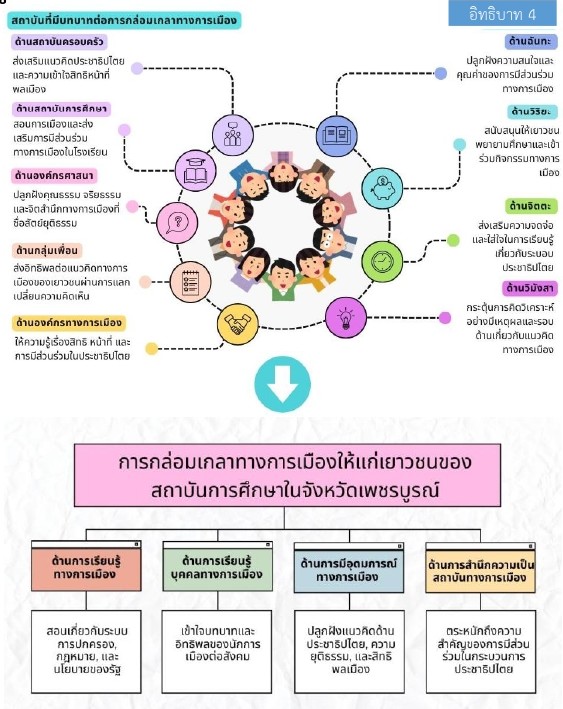
The research findings revealed that: 1. Educational institutions played a crucial role in instilling knowledge regarding citizens' rights and duties through curricula and supplementary activities, such as educational excursions and training camps, thereby enhancing youths' understanding of political systems and promoting critical thinking skills; 2. Factors influencing political socialization included political organizations (50.0%), educational institutions (39.6%), and peer groups (20.0%). The Buddhist principle of Iddhipada, Path of Accomplishment was found to significantly influence the learning process, particularly through Citta, attention and engagement (65.7%) and Viriya, perseverance (27.3%); 3. Buddhist methods for promoting political socialization among youths comprised Chanda; desire to learn politics, Viriya; effort to study, Citta; attention to political news, and Vimamsa; critical inquiry and understanding of political diversity, all contributing to the development of responsible and competent citizenship.
References
กัญญรัตน์ เกียรติสุภา. (2567). บทบาทเยาวชนกับการมีส่วนร่วมในระบอบประชาธิปไตย.สืบค้น 5 มกราคม 2567, จาก http://www.thailandchonburi.com/index.php?lay=show&ac=article&Id=538788666.
ดอนล่าร์ เสนา. (2560). การพัฒนาภาวะผู้นำตามหลักพุทธธรรมของผู้บริหารองค์การบริหารส่วนตำบลในจังหวัดพิษณุโลก. วารสาร มจร สังคมศาสตร์ปริทรรศน์, 6(2) (ฉบับพิเศษ), 183 - 194.
พรรชรนันท์ สายจันดี และคณะ. (2565). การรับรู้ทางการเมือง การกล่อมเกลาทางการเมือง และการมีส่วนร่วมทางการเมืองของเยาวชนในประเทศไทย. วารสารพุทธปรัชญาวิวัฒน์, 6(2), 26-40.
พระบุญเพ็ง สิทธิวงษา. (2562). การใช้หลักอิทธิบาท 4 ในการบริหารจัดการท้องถิ่นของบุคลากรองค์การบริหารส่วนตำบลสีออ อำเภอกุมภวาปี จังหวัดอุดรธานี. วารสารมหาจุฬานาครทรรศน์, 6(5), 2460-2480.
พระมหาบรรจง ติสรโณ (ศรีสุข). (2560). ศึกษาการประยุกต์ใช้หลักอิทธิบาทธรรม 4 ในการจัดการเรียนการสอนของโรงเรียนปริยัติคุณรสวิทยา อำเภอเมืองสุรินทร์ จังหวัดสุรินทร์. วารสารมหาจุฬานาครทรรศน์, 4(7), 50-61.
พระศิลาศักดิ์ สุเมโธ (บุญทอง) และบุญฤทธิ์ เพ็ชรวิศิษฐ. (2562). ความสัมพันธ์ระหว่างการกล่อมเกลาทางการเมืองกับวัฒนธรรมทางการเมือง. วารสารปัญญาปณิธาน, 4(1), 33-49.
พัชรี ศิลารัตน์. (2557). การใช้หลักอิทธิบาท 4 ในการส่งเสริมความรู้ความเข้าใจในระบอบประชาธิปไตยของเยาวชนเทศบาลเมืองร้อยเอ็ด พ.ศ. 2556. วารสารสถาบันวิจัยญาณสังวร, 5(2), 29 – 38.
พิชิต กันยาวรรณ และธรรมนิตย์ วราภรณ์. (2560). การกล่อมเกลาทางการเมือง และวัฒนธรรมทางการเมืองที่ส่งผลต่อประชาธิปไตยแบบมีส่วนร่วมของประชาชนในเขตพื้นที่ขององค์การบริหารส่วนตำบล ในภาคตะวันออกเฉียงเหนือตอนล่าง. วารสารมนุษยศาสตร์และสังคมศาสตร์ มหาวิทยาลัยราชภัฏอุบลราชธานี, 8(2), 177-189.
สำนักงานศึกษาธิการจังหวัดเพชรบูรณ์. (2564). ข้อมูลพื้นฐานด้านการศึกษา: ข้อมูลสารสนเทศด้านการศึกษาจังหวัดเพชรบูรณ์ ประจำปี พ.ศ. 2564. เพชรบูรณ์: สำนักงานศึกษาธิการจังหวัดเพชรบูรณ์.
Yamane, Taro. (1973). Statistics: An Introductory Analysis (3rd ed.). New York: Harper and Row.
Downloads
Published
How to Cite
Issue
Section
Categories
License
Copyright (c) 2025 Academic Journal of Political Science and Public Administration

This work is licensed under a Creative Commons Attribution-NonCommercial-NoDerivatives 4.0 International License.