THAI-STYLE DEMOCRACY AND MORAL POLITICS
Keywords:
Democracy, Moralized Politics, Legitimacy of PowerAbstract
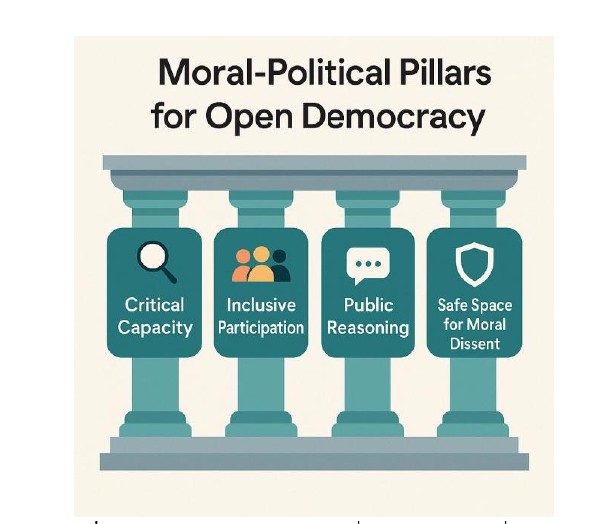
Objectives of this academic paper were to analyze and critique the power relationship between the concept of Thai democracy and moral politics within the scope of the content that focuses on exploring the use of morality as a tool of the state to control and direct the political space of citizens in Thai society. The article pointed out that the concept of Thai democracy is not just an endemic cultural framework. Rather, it is used to legitimize authoritarian regimes through a definition of morality monopolized by the state or elite groups. Morality in this way has been made into a single unquestionable standard and is cleverly applied through public policy. This leads to a reduction in freedom of thought. Diversity and Equal Participation of Citizens Moral politics in the Thai context is an ideological process that does not open the space for criticism or debate on the set of moral values defined by the state. It presents Buddhist conceptual frameworks such as Dharma, non-attachment to the ego, and freedom from fear as a tool to question the moral monopoly of the state. and pushing morality back to the area of bargaining. Criticism and true citizen participation. New knowledge through the pillar of political morality, which consists of the principle of critical ability. These four pillars can be used as a policy framework for designing a democracy that allows for a diverse moral coexistence in a sustainable manner in contemporary democracies.
References
กาญจนาพร เชยอักษร. (2565). คนดีและความดีในทางการเมืองไทย : การต่อสู้ทางความหมายทางการเมืองระหว่าง 2549-2557. กรุงเทพฯ: จุฬาลงกรณ์มหาวิทยาลัย.
โกวิท โพธิสาร. (2558). วิจักขณ์ พานิช : ไม่ได้พูดว่ารัฐต้องไม่มีศาสนา. สืบค้น 2 มกราคม 2568, จาก https://thecitizen.plus/node/56
ธเนศ วงศ์ยานนาวา. (2567). ประชาชนคืออะไร?. สืบค้น 2 มกราคม 2568, จาก https://www.sm-thaipublishing.com/content/7667/thanes-wong-people
Chambers, P. (2012). Superficial democracy in Thailand. Asian Survey, 52(6), 1020–1041.
Connors, M. K. (2008). Democracy and National Identity in Thailand. Copenhagen: NIAS Press.
Habermas, J. (1989). The Structural Transformation of the Public Sphere. USA: MIT Press.
Held, D. (2006). Models of democracy (3rd ed.). Cambridge: Polity Press.
Phongpaichit, P. & Baker, C. (2004). Thaksin: The Business of Politics in Thailand. Chiang Mai: Silkworm Books.
Swearer, D. K. (2010). The Buddhist World of Southeast Asia. New York: State University of New York Press.
Downloads
Published
How to Cite
Issue
Section
Categories
License
Copyright (c) 2025 Academic Journal of Political Science and Public Administration

This work is licensed under a Creative Commons Attribution-NonCommercial-NoDerivatives 4.0 International License.