INTEGRATION OF BUDDHIST PRINCIPLES FOR PROMOTING POLITICAL POPULARITY TOWARD POLITICAL PARTIES IN THE ELECTION OF MEMBERS OF THE HOUSE OF REPRESENTATIVES IN CHUMPHON PROVINCE
Keywords:
Chumphon Provincial Representative, Buddhist Principles, Political PopularityAbstract
Objectives of this research article were: 1. To study the political popularity, 2. To study the factors affecting political popularity, and 3. To present the integration of Buddhist principles for promoting political popularity of political parties in the general election of the House of Representatives in Chumphon Province. The research methodology was the mixed-methods approach. Qualitative research collected data from 19 key informants divided into two groups: religious leaders and political leaders, using in-depth interviews and analyzed using descriptive interpretation. The quantitative research collected data from 400 people in Chumphon Province using a questionnaire, and the data were analyzed using descriptive statistics, including frequency, percentage, mean, and standard deviation, as well as stepwise multiple regression analysis.
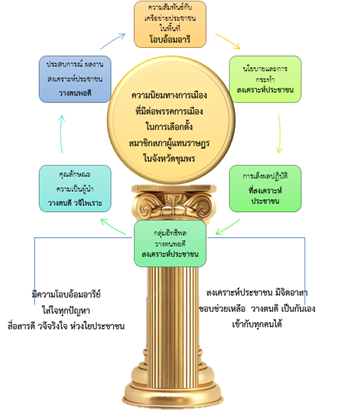
The research results were found that 1. The popularity of political parties in Chumphon was due to continuous work in the area, economic development policies, communication that reached the people, and strong local networks. It did not depend on trends but must build long-term confidence. 2. The political popularity factor affected the political popularity of political parties in the election of members of the House of Representatives in Chumphon Province, predicted by 71.1 percent, and the four principles of Sanghahavattu, social welfare, affected political popularity, predicted by 44.8 percent. 3. Integrating Buddhist principles to promote political popularity in Chumphon Province was as follows: The principle of Dana, charity, sustainable giving through career development, education, and community; the principle of Piyavaca,kind words, building trust with polite words, going to the area, talking sincerely; the principle of Atthachariya, continuously helping people; and the principle of Samanattata, being neutral, transparent, listening, and building political confidence.
References
ธาตรี มหันตรัตน์. (2559). นักการเมืองถิ่นจังหวัดอุทัยธานี. วารสารวิจัยราชภัฏกรุงเก่า, 3(2), 49-54.
ธีรยุทธ ชะนิล. (2566). การประยุกต์หลักพุทธธรรม และการสื่อสารทางการเมืองเพื่อสร้างความนิยมในการเลือกตั้งระดับท้องถิ่น ในจังหวัดนครศรีธรรมราช. วารสารสหวิทยาการนวัตกรรมปริทรรศน์, 7(4), 295–308.
ประคอง มาโต และคณะ. (2564). การส่งเสริมความนิยมทางการเมืองของประชาชนมีต่อนักการเมืองในจังหวัดอุทัยธานี. วารสารวิจยวิชาการ, 5(2), 115–128. https://doi.org/10.14456/jra.2022.37
พระพรหมคุณาภรณ์ (ป. อ. ปยุตฺโต). (2546). ธรรมนูญชีวิต. กรุงเทพฯ: สำนักพิมพ์ผลิธัมม์.
มหาจุฬาลงกรณราชวิทยาลัย. (2539). พระไตรปิฎกฉบับภาษาไทย ฉบับมหาจุฬาลงกรณราชวิทยาลัย. กรุงเทพฯ: โรงพิมพ์มหาจุฬาลงกรณราชวิทยาลัย.
สำนักงานคณะกรรมการการเลือกตั้งประจำจังหวัดชุมพร. (2566). สถิติการเลือก สส.จังหวัดชุมพร. สืบค้น 2 มีนาคม 2567, จาก https://www.ect.go.th/th/chumphon/statistical-information-scores-mp/35043
Yamane, T. (1973). Statistics: An Introductory Analysis (3rd ed.). New York: Harper and Row.
Downloads
Published
How to Cite
Issue
Section
Categories
License
Copyright (c) 2025 Academic Journal of Political Science and Public Administration

This work is licensed under a Creative Commons Attribution-NonCommercial-NoDerivatives 4.0 International License.