A MODEL FOR DEVELOPING AND IMPROVING THE QUALITY OF LIFE OF YOUTH USING THE PHILOSOPHY OF SUFFICIENCY ECONOMY IN THE JUVENILE OBSERVATION AND PROTECTION CENTER IN CHANTHABURI PROVINCE
Keywords:
Youth Quality of Life, Sufficiency Economy, Integrated Development, Juvenile Observation and Protection Center, Chanthaburi ProvinceAbstract
Objectives of this research article were: 1. To study the application of sufficiency economy philosophy to the development and improvement of youth quality of life. 2. To present a model for the development and improvement of youth quality of life using the sufficiency economy philosophy in the Chanthaburi Juvenile Observation and Protection Center. This research was an action research consisting of quantitative research, data collection using questionnaires with 50 parents of youths, data analysis by finding frequency, percentage, mean and standard deviation, and qualitative research by in-depth interviews with key informants who were personnel in the observation center working on youth learning and development activities, totaling 10 people, as well as organizing learning base activities for youths in the observation center to practice. Data analysis was done by analyzing and interpreting data obtained from the interviews.
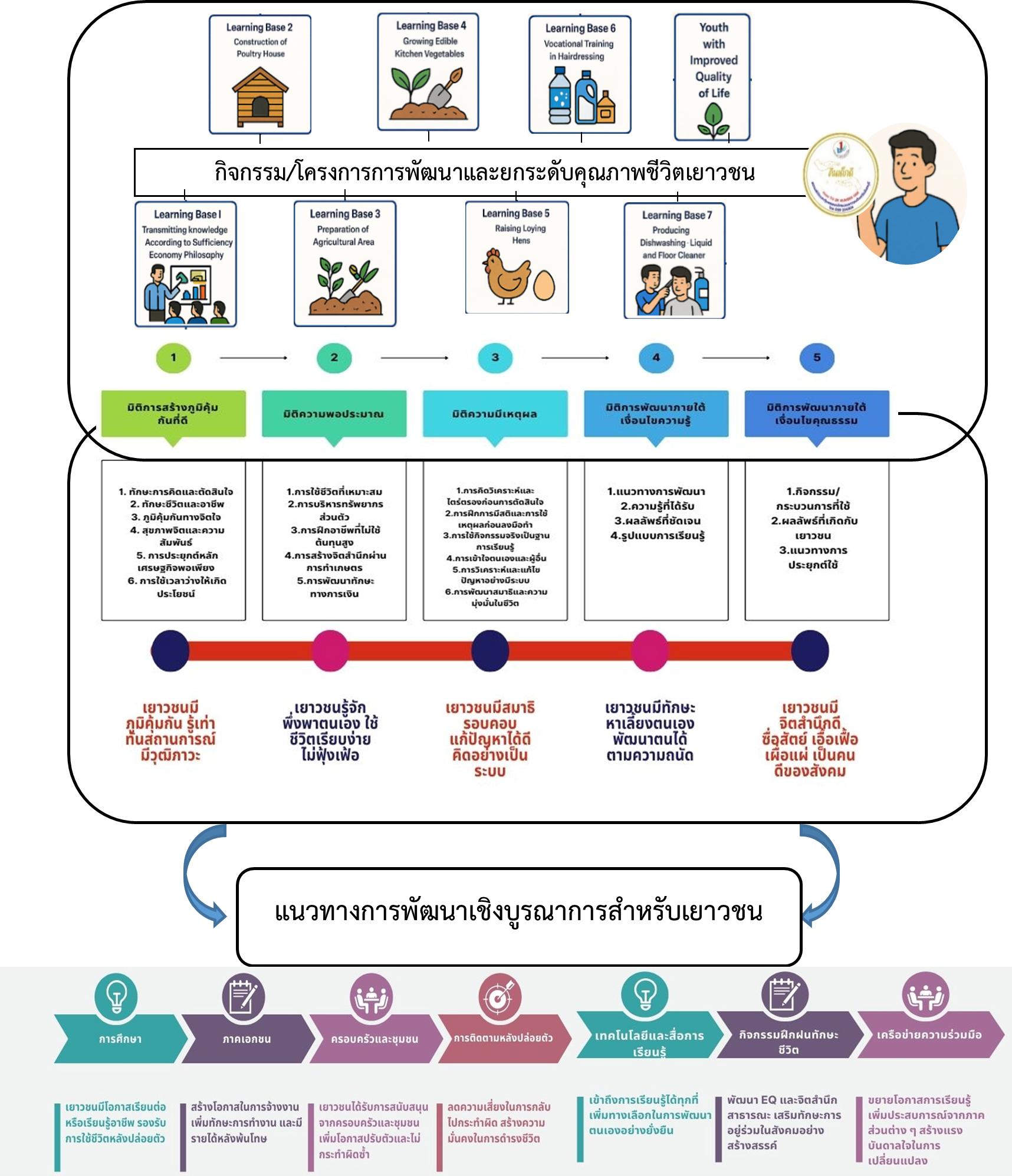
The findings revealed that: 1. The application of the Sufficiency Economy Philosophy was implemented through the principles of “Three Rings and Two Conditions,” consisting of moderation (living without excess), reasonableness (systematic planning), and self-immunity (developing life skills). The two supporting conditions included knowledge (gained from real-life experiences) and morality (instilling honesty, compassion, and social responsibility) to help young people build a stable and sustainable foundation in life. 2. The proposed prototype model focused on empowering juveniles for successful reintegration into society, emphasizing knowledge acquisition, life skills development, and moral cultivation. This was achieved through eight experiential learning stations, such as agriculture, vocational training, and creative thinking exercises. These activities were aligned with SEP and five developmental dimensions: internal immunity, daily-life moderation, rational thinking, experiential learning, and the cultivation of discipline and responsibility. The model provided a structured framework for youth transformation grounded in SEP, offering sustainable reintegration pathways and reducing the risk of recidivism.
References
กรมพินิจและคุ้มครองเด็กและเยาวชน. (2561). แนวทางการฟื้นฟูและพัฒนาเด็กและเยาวชนในสถานพินิจ. กรุงเทพฯ: กระทรวงยุติธรรม.
จรัสศรี พัวจินดาเนตร. (2560). การขับเคลื่อนปรัชญาของเศรษฐกิจพอเพียงในภาครัฐ. กรุงเทพฯ: สำนักงานคณะกรรมการพัฒนาระบบราชการ (ก.พ.ร.).
นิภา พานิชวงศ์. (2563). การเสริมสร้างภูมิคุ้มกันของชุมชนตามแนวเศรษฐกิจพอเพียง,วารสารพัฒนาชุมชน, 8(1), 33–47.
พระปลัดวรกิจ วรกิจฺโจ (กาญจนครุฑ). (2567). เศรษฐกิจพอเพียงกับหลักธรรมในพระพุทธศาสนา : แนวทางการดำเนินชีวิตอย่างยั่งยืน. นครปฐม: วัดพระปฐมเจดีย์ราชวรมหาวิหาร.
พัชราภรณ์ วงศ์สารคาม. (2562). การบริหารจัดการครัวเรือนตามแนวทางเศรษฐกิจพอเพียง : การพึ่งพาตนเองและการใช้ทรัพยากรอย่างมีประสิทธิภาพ. กรุงเทพฯ: สำนักพิมพ์แห่งจุฬาลงกรณ์มหาวิทยาลัย.
ศูนย์ศึกษาเศรษฐกิจพอเพียง. (2560). การประยุกต์ใช้เศรษฐกิจพอเพียงในชุมชนท้องถิ่น. กรุงเทพฯ: สำนักงานกองทุนสนับสนุนการวิจัย.
สำนักงานคณะกรรมการพัฒนาการเศรษฐกิจและสังคมแห่งชาติ. (2557). แผนพัฒนาเศรษฐกิจและสังคมแห่งชาติฉบับที่ 11 (พ.ศ. 2555–2559). กรุงเทพฯ: สำนักงานคณะกรรมการพัฒนาการเศรษฐกิจและสังคมแห่งชาติ.
สุจิตรา ชลกาญจน์สกุล. (2565). การประยุกต์ใช้ปรัชญาของเศรษฐกิจพอเพียงในบริบทของชุมชนเมือง. กรุงเทพฯ: มหาวิทยาลัยธรรมศาสตร์.
สุเมธ ตันติเวชกุล. (2552). เศรษฐกิจพอเพียงคือรากฐานของประเทศ สยามรัฐ. กรุงเทพฯ: สำนักงานคณะกรรมการพัฒนาการเศรษฐกิจและสังคมแห่งชาติ.
Downloads
Published
How to Cite
Issue
Section
Categories
License
Copyright (c) 2025 Academic Journal of Political Science and Public Administration

This work is licensed under a Creative Commons Attribution-NonCommercial-NoDerivatives 4.0 International License.