PUBLIC ADMINISTRATION 4.0: DECENTRALIZED AUTONOMOUS ORGANIZATIONS, GOOD GOVERNANCE, AND PUBLIC SERVICE IN THE DIGITAL ERA
Keywords:
Public Administration, Decentralized Autonomous Organizations, Good Governance and Public ServiceAbstract
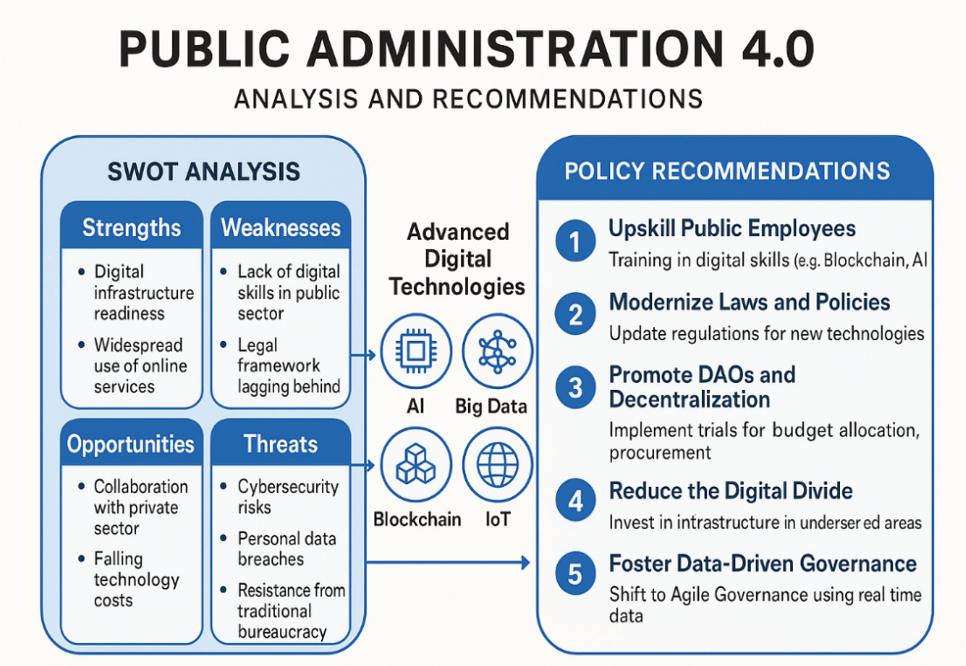
This article analyzes the dynamics of public administration in the digital era through the conceptual framework of Public Administration 4.0, which builds upon New Public Management and Collaborative Governance. It emphasizes the use of advanced digital technologies such as blockchain and smart contracts to enhance efficiency, transparency, and citizen participation. Particular attention is given to the application of Decentralized Autonomous Organizations (DAO) in participatory budgeting, community management, and the design of public policies based on open data. The analysis reveals that DAOs have strong potential to reduce corruption, increase transparency, and decentralize decision-making, thereby enabling genuine citizen participation. However, the implementation of DAOs in the public sector still faces significant challenges, particularly in terms of legal frameworks, bureaucratic structures, and institutional acceptance. The article proposes a policy framework to support Thailand’s digital transformation in the public sector, emphasizing the development of technological infrastructure, upskilling public personnel, and designing inclusive policies that foster active civic engagement.
References
กมลา บัวยั่งยืน. (2561). ปัญหากฎหมายเกี่ยวกับสัญญาอัจฉริยะ (วิทยานิพนธ์นิติศาสตรมหาบัณฑิต สาขาวิชากฎหมายการค้าระหว่างประเทศ). ปทุมธานี: มหาวิทยาลัยธรรมศาสตร์.
กัลยาณี แก้วเมือง และคณะ. (2566). การบริหารงานภาครัฐในยุคดิจิทัล: แนวคิดและพัฒนาการจัดทำบัตรประชาชนดิจิทัล (Digital ID). วารสารการจัดการและพัฒนาท้องถิ่น มหาวิทยาลัยราชภัฏพิบูลสงคราม, 3(1), 74–90.
พระมหาไทยน้อย ญาณเมธี (สลางสิงห์) และพระศิลาศักดิ์ สุเมโธ (บุญทอง). (2564). การปรับตัวองค์กรภาครัฐสู่ยุคความเป็นรัฐบาลดิจิทัล. วารสารวิชาการธรรมทรรศน์, 21(3), 289–299.
เรวัต แสงสุริยงค์. (2562). บนเส้นทางการพัฒนารัฐบาลอิเล็กทรอนิกส์ในสังคมไทย: ยุคดิจิทัล. วารสารวิชาการมนุษยศาสตร์และสังคมศาสตร์ มหาวิทยาลัยบูรพา, 27(55), 294–317.
สำนักงานคณะกรรมการดิจิทัลเพื่อเศรษฐกิจและสังคมแห่งชาติ. (2565). แผนพัฒนาดิจิทัลเพื่อเศรษฐกิจและสังคมแห่งชาติ (พ.ศ. 2566–2570). กรุงเทพฯ: กระทรวงดิจิทัลเพื่อเศรษฐกิจและสังคม.
สำนักงานพัฒนาธุรกรรมทางอิเล็กทรอนิกส์. (2565). ETDA พาสำรวจ 5 ประเทศต้นแบบรัฐบาลดิจิทัล พัฒนา e-Government สร้างบริการสุดล้ำเพื่อประชาชน. สืบค้น 28 สิงหาคม 2568, จาก https://www.etda.or.th/th/Useful-Resource/5e-Government.aspx
สำนักงานพัฒนารัฐบาลดิจิทัล (องค์การมหาชน). (2563). เปลี่ยนผ่านภาครัฐสู่ยุคดิจิทัล (Transform Government to The Digital Age). สืบค้น 28 สิงหาคม 2568, จาก https://shorturl.asia/nhGRr
ACSH (2022). Open [Government] Data Policies and Practices: Select Country Cases. Astana, Kazakhstan: Astana Civil Service Hub.
Bertot, J. C. et al. (2010). Using ICTs to Create a Culture of Transparency: e-Government and Social Media as Openness and Anti-Corruption Tools for Societies. Government Information Quarterly, 27(3), 264–271.
Choi, Y. S. (2020). Smart City Development Projects in The Republic of Korea. R-Economy, 6(1), 40–49.
Duggal, M. (2021). The Dawn of the Digital Yuan: China’s Central Bank Digital Currency and Its Implications. Stockholm-Nacka: Institute for Security and Development Policy.
Frana, P. L. (2024). Assessing Smart Nation Singapore as an International Model for AI Responsibility. International Journal on Responsibility, 7(1), 1–30.
Hood, C. (1991). A Public Management for All Seasons?. Public Administration, 69(1), 3–19.
Hughes, O. E. (2003). Public Management and Administration: An Introduction. (3rd ed.). Basingstoke, UK: Palgrave Macmillan.
Kettunen, P. & Kallio, J. (2020). Digital Government as a Tool for Innovation in the Public Sector. International Journal of Public Sector Management, 33(5), 531-548.
Mærøe, A. R. et al. (2020). Increasing Citizen Participation in E-Participatory Budgeting Processes. Journal of Information Technology & Politics, 18(2), 1–23.
Margetts, H. & Dunleavy, P. (2013). The Second Wave of Digital-Era Governance: A Quasi-Paradigm for Government on The Web. Philosophical Transactions A, 371(1987), 1-17.
Osborne, S. P. (2006). The New Public Governance?. Public Management Review, 8(3), 377–387.
Razaque, A. et al. (2025). Blockchain-Enabled Smart Contracts and Prioritized Delegated Proof-of-Stake Paradigm for Secure and Scalable Electronic Voting Systems. Blockchain: Research and Applications, 6(1), 1-17.
Schuppan, T. (2009). E-government in developing countries: Experiences from Sub-Saharan Africa. Government Information Quarterly, 26(1), 118–127.
Tapscott, D. & Tapscott, A. (2017). How Blockchain is Changing Finance. Boston, MA, USA: Harvard Business Review.
_____. (2017). Blockchain Revolution: How the Technology Behind Bitcoin and Other Cryptocurrencies is Changing the World. New York: Penguin.
Tunzina, T. et al. (2024). Blockchain-Based Central Bank Digital Currency: Empowering Centralized Oversight with Decentralized Transactions. IEEE Access, 12, 192689-192709.
West, D. M. (2004). E-Government and The Transformation of Service Delivery and Citizen Attitudes. Public Administration Review, 64(1), 15–27.
Zohar, A. (2015). Bitcoin: Under the Hood. Communications of the ACM, 58(9), 104–113.
Downloads
Published
How to Cite
Issue
Section
Categories
License
Copyright (c) 2026 Academic Journal of Political Science and Public Administration

This work is licensed under a Creative Commons Attribution-NonCommercial-NoDerivatives 4.0 International License.