DIGITAL TECHNOLOGY READINESS FOR MANAGEMENT IN THE NAKHON RATCHASIMA PROVINCIAL ADMINISTRATIVE ORGANIZATION
Keywords:
Digital Technology Readiness, Organizational Management, Provincial Administrative OrganizationAbstract
Objectives of this research article were: 1. To study the level of digital technology readiness and 2. To analyze the relationship between readiness factors and management efficiency of Nakhon Ratchasima Provincial Administrative Organization (PAO). This research was quantitative research. The sample consisted of 400 people in Nakhon Ratchasima Province. The samples were selected using a simple questionnaire that was quality checked by experts. The result of the assessment was a consistency index of 0.92 and a reliability value of 0.926. The study results were analyzed using descriptive statistics, including percentage, mean, standard deviation, and inferential statistics for hypothesis testing using multiple regression analysis.
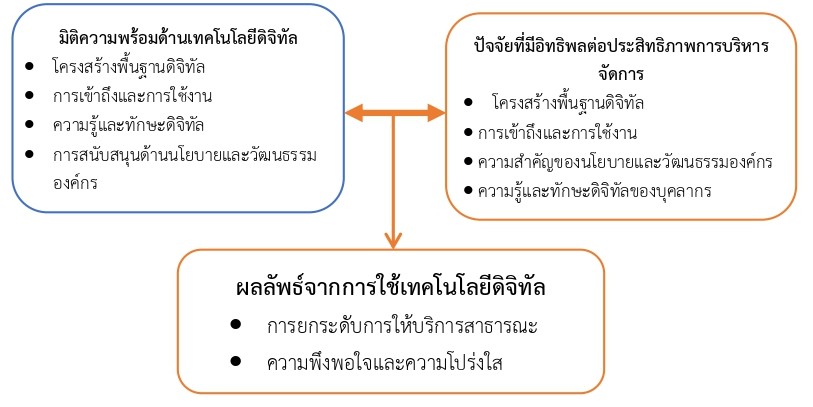
The research results were found that: 1. The PAO's digital technology readiness was at a high level (mean 4.40), especially in terms of access and usage (mean 4.49). Meanwhile, the PAO's management efficiency had an average of 4.48, which was also at a high level. 2. The multiple regression analysis was found that digital technology readiness in all dimensions, including digital infrastructure, access and usage, digital knowledge and skills, policy support and organizational culture, had a positive and statistically significant influence (p < 0.01) on management efficiency (R² = .939). This was consistent with the T-O-E Framework and the UTAUT theory, which indicated that technology development must integrate technology, organization, and environment. The results of this study can therefore serve as an important guideline for PAOs and other local agencies in formulating digital development strategies to enhance public administration efficiency.
References
สำนักงานพัฒนารัฐบาลดิจิทัล. (2566). รายงานรัฐบาลดิจิทัลประเทศไทย 2566. กรุงเทพฯ: สำนักงานพัฒนารัฐบาลดิจิทัล.
อนุรัตน์ อนันทนาธร (2566). รัฐบาลดิจิทัลของไทย. คณะรัฐศาสตร์และนิติศาสตร์. ชลบุรี: มหาวิทยาลัยบูรพา.
อารีรัตน์ อาษาไชย. (2566). การพัฒนาทักษะด้านดิจิทัลของบุคลากรในพื้นที่สำนักงานอัยการภาค 3 จังหวัดนครราชสีมา. วารสารการจัดการการเมืองการปกครองและท้องถิ่น, 1(3), 50–60.
Cronbach, L. J. (1951). Coefficient alpha and the internal structure of tests. Psychometrika, 16(3), 297–334.
Ifinedo, P. (2011). The influence of organizational factors on e-government adoption and implementation in developing countries: A case study of Nigeria. Journal of Information Technology, 26(1), 54-74.
Ifinedo, P. (2011). Internet/e-business technologies acceptance in Canada’s SMEs: An exploratory investigation. Internet Research, 21(3), 255-281.
Kettunen, P., et al. (2021). Digital transformation of local governments: A systematic literature review. Government Information Quarterly, 38(4), 101590.
Kettunen, P., et al. (2021). Digital Transformation in Public Administration: Key drivers and challenges. Journal of Public Administration Research and Theory, 31(3), 451-467.
Ndou, V. (2004). E-Government for Developing Countries: Opportunities and Challenges. The Electronic Journal of Information Systems in Developing Countries, 18(1), 1-24.
Tornatzky, L. G., & Fleischer, M. (1990). The Processes of Technological Innovation. Lexington Books.
Tangi, C., et al. (2021). Digital transformation and organizational success: Evidence from digital adoption in the public sector. Public Administration Review, 81(2), 305-317.
Venkatesh, V., et al. (2003). User acceptance of information technology: Toward a unified view. MIS Quarterly, 27(3), 425-478.
Westerman, G., et al. (2014). Digital Transformation: A Roadmap for Billion-Dollar Organizations. Harvard Business Review, 92(9), 60-70.
Yamane, T. (1973). Statistics an Introductory Analysis. (3rd Ed.). New York: Harper & Row, Publishers, Inc.
Downloads
Published
How to Cite
Issue
Section
Categories
License
Copyright (c) 2025 Academic Journal of Political Science and Public Administration

This work is licensed under a Creative Commons Attribution-NonCommercial-NoDerivatives 4.0 International License.