THE FOUR BRAHMAVIHARAS AND LEADERSHIP DEVELOPMENT IN MODERN ORGANIZATIONS
Keywords:
The Four Brahmaviharas, Leadership Development, Modern OrganizationsAbstract
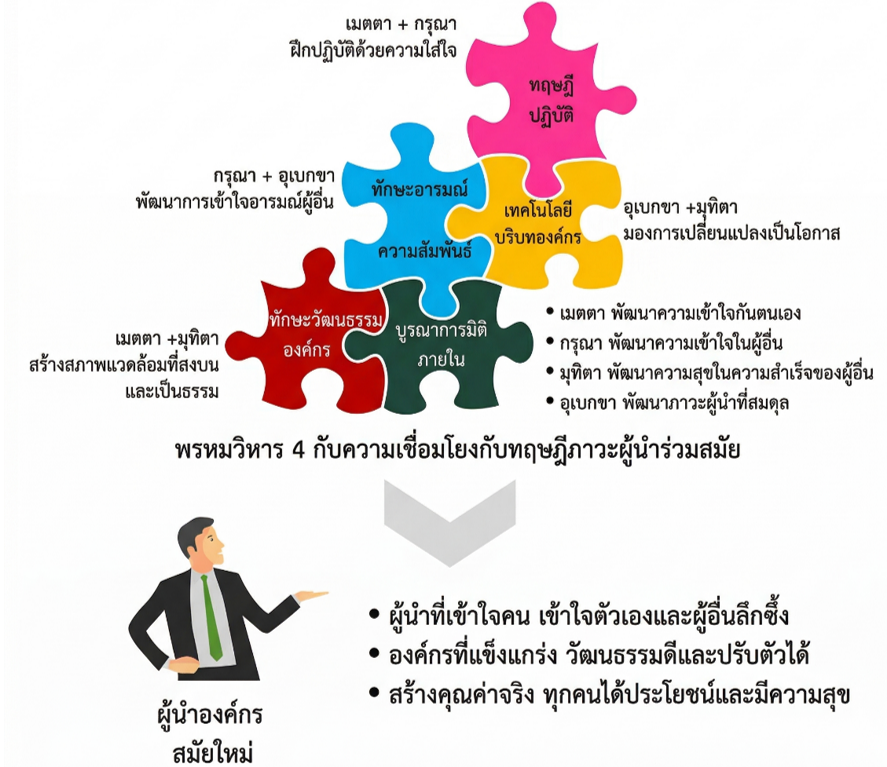
This academic article aimed to analyze the role of the Four Brahma-viharadhamma in developing leadership potential within modern organizations by examining their connections with contemporary leadership theories and proposing practical applications in human resource management and organizational culture development. The study employed documentary analysis and theoretical synthesis, comparing the Four Brahmaviharadhamma: Metta; Loving-kindness, Karuna; Compassion, Mudita; Sympathetic Joy, and Upekkha; Equanimity with modern leadership theories including Transformational Leadership, Servant Leadership, Ethical Leadership, Emotional Intelligence, and Authentic Leadership. The analysis revealed that the Four Brahmaviharadhamma can enhance leaders’ internal qualities by fostering self-awareness and awareness of others, emotional stability, compassion, and fairness, qualities essential in today’s dynamic and complex organizational environment. Furthermore, the application of these principles promoted positive team relationships, established ethical organizational culture, and supported sustainable organizational growth. The integration of the Four Brahmaviharadhamma with contemporary leadership frameworks offered a promising alternative for developing holistic leaders who possess both managerial effectiveness and psychological stability. This approach is particularly relevant to current societal conditions and organizational needs that emphasize sustainability and human-centered development. The study contributed to leadership development literature by bridging Eastern wisdom traditions with Western management theories, providing a comprehensive framework for cultivating leaders who can navigate the complexities of modern organizational challenges while maintaining ethical integrity and emotional balance.
References
พระพรหมคุณาภรณ์ (ป.อ. ปยุตฺโต). (2543). พุทธธรรม (ฉบับปรับขยาย). กรุงเทพฯ: มหาจุฬาลงกรณราชวิทยาลัย.
มหาจุฬาลงกรณราชวิทยาลัย. (2539). พระไตรปิฎกฉบับภาษาไทย ฉบับมหาจุฬาลงกรณราชวิทยาลัย. กรุงเทพฯ: โรงพิมพ์มหาจุฬาลงกรณราชวิทยาลัย.
Avolio, B. J. & Gardner, W. L. (2005). Authentic Leadership Development: Getting to The Root of Positive Forms of Leadership. The Leadership Quarterly, 16(3), 315–338.
Bass, B. M. & Riggio, R. E. (2006). Transformational Leadership (2nd ed.). Mahwah, NJ: Lawrence Erlbaum Associates.
Brown, M. E. & Treviño, L. K. (2006). Ethical Leadership: A Review and Future Directions. The Leadership Quarterly, 17(6), 595–616.
Daft, R. L. (2021). Organization Theory and Design (13th ed.). Boston, MA: Cengage Learning.
Goleman, D. (2006). Emotional Intelligence: Why It Can Matter More Than IQ. New York, NY: Bantam Books.
Greenleaf, R. K. (1977). Servant Leadership: A Journey into The Nature of Legitimate Power and Greatness. New York, NY: Paulist Press.
Gunaratana, H. (2002). Eight Mindful Steps to Happiness: Walking the Buddha's Path. Somerville, MA: Wisdom Publications.
Northouse, P. G. (2021). Leadership: Theory and Practice (9th ed.). Thousand Oaks, CA: SAGE Publications.
Scharmer, O. C. (2009). Theory U: Leading from The Future as It Emerges. San Francisco, CA: Berrett-Koehler Publishers.
Schein, E. H. (2017). Organizational Culture and Leadership (5th ed.). Hoboken, NJ: Wiley.
Downloads
Published
How to Cite
Issue
Section
Categories
License
Copyright (c) 2026 Academic Journal of Political Science and Public Administration

This work is licensed under a Creative Commons Attribution-NonCommercial-NoDerivatives 4.0 International License.