EMPOWERMENT OF SELF-RELIANT LOCAL COMMUNITIES IN PHRA NAKHON SI AYUTTHAYA PROVINCE
Keywords:
Empowerment, Local Communities, Self-ReliantAbstract
Objectives of this research paper were: 1. To study the capacity of local communities to be self-reliant. 2. To obtain innovative processes to increase the capacity of self-reliant local communities and 3. To evaluate the innovation of processes to increase the capacity of self-reliant local communities in Ayutthaya Province, this study employed a mixed-methods design. Data were collected from 392 samples in Ayutthaya Province. 18 key informants were interviewed, and 9 innovations were evaluated using purposeful sampling. The research tools were a questionnaire with a reliability (Cronbach’s alpha) = 0.981 and an in-depth-interview script. Data was analyzed using both descriptive and inferential data analysis.
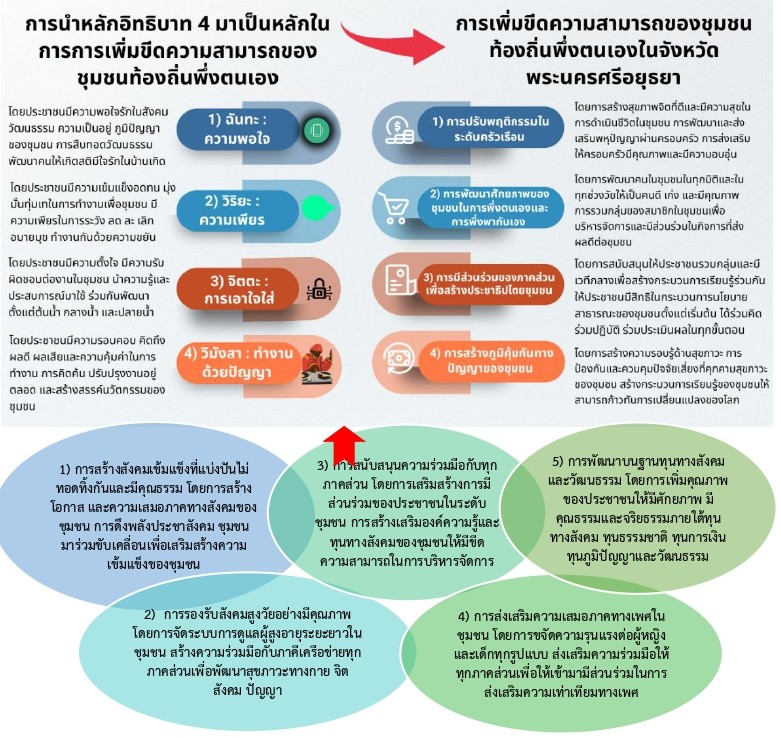
The research results were found that 1. The capacity of local self-reliant communities was found to be at a moderate level, by overall, including behavioral adjustment at the household level, community potential for self - reliance, community intellectual immunity, and sectoral participation in building community democracy. 2. The process of innovations for increasing the capacity of local self-reliant communities was found that the communities applied the principles of social empowerment, namely, building a strong society that shares and does not abandon each other and has morality, supporting a quality aging society, supporting cooperation with all sectors, promoting gender equality in the community, and developing on the basis of social and cultural capital by using Iddhipadadhamma as the main principles of practice, namely, Chanda (aspiration), Viriya (effort), Citta (focus), Vimamsa (investigation), leading to increased community capacity, resulting in behavioral adjustment at the household level. Developing the potential of communities to be self-reliant and self-reliant, participation of sectors to create community democracy, and building intellectual immunity of communities. And 3. Evaluating the results of innovation processes to increase the capacity of self-reliant local communities in Phra Nakhon Si Ayutthaya Province was found that innovations to enhance the social power of communities, the four principles of Iddhipadadhamma and innovation processes to increase the capacity of self-reliant local communities in Phra Nakhon Si Ayutthaya Province were found to be most appropriate in all aspects.
References
ประเวศ วะสี. (2553). การจัดการตนเองของชุมชนและท้องถิ่น. กรุงเทพฯ: บพิธการพิมพ์.
พระมหาสุเมฆ สมาหิโต (ทวีกุล). (2562). โมเดลความสัมพันธ์เชิงสาเหตุของประสิทธิผลพุทธบูรณาการการบริหารงานขององค์กรปกครองส่วนท้องถิ่นในจังหวัดพิจิตร. วารสารมหาวิทยาลัยคริสเตียน, 25(2), 50-64.
ภัชลดา สุวรรณนวล และคณะ. (2565). รูปแบบการบริหารจัดการชุมชนวิถีพุทธสู่ความพอเพียงในจังหวัดสุราษฎร์ธานี. วารสารมหาจุฬานาครทรรศน์, 9(1), 34-49.
สำนักงานคณะกรรมการพัฒนาการเศรษฐกิจและสังคมแห่งชาติ สำนักนายกรัฐมนตรี. (2559). สรุปสาระสำคัญ แผนพัฒนาเศรษฐกิจและสังคมแห่งชาติ ฉบับที่สิบสอง พ.ศ. 2560-2564. กรุงเทพฯ: สำนักงานคณะกรรมการพัฒนาการเศรษฐกิจและสังคมแห่งชาติ สำนักนายกรัฐมนตรี.
สำนักงานสถิติจังหวัดพระนครศรีอยุธยา. (2567). ตัวชี้วัดที่สำคัญของจังหวัด. สืบค้น 4 กรกฎาคม 2568, จาก : https://ayuttaya.nso.go.th/
สุวัฒน์ คงแป้น. (2563). 12 ปี สภาองค์กรชุมชน ก้าวไปข้างหน้ากับการพัฒนาคุณภาพชีวิต. กรุงเทพฯ: สำนักประสานเครือข่ายสภาองค์กรชุมชน.
อดิศักดิ์ ปิยะสุวรรณ และคณะ. (2566). การบูรณาการหลักพุทธธรรมเพื่อส่งเสริมนวัตกรรมการบริหารงานของ การประปานครหลวง. วารสารสหวิทยาการนวัตกรรมปริทรรศน์, 7(1), 41–54.
Yamane, T. (1973). Statistics: An Introductory Analysis. (3rd Ed). New York: Harper and Row Publications.
Downloads
Published
How to Cite
Issue
Section
Categories
License
Copyright (c) 2026 Academic Journal of Political Science and Public Administration

This work is licensed under a Creative Commons Attribution-NonCommercial-NoDerivatives 4.0 International License.