SANGAHAVATTHU IV PRINCIPLES AND THE DEVELOPMENT OF COMMUNICATION FOR THAI EXPORT TO THE GLOBAL MARKET
Keywords:
Sangahavatthu IV Principles, Communication Development, Thai Export to the Global MarketAbstract
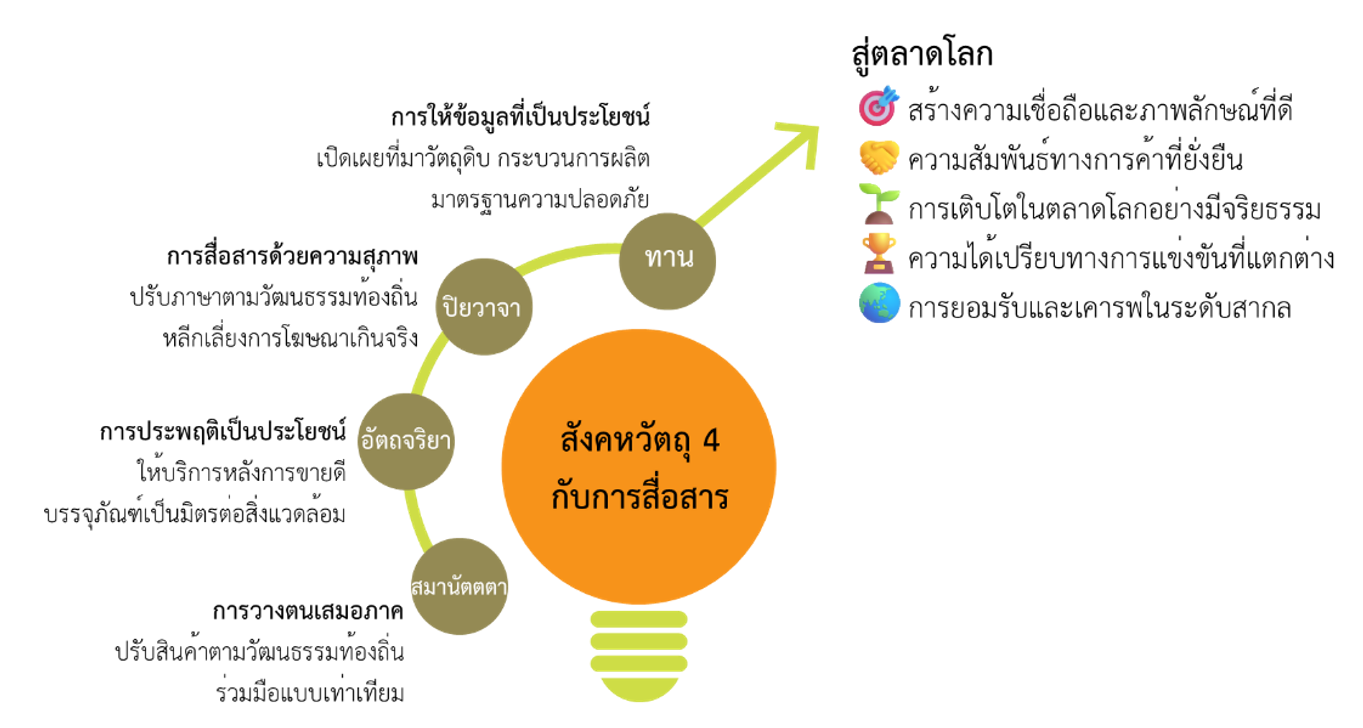
This academic article aimed to explore and propose an approach for applying the Buddhist principle of Sangahavatthu 4 comprising Dana, generosity, Piyavaca, kind speech, Atthacariya, beneficial conduct, and Samanattata, equality, to develop strategic communication frameworks for Thai export to the global market, conducted through documentary analysis and theoretical synthesis. The study revealed that communication in international trade contexts served not merely as a process of product information transmission, but also as a crucial mechanism for establishing credibility, strategic relationships, and global commercial identity. The application of Sangahavatthu 4 can lead to the development of four communication dimensions: providing transparent and impartial information, employing appropriate and constructive language, implementing actions that reflected social responsibility, and demonstrating respect for cultural diversity. These dimensions aligned with contemporary trends toward ethical and sustainable consumption patterns among modern consumers. This study held both theoretical and practical significance by demonstrating the potentials for integrating Buddhist principles into international marketing communication strategies to create sustainable competitive advantages.
References
มหาจุฬาลงกรณราชวิทยาลัย. (2539). พระไตรปิฎกฉบับภาษาไทย ฉบับมหาจุฬาลงกรณราชวิทยาลัย. กรุงเทพฯ: โรงพิมพ์มหาจุฬาลงกรณราชวิทยาลัย.
Adler, R. B. et al. (2018). Understanding Human Communication. New York: Oxford University Press.
Asian Economic Papers. (2017). The Rise and Fall of Thailand's Export-Oriented Industries. MIT Press, 16(3), 128-150.
Berelson, B. & Steiner, G. A. (1964). Human Behavior: An Inventory of Scientific Findings. New York: Harcourt, Brace & World.
Berlo, D. K. (1960). The Process of Communication: An Introduction to Theory and Practice. New York: Holt, Rinehart and Winston.
European Academy for Executive Education. (2020). Cultural Barriers and How to Overcome Them in Your Global Company as A Global Leader. Retrieved April 22, 2025, from https://eurac.com/cultural-barriers-and-how-to-overcome-them-in-your-global-company-as-a-global-leader/
Gudykunst, W. B. & Kim, Y. Y. (2003). Communicating with Strangers: An Approach to Intercultural Communication (4th ed.). New York: McGraw-Hill.
Lobeda, B. (2023). Cross-Cultural Communication: Overcoming Challenges in Global Business. Retrieved April 2, 2025, from https://shorturl.asia/JFOtY
Ma, C. et al. (2025). The Mandarin Advantage: How Thai University Students Are Facilitating Cross-Border E-Commerce for Chinese Tourists in Thailand’s Post-COVID Recovering Hospitality Sector. Retrieved April 22, 2025, from https://shorturl.asia/j3To4
Melkote, S. R. & Steeves, H. L. (2001). Communication for Development in the Third World: Theory and Practice for Empowerment (2nd ed.). New Delhi: SAGE Publications.
Nye, J. S. (2004). Soft Power: The Means to Success in World Politics. New York: Public Affairs.
PwC. (2024). Consumers Willing to Pay 9.7% Sustainability Premium, Even As Cost-of-Living and Inflationary Concerns Weigh: Pwc 2024 Voice of The Consumer Survey. Retrieved March 6, 2025, from https://shorturl.asia/cXlum
Raksong, R. & Muenthaisong, K. (2025). Competitiveness of Thailand Cassava Export: An Empirical Analysis of ASEAN Markets. Research on World Agricultural Economy, 6(2), 379–393.
Schramm, W. (1954). How Communication Works. In W. Schramm (Ed.), The Process and Effects of Mass Communication. (pp. 3–26). Urbana: University of Illinois Press.
Servaes, J. (Ed.) (2008). Communication for Development and Social Change. Thousand Oaks, CA: SAGE Publications.
Thussu, D. K. (2018). International Communication: Continuity and Change (3rd ed.). London: Bloomsbury Publishing.
U.S. Department of Commerce. (2024). Thailand - Market challenges. Country Commercial Guides. Retrieved April 22, 2025, from https://shorturl.asia/ykZ9K
World Bank. (2023). Global Economic Prospects: Weak Growth, High Inflation. Washington, DC: World Bank.
Downloads
Published
How to Cite
Issue
Section
Categories
License
Copyright (c) 2026 Academic Journal of Political Science and Public Administration

This work is licensed under a Creative Commons Attribution-NonCommercial-NoDerivatives 4.0 International License.