THE INFLUENCE OF DIGITAL MARKETING COMMUNICATIONS AFFECTING THE BASIC SUCCESS BEHAVIOR OF GENERATION Z TEENAGERS
Keywords:
Digital Marketing Communication, Generation Z, Success Behavior, Content Credibility, InfluencerAbstract
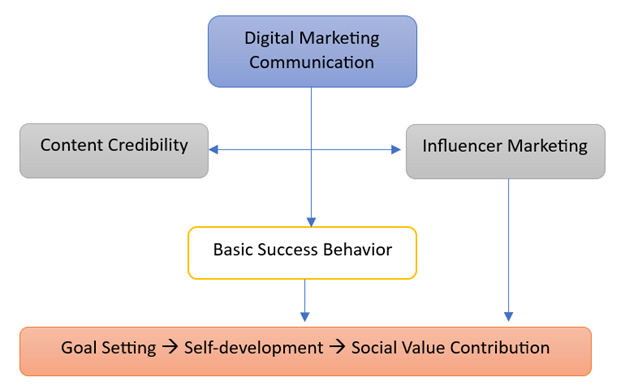
Objectives of this research paper were: 1. To study digital marketing communication awareness level 2. To study basic success behaviors of generation Z teens in Thailand and 3. To analyze the Influence of digital marketing communication on such behaviors, conducted by the quantitative research. The samples used in the research were 400 Gen Z teenagers and used the survey method through an online questionnaire. Data was analyzed with descriptive statistics and multiplier regression analysis.
The findings showed that: 1. Gen Z teens had a high level of awareness of digital marketing communications, especially in terms of interactive experiences, content trust, and brand interaction. 2. This group of teens also exhibited a high level of basic achievement behaviors, such as goal setting and self-improvement. This directly affected goal setting. Self-development and social participation of adolescents.
References
ปอรยา สุวรรณสิทธิ์. (2565). ปัจจัยที่ส่งผลต่อความสำเร็จในการเรียนรู้ทางไกล สำหรับนักเรียน สังกัดอาชีวศึกษา จังหวัดชัยนาท (วิทยานิพนธ์ปริญญามหาบัณฑิตสาขาวิชาวิจัยและประเมินทางการศึกษา). พิษณุโลก: มหาวิทยาลัยนเรศวร.
สำนักบริหารการทะเบียน กรมการปกครอง. (2568). จำนวนประชากรกลุ่มเจนฯ ซีในประเทศไทย. กรุงเทพฯ: กรมการปกครอง กระทรวงมหาดไทย.
สุนทรีย์ สองเมือง. (2566). พฤติกรรมผู้บริโภคกลุ่มเจนเนอเรชัน Z และกลยุทธ์การตลาดดิจิทัล 4.0 ที่ส่งผลต่อกระบวนการตัดสินใจซื้อสินค้าในจังหวัดนนทบุรี. วารสารการบัญชีและการจัดการ, 15(1), 115-127.
Chaffey, D., & Ellis-Chadwick, F. (2019). Digital Marketing: Strategy and Implementation. London: Pearson Education.
Francis, T., & Hoefel, F. (2018). ‘True Gen’: Generation Z and its implications for companies. Retrieved June 10, 2025, from https://www.mckinsey.com/industries/consumer-packaged-goods/our-insights/true-gen-generation-z-and-its-implications-for-companies#/
Hair, J. F., et al. (2009). Multivariate Data Analysis (7th ed.). London: Pearson.
Hossain, M. (2018). Understanding the Attitude of Generation Z Consumers Towards Advertising Avoidance on the Internet. European Journal of Business and Management, 10(36), 86-96.
Jumawan, R. C. (2025). Comparing Local and Foreign Tourists' Behavior Toward Local Food in Siquijor Using the AISDALSLove Model: A Path Analysis to Guide Marketing Strategies. Journal of Business and Management Studies, 7(3), 128-144. https://doi.org/10.32996/jbms.2025.7.3.12
Kotler, P., & Keller, K. L. (2014). Marketing management (15th ed.). London: Pearson.
Kutner, M. H., et al., (2004). Applied linear statistical models (5th ed.). McGraw-Hill/Irwin.
Likert, R. (1933). The Method of Constructing and Attitude Scale in Attitude Theory and Measurement. Retrieved June 10, 2025, from https://www.sfu.ca/~palys/Likert-1933-TheMethodOfConstructingAnAttitudeScale.pdf
Locke, E. A., & Latham, G. P. (2002). Building a Practically Useful Theory of Goal Setting and Task Motivation: A 35-Year Odyssey. American Psychologist, 57(9), 705-717. https://doi.org/10.1037/0003-066X.57.9.705
Nguyen, T. M. A., & Dong V. T. (2024). Factors Affecting the Avoidance of Online Advertising on Facebook of Gen Z in Hanoi. International Journal of Scientific Research and Management (IJSRM), 12(11), 8009-8019. https://doi.org/10.18535/ijsrm/v12i11.em18
Rachmad, Y.E. (2023). Digital Influence Theory. Alexandria Bibliotheca Kitab Nashr. https://doi.org/10.17605/osf.io/aursv
Turner, A. (2015). Generation Z: Technology and social interest. The Journal of Individual Psychology, 71(2), 103–113.
Twenge, J. M. (2017). iGen: Why Today's Super-Connected Kids Are Growing Up Less Rebellious, More Tolerant, Less Happy and Completely Unprepared for Adulthood and What That Means for the Rest of Us. NY: Atria.
Van de Casteele, M., et al., (2024). Unraveling the Role of Social Media on Adolescents’ Daily Goals and Affect: The Interplay Between Basic Psychological Needs and Screen Time. Interacting with Computers. Advance online publication. Interacting with Computers, iwad055, https://doi.org/10.1093/iwc/iwad055
Williams, K. C., et al., (2010). Multi-generational marketing: Descriptions, characteristics, lifestyles, and attitudes. Journal of Applied Business and Economics, 11(2), 21 - 36.
Yahya, M. A., & Mammadzada, H. (2024). Targeting generation Z: A systematic literature review (SLR) and bibliometric analysis for effective marketing. Journal of Politics Economy and Management, 7(1), 21-44. https://doi.org/10.5281/zenodo.13891399
Yamane, T. (1973). Statistics: An Introductory Analysis (3rd ed.). New York: Harper & Row.
Yasmin, A., et al., (2015). Effectiveness of Digital Marketing in the Challenging Age: An Empirical Study. International Journal of Management Science and Business Administration, 1(5), 69–80.
Zimmerman, B. J. (2015). Self-Regulated Learning: Theories, Measures, and Outcomes. International Encyclopedia of the Social & Behavioral Sciences, 21, 541-546. http://dx.doi.org/10.1016/B978-0-08-097086-8.26060-1
Downloads
Published
How to Cite
Issue
Section
Categories
License
Copyright (c) 2026 Academic Journal of Political Science and Public Administration

This work is licensed under a Creative Commons Attribution-NonCommercial-NoDerivatives 4.0 International License.