POLICY RECOMMENDATIONS FOR DEVELOPING WANGTANODE COMMUNITY INTO A LEARNING CITY THROUGH SUSTAINABLE URBAN DEVELOPMENT MECHANISMS
Keywords:
Policy Proposal, Wang Tanode Community, Learning CityAbstract
Objectives of this research article were: 1.To synthesize concepts, theories, and research related to the development of a learning city using sustainable urban development mechanisms; 2. To assess the social impact (SROI) of development projects in Wang Tanode community using the synthesized variables; and 3. To present policy proposals for developing Wang Tanode community into a learning city. The research was mixed methods: The qualitative research, key informants were local leaders, community leaders, and those involved in policy implementation in the community who participated in planning community development through policies, activities, and various projects in the area. Data was collected using in-depth interviews. The quantitative research, data were collected from the sample groups consisted of residents from 10 villages in Wang Tanode area, by purposive sampling and analyzed data with frequencies, means, and standard deviations.
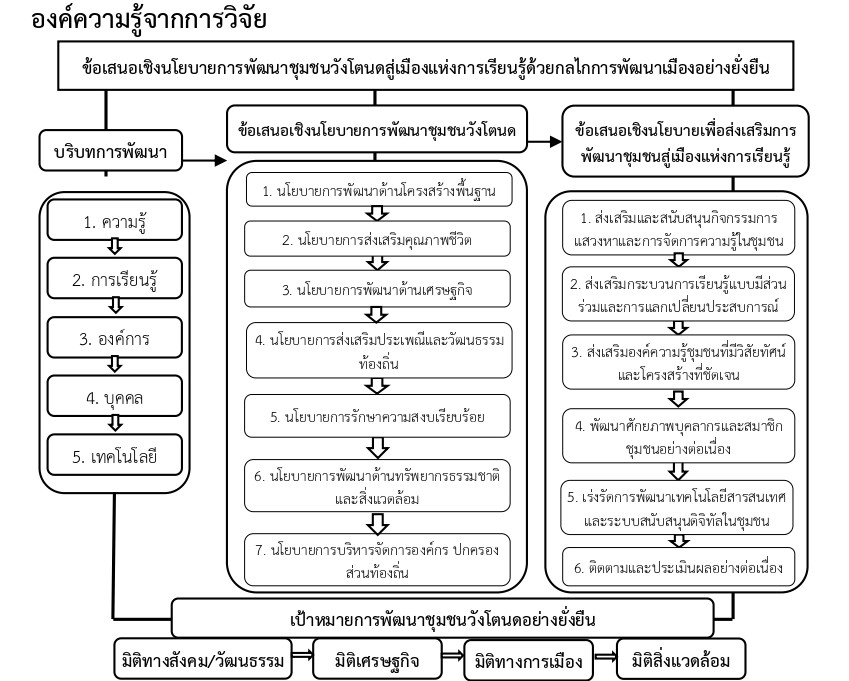
The results showed that 1. The learning city concept of Wang Tanode emphasized six dimensions: promoting lifelong learning in all dimensions; (Knowledge development), promoting equality and access to learning opportunities; promoting quality and excellence of learning; promoting a culture of learning in families, communities and workplaces; increasing the capacity of local learners and workers to strengthen the knowledge-based economy and building partnerships between various organizations. 2. The social return on investment (SROI) was higher than 1.0 in all aspects, including “knowledge” with the highest at 4.0 baht per 1 baht invested, followed by “learning” and “organization” at 3.5 baht, and “technology” with the lowest at 3.0 baht. And 3. Policy proposals were divided into 4 parts: 1. Community context and basic potential 2. Policy proposals for holistic community development 3. Specific policy proposals for learning city development and 4. Sustainable development goals.
References
กระทรวงศึกษาธิการ. (2564). นโยบายการจัดการศึกษาตลอดชีวิต. กรุงเทพฯ: กระทรวงศึกษาธิการ.
กระทรวงการอุดมศึกษา วิทยาศาสตร์ วิจัยและนวัตกรรม. (2565). นโยบายและยุทธศาสตร์การพัฒนาการเรียนรู้ตลอดชีวิตของประเทศไทย. กรุงเทพฯ: กระทรวงการอุดมศึกษา วิทยาศาสตร์ วิจัยและนวัตกรรม.
สำนักงานสภาพัฒนาการเศรษฐกิจและสังคมแห่งชาติ. (2561). ยุทธศาสตร์ชาติ 20 ปี (พ.ศ. 2561–2580). กรุงเทพฯ: สำนักงานสภาพัฒนาการเศรษฐกิจและสังคมแห่งชาติ.
สำนักงานสภาพัฒนาการเศรษฐกิจและสังคมแห่งชาติ. (2565). แผนพัฒนาเศรษฐกิจและสังคมแห่งชาติ ฉบับที่ 13 (พ.ศ. 2566–2570). กรุงเทพฯ: สำนักงานสภาพัฒนาการเศรษฐกิจและสังคมแห่งชาติ.
สำนักงานพัฒนาชุมชนอำเภอนายายอาม. (2566). รายงานข้อมูลศักยภาพชุมชนอำเภอนายายอาม. จันทบุรี: สำนักงานพัฒนาชุมชนอำเภอนายายอาม.
องค์การบริหารส่วนตำบลวังโตนด. (2566). ข้อมูลทั่วไปตำบลวังโตนด. จันทบุรี: องค์การบริหารส่วนตำบลวังโตนด.
Cheng, K. M., & Mok, K. H. (2017). Education and the Learning City: Global Perspectives and Local Initiatives. Hong Kong: Hong Kong University Press.
Chisholm, L., & Clercq, F. (2004). The Development of Lifelong Learning Policies in European Cities. European Journal of Education, 39(1), 33-46.
Graham, A. (2009). Building Learning Cities: A Global Perspective. New York: Routledge.
Klarenbeek, R., & Post, M. (2010). Lifelong Learning and Urban Development: Creating Collaborative Learning Environments. Urban Learning Review, 2(1), 39-52.
Lowe, J. (2011). The Role of Social Networks in Urban Learning: An Investigation of Lifelong Learning in Urban Communities. Urban Studies, 48(6), 1253-1270.
Longworth, N. (2006). Learning Cities, Learning Regions, Learning Communities: Lifelong Learning and Local Government. London: Routledge.
Ritzen, J., & Easterly, W. (2006). The Role of Education in Urban Development. Washington, D.C.: World Bank.
UNESCO. (2015). Guidelines for Building Learning Cities. Hamburg: UNESCO Institute for Lifelong Learning.
Downloads
Published
How to Cite
Issue
Section
Categories
License
Copyright (c) 2026 Academic Journal of Political Science and Public Administration

This work is licensed under a Creative Commons Attribution-NonCommercial-NoDerivatives 4.0 International License.