BUDDHADHAMMA INTEGRATED NINE KEYS PRINCIPLES OF PALANGJIT DHARMA JAKRAWAN INSTITUTE FOR DEVELOPING TRANSFORMATIONAL LEADERSHIP AMONG VOLUNTEERS AT HUA HIN MUNICIPALITY, PRACHUAP KHIRI KHAN PROVINCE
Keywords:
Buddhist Integration, Transformational Leadership, Volunteerism, Nine Keys PrinciplesAbstract
The objectives of this research article were: 1. To examine the transformational leadership of volunteer workers, 2. To investigate the factors influencing transformational leadership, and 3. To propose a Buddhist integration approach for developing transformational leadership through the Nine Keys Principles of the Palangjit Dharma Jakrawan Institute within Hua Hin Municipality, Prachuap Khiri Khan Province, conducted by the mixed methods. For the quantitative method, the samples consisted of 139 volunteers who had completed transformational leadership training, selected through stratified random sampling. Data was collected using questionnaires, distributed and retrieved within 30 days, and analyzed using descriptive statistics and stepwise multiple regression analysis. For the qualitative method, in-depth interviews were conducted with 18 key informants, guided by research framework-based questions. Each interview lasted 45–60 minutes, with participants’ consent for audio recording. Data was analyzed through descriptive content interpretation.
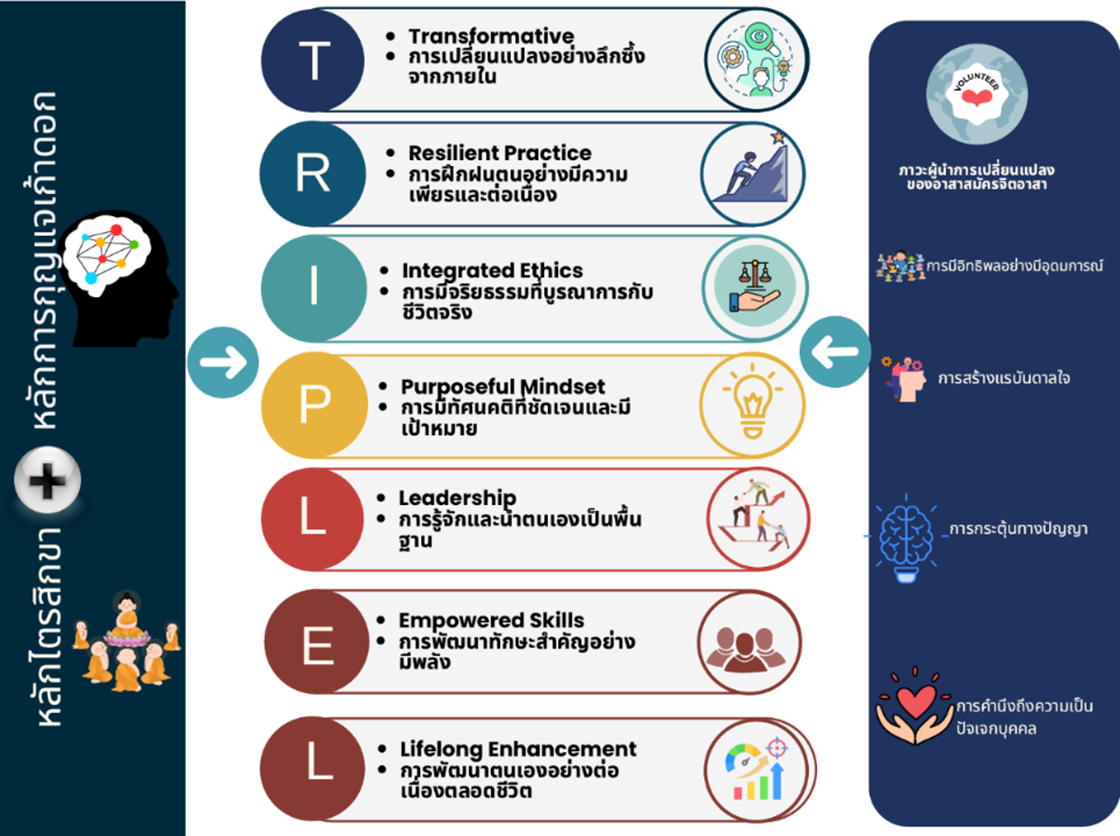
The findings revealed that: 1. Overall transformational leadership was at a moderate level; 2. The key factors that significantly predicted transformational leadership at a high level were the Buddhist principles of Tisikkha specifically Samadhi, concentration and Panna, wisdom and six dimensions of the Nine Keys Principles, namely generosity, self-exploration, problem-solving, communication and cognitive skills, positive thinking and forgiveness, and leadership, with statistical significance at the 0.01 and 0.05 levels; and 3. The integration of Buddhist teachings in concentration enhanced determination, perseverance, and carefulness, while the development of wisdom fostered creativity and analytical thinking for continuous improvement. The integrated application of the Nine Keys Principles enabled volunteers to cultivate four core characteristics of transformational leadership: idealized influence, inspirational motivation, intellectual stimulation, and individualized consideration.
References
กัลยา วานิชย์บัญชา. (2553). การวิเคราะห์สถิติขั้นสูงด้วย SPSS for Windows (พิมพ์ครั้งที่ 8). กรุงเทพฯ: ภาควิชาสถิติ คณะพาณิชยศาสตร์และการบัญชี จุฬาลงกรณ์มหาวิทยาลัย.
ไกรศร วันละ และเสาวลักษณ์ โกศลกิตติอัมพร. (2564). การขับเคลื่อนเป้าหมายการพัฒนาอย่างยั่งยืนของประเทศไทย. วารสาร มจร บาฬีศึกษาพุทธโฆสปริทรรศน์, 7(3), 56-66.
ชญาดา เข็มเพชร. (2559). การพัฒนาผู้นำต้นแบบในสังคมไทย. วารสาร มจร สังคมศาสตร์ปริทรรศน์, 6(4), 38–50.
ชณภา ปุญณนันท์ และบุญทัน ดอกไธสง. (2567). การพัฒนาภาวะผู้นำเชิงนวัตกรรมผ่านหลักการกุญแจเก้าดอกของสถาบันพลังจิต ธรรมะ จักรวาลของบุคลากรเทศบาลเมืองในจังหวัดประจวบคีรีขันธ์. วารสารพุทธนวัตกรรมและการจัดการ, 7(5), 1–14.
ดวงใจ ปินตามูล และคณะ. (2560). การพัฒนาคุณลักษณะภาวะผู้นำมุ่งให้บริการของผู้บริหารองค์กรปกครองส่วนท้องถิ่นในจังหวัดเพชรบูรณ์ตามแนวพุทธธรรม. วารสาร มจร สังคมศาสตร์ปริทรรศน์, 6(2-04), 199-210.
นฤมล เพ็ญสิริวรรณ และคณะ. (2562). ปัจจัยที่ส่งผลต่อภาวะผู้นำของผู้บริหารเทศบาลตำบลในจังหวัดนนทบุรี. วารสารมหาจุฬานาครทรรศน์, 6(4), 5641-5658.
นัทปภา นุชาภัทร และบุญทัน ดอกไธสง. (2567). ประสิทธิผลการพัฒนาทุนมนุษย์ผ่านหลักการกุญแจเก้าดอกของสถาบันพลังจิต ธรรมะ จักรวาล. วารสารพุทธนวัตกรรมและการจัดการ, 7(5), 15–28.
ประจักษ์ ขุราษี. (2560). การบูรณาการหลักพุทธธรรมเพื่อพัฒนาภาวะผู้นำทางการบริหารของกรุงเทพมหานคร. วารสาร มจร สังคมศาสตร์ปริทรรศน์, 6(2-03), 255–268.
พระครูปลัดชาติชาย ญาณโสภโณ (ขุมเงิน) และคณะ. (2563). การบูรณาการหลักพุทธธรรมเพื่อการพัฒนาศักยภาพผู้สูงอายุของเทศบาลในจังหวัดลำพูน. วารสาร มจร สังคมศาสตร์ปริทรรศน์, 9(4), 64–75.
พระครูปลัดวัชรพงษ์ วชิรปญฺโญ (ปล้องขัน). (2559). ภาวะผู้นำเชิงพุทธเพื่อการบูรณาการพัฒนาชุมชนในจังหวัดน่าน. วารสาร มจร สังคมศาสตร์ปริทรรศน์, 6(2-04), 433–448.
พระประเสริฐ วรธมฺโม (ธิลาว) และคณะ. (2559). พุทธบูรณาการการพัฒนาทุนมนุษย์สู่ความเป็นองค์กรสมรรถนะสูงของสถาบันการศึกษาระดับอุดมศึกษาของคณะสงฆ์ไทย. วารสาร มจร สังคมศาสตร์ปริทรรศน์, 5(1), 71-84.
พระมหาสกล วงษ์เขียด และคณะ. (2560). รูปแบบการเสริมสร้างภาวะผู้นำกลุ่มสัจจะสะสมทรัพย์เพื่อการพัฒนาชุมชนยั่งยืน ภาคเหนือตอนล่าง. วารสาร มจร สังคมศาสตร์ปริทรรศน์, 6(3), 14–25.
รักยิ่ง โรจนเกตุปัญญา และบุญทัน ดอกไธสง. (2567). การประยุกต์หลักพุทธจริยธรรมผ่านหลักการกุญแจเก้าดอกเพื่อพัฒนาภาวะผู้นำนักศึกษาระดับปริญญาตรีในกรุงเทพมหานคร ของสถาบันพลังจิตธรรมะ จักรวาล. วารสารพุทธนวัตกรรมและการจัดการ, 7(5), 29–44.
วรรณกานต์ ขาวลาภ. (2560). การพัฒนาภาวะผู้นำในการสื่อสารเชิงพุทธบูรณาการของกระทรวงแรงงาน. วารสาร มจร สังคมศาสตร์ปริทรรศน์, 6(2-05), 161–170.
ไอทีธุรกิจ. (2568). หัวหินเมืองตากอากาศของไทยและต่างชาติ. สืบค้น 10 มกราคม 2568, จาก https://today.line.me/th/v2/article/DWGXGg
Hinkle, D.E. et al., (2003). Applied Statistics for the Behavioral Sciences (5th ed.). Boston, MA: Houghton Mifflin.
Likert, R. (1967). The method of constructing and attitude scale. New York: Wiley & Son.
Poedloknimit, C., & Klomkul, L. (2020). A causal relationship model of mental development and create intellectual prosperity among ethical training in Palangjit Dhamma Jakrawan Institution with Nine-Keys Philosophy as a mediator. Solid State Technology, 63(2), 1576-1581.
Punnanan, C. (2021). Effects of Dharma practices on psychological well-being of the participants mental development and create intellectual program of the Palangjit Dharma Jakrawan Institute (PDJ) applying the principles of the Nine Keys Philosophy. Psychology and Education Journal, 58(1), 5503-5509.
United Nations Environment Programme. (2019). Global environment outlook – GEO-6: Healthy planet, healthy people. Retrieved December 25, 2024, from https://www.unep.org/resources/global-environment-outlook-6
Yamane, T. (1973). Statistics: An introductory analysis (3rd ed.). New York: Harper and Row Publications.
Downloads
Published
How to Cite
Issue
Section
License
Copyright (c) 2026 Academic Journal of Political Science and Public Administration

This work is licensed under a Creative Commons Attribution-NonCommercial-NoDerivatives 4.0 International License.