POLICY ON THE ESTABLISHMENT OF THE OFFICE OF MONASTIC PROPERTY MANAGEMENT IN THAILAND
Keywords:
Policy, Office of Monastic Property Management, Thai SanghaAbstract
Objectives of this research aimed: 1. To study the principles and methods of managing monastery assets in Thailand; 2. To develop a model office for managing monastery assets in Thailand; and 3. To develop policy recommendations for managing monastery assets in Thailand, conducted by the research and development (R&D) research. The quantitative research, samples consisted of 500 monks and lay people, divided into 250 monks and 250 lay people. The research instrument was an online questionnaire. Descriptive statistics, including frequency and percentage, were used for data analysis, while inferential statistics, such as the t-test, were used for hypothesis testing and data comparison. For the qualitative research, key informants included 11 senior Buddhist monks, 5 executives from the National Office of Buddhism, 3 Buddhist scholars, and 6 specialists. The research instrument was a semi-structured in-depth interview script. The primary method used for qualitative data analysis was content descriptive interpretation.
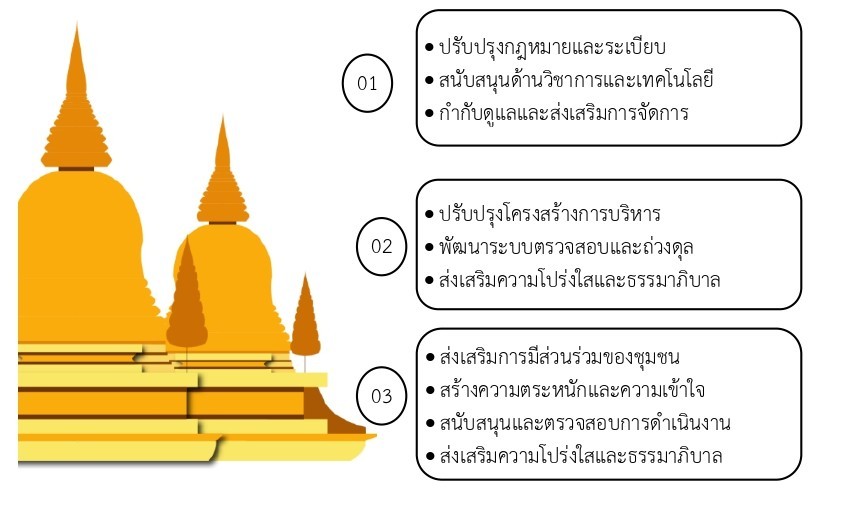
The research findings revealed that: 1. The management of monastery assets should adhere to three principles: the integration of Buddhist principles, legal principles (the Sangha Act of 1962), and modern management principles. This included systematic and transparent practices in four areas: finance, land, religious property, and income, requiring cooperation from all sectors. 2. The model for a monastery asset management office aimed to improve efficiency and transparency. This must begin with obtaining approval from the Supreme Sangha Council, establishing an organizational structure at the provincial level, developing a database system using technology, building collaborative networks with the government and private sectors, and continuous monitoring and evaluation. 3. Policy recommendations encompassed three groups: the Sangha should establish a provincial-level monastery asset management office and develop a governance oversight system; the government should amend the law (the Sangha Act) and provide academic and technological support; and civil society should promote constructive participation and oversight.
References
กนก แสนประเสริฐ และคณะ. (2545). การจัดการดูแลทรัพย์สินและศาสนสมบัติของวัด (รายงานวิจัย). กรุงเทพฯ: สถาบันบัณฑิตพัฒนบริหารศาสตร์.
ณดา จันทร์สม และคณะ. (2556). รูปแบบการจัดการปัญหาการบุกรุกที่ดินของวัด. วารสารศิลปากรศึกษาศาสตร์วิจัย, 5(2), 334–335.
ณดา จันทร์สม. (2555). การบริหารการเงินของวัดในประเทศไทย: ความสอดคล้องตามหลักธรรมาภิบาล. วารสารพัฒนบริหารศาสตร์, 54(1), 107-141.
พระมหาธฤติ วิโรจโน. (2557). รูปแบบการพัฒนาพระสังฆาธิการเพื่อประสิทธิภาพการบริหารกิจการคณะสงฆ์ (วิทยานิพนธ์พุทธศาสตรดุษฎีบัณฑิต สาขาวิชารัฐประศาสนศาสตร์). พระนครศรีอยุธยา: มหาวิทยาลัยมหาจุฬาลงกรณราชวิทยาลัย.
พระมหาสุนันท์ สุนนฺโท. (2557). การพัฒนารูปแบบการจัดการศาสนสมบัติของวัดในจังหวัดพระนครศรีอยุธยา (วิทยานิพนธ์พุทธศาสตรดุษฎีบัณฑิต สาขาการจัดการเชิงพุทธ). พระนครศรีอยุธยา: มหาวิทยาลัยมหาจุฬาลงกรณราชวิทยาลัย.
พระมหาสุระ ญาณธโร และคณะ. (2560). การทุจริตการเงินของวัดในจังหวัดนครปฐม. วารสารสมาคมนักวิจัย, 22(2), 124–125.
พระวีรชน ฐิตวีรชโน. (2561). การบริหารการเงินของวัดตามหลักธรรมาภิบาลในอำเภอบางปะอิน จังหวัดพระนครศรีอยุธยา (วิทยานิพนธ์พุทธศาสตรดุษฎีบัณฑิต สาขาวิชารัฐประศาสนศาสตร์). พระนครศรีอยุธยา: มหาวิทยาลัยมหาจุฬาลงกรณราชวิทยาลัย.
พระอำนวย หมอกเมฆ. (2553). กลยุทธ์การบริหารวัดในพระพุทธศาสนาสำหรับเจ้าอาวาสวัดราษฎร์ในเขตหนเหนือ ภาค 4. วารสารสักทอง, 19(1), 73-90.
Downloads
Published
How to Cite
Issue
Section
Categories
License
Copyright (c) 2026 Academic Journal of Political Science and Public Administration

This work is licensed under a Creative Commons Attribution-NonCommercial-NoDerivatives 4.0 International License.