THE DEVELOPMENT OF LOCAL GOVERNMENT ORGANIZATIONS IN PHETCHABURI USING WISDOM AND MORALITY AS THE FOUNDATION
Keywords:
Local Governance, Wisdom, Ethics, Good Governance, Buddhist PrinciplesAbstract
Objectives of this research article were: 1. To study the current situation, problems, obstacles, and development guidelines for local government administration; 2. To synthesize (deconstruct) the process of developing local government administration; and 3. To propose a model for local government administration based on wisdom and morality in Phetchaburi Province. A qualitative research methodology was used, collecting data from eight local government organizations, namely sub-district municipalities and sub-district administrative organizations, through in-depth interviews, focus group discussions, and field observation.
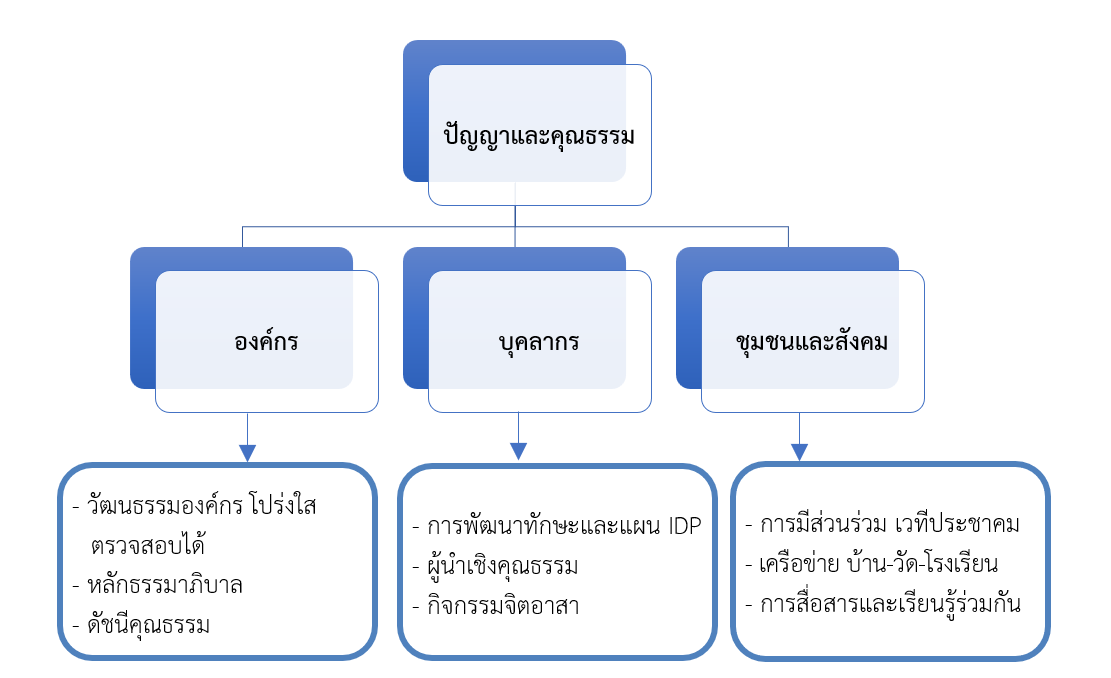
The research findings indicate that: 1. The administration of local government organizations in Phetchaburi Province based on wisdom and morality is a guideline consistent with the Thai local context and is practically implementable. It promotes transparency, trust, and public participation. If continuously developed, it will become a sustainable model of local administration based on “wisdom” and “morality.” 2. The research synthesizes the “Phetchaburi Wisdom and Morality Governance Model,” driven through six steps (wisdom-leadership-participation-good governance-culture-learning), integrating Buddhist principles into administration to create transparent and strong organizations based on the concept of “manage with wisdom, lead with morality.” “Development through Participation” towards Local Sustainability: 3. This model is based on Buddhist principles, including the Four Noble Truths, the Four Sublime States of Mind, the Four Principles of Social Harmony, and the principles of good governance. Its key concept is “Manage with wisdom, lead with virtue, foster participation, and develop sustainably”, reflecting a holistic approach to local administration that integrates intellectual reasoning with spiritual values, leading to transparent, fair, and truly trustworthy governance.
References
ชาญยุทธ หาญชนะ. (2567). การบริหารตามหลักธรรมาภิบาลที่ส่งผลต่อประสิทธิภาพขององค์กรปกครองส่วนท้องถิ่น. วารสารการบริหารการศึกษาและภาวะผู้นำ, 12(48), 350–359.
ถวิลวดี บุรีกุล. (2552). การมีส่วนร่วมของประชาชนในกระบวนการนโยบายสาธารณะ. นนทบุรี: สถาบันพระปกเกล้า.
ธนกร ชูสุขเสริม และพระมหาวิรุธ วิโรจโน. (2565). ธรรมาภิบาลกับการมีส่วนร่วมของประชาชนในการบริหารจัดการองค์กรปกครองส่วนท้องถิ่นไทย. วารสารพุทธศาสตร์ มจร.อุบลราชธานี, 4(2), 581–594.
มณฑิรา มีรส. (2559). รูปแบบการประยุกต์ใช้หลักธรรมาภิบาลในการบริหารงานองค์การบริหารส่วนจังหวัด: กรณีศึกษา จังหวัดปราจีนบุรี. วารสารวิชาการมนุษยศาสตร์และสังคมศาสตร์, 24(44), 105–120.
สำนักงานคณะกรรมการป้องกันและปราบปรามการทุจริตแห่งชาติ (ป.ป.ช.). (2567). รายงานประจำปีเกี่ยวกับการร้องเรียนทุจริตระดับท้องถิ่น. กรุงเทพฯ: สำนักงานคณะกรรมการป้องกันและปราบปรามการทุจริตแห่งชาติ.
สำนักงานคณะกรรมการพัฒนาระบบราชการ. (2560). หลักธรรมาภิบาลของการบริหารกิจการบ้านเมืองที่ดี. กรุงเทพฯ: สำนักงานคณะกรรมการพัฒนาระบบราชการ.
_____. (2566). รายงานแนวทางธรรมาภิบาลขององค์กรภาครัฐ. กรุงเทพฯ: สำนักงานคณะกรรมการพัฒนาระบบราชการ.
สำนักงานส่งเสริมการปกครองท้องถิ่นจังหวัดเพชรบุรี. (2567). รายงานการประเมินประสิทธิภาพการบริหารขององค์กรปกครองส่วนท้องถิ่นจังหวัดเพชรบุรี. เพชรบุรี: สำนักงานส่งเสริมการปกครองท้องถิ่นจังหวัดเพชรบุรี.
อภิชัย พิทยานนทกุล. (2566). ธรรมาภิบาลกับการบริหารงานองค์กรปกครองส่วนท้องถิ่นไทย. วารสารวิชาการรัฐศาสตร์และรัฐประศาสนศาสตร์, 5(2), 1–12.
อรนันท์ กลันทปุระ และปฏิภาณ ชัยเสนา. (2565). การมีส่วนร่วมของประชาชนในการปกครองส่วนท้องถิ่น กรณีศึกษา องค์การบริหารส่วนตำบลรำพัน อำเภอท่าใหม่ จังหวัดจันทบุรี. วารสารพุทธนวัตกรรมและการจัดการ, 5(2), 69–80.
Denhardt, J. V. & Denhardt, R. B. (2000). The New Public Service: Serving Rather Than Steering. New York: M.E. Sharpe.
Osborne, D. & Gaebler, T. (1992). Reinventing Government: How The Entrepreneurial Spirit is Transforming the Public Sector. New York: Addison-Wesley.
Putnam, R. D. (1993). Making Democracy Work: Civic Traditions in Modern Italy. Princeton. New York: Princeton University Press.
UNDP. (2018). Governance for Sustainable Development: Principles and Practices. New York: United Nations Development Programme.
Downloads
Published
How to Cite
Issue
Section
Categories
License
Copyright (c) 2026 Academic Journal of Political Science and Public Administration

This work is licensed under a Creative Commons Attribution-NonCommercial-NoDerivatives 4.0 International License.