STATE CAPTURE: WHEN CRIMINAL CAPITAL BUYS STATE POWER
Keywords:
State Capture, Rule of Law, Political LegitimacyAbstract
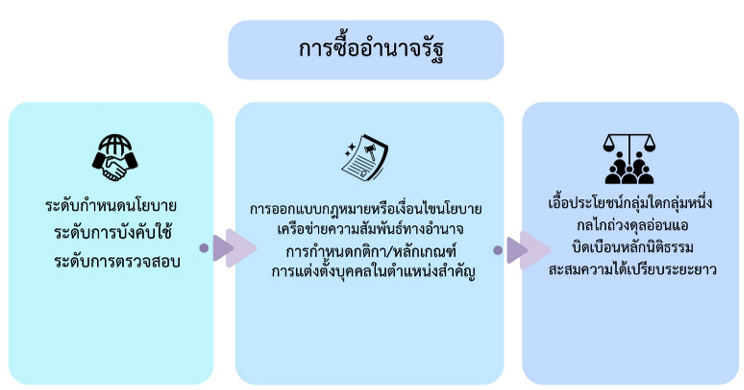
This article aims to examine the phenomenon of “state capture” and its impacts on the rule of law and the legitimacy of democratic governance. State capture constitutes a distortion of sovereign power and occurs when specific interest groups exert undue influence over the formulation of laws, public policies, and the direction of state administration. As a result, the exercise of state power no longer reflects the will of the people in accordance with the principles of the rule of law and the constitution, but instead serves the interests of powerful elites. This study is based on documentary research drawing on books, textbooks, academic articles, research studies, official documents, and electronic media from both Thai and international sources. The data, comprising both primary and secondary sources, are analyzed and synthesized using a descriptive research method. The findings indicate that state capture involves the systematic infiltration of interest groups into policymaking processes, legislative frameworks, and state institutions in order to secure particularistic benefits. Such practices undermine the independence of the state and transform it into an instrument of capital, thereby distorting the rule of law and the sovereign will of the people. Accordingly, this article seeks to elucidate the phenomenon of state capture, its processes, indicators, and resulting impacts. It further emphasizes the necessity of preventing state capture under the rule of law through robust legal and constitutional mechanisms, alongside strengthening civil society participation in monitoring, oversight, and inclusive decision-making. These measures are essential to safeguarding and sustaining democratic governance.
References
ดาวน้อย สุทธินิภาพันธ์. (2560). หลักประชาธิปไตย สิทธิและเสรีภาพในสังคมพหุลักษณ์ (รายงานการอบรม). กรุงเทพฯ: สำนักงานศาลรัฐธรรมนูญ.
ศาลรัฐธรรมนูญ. (ม.ป.ป.). หลักนิติธรรมตามรัฐธรรมนูญแห่งราชอาณาจักรไทย. สืบค้น 9 พฤศจิกายน 2568, จาก https://occ_th.constitutionalcourt.or.th/
ศิริ พันธ์ทา. (2561). รัฐและการจัดระเบียบของรัฐ. Journal of Modern Learning Development, 3(1), 28–42.
สฤณี อาชวานันทกุล. (2565). การยึดกุมกลไกกำกับดูแล (Regulatory Capture). สืบค้น 6 พฤศจิกายน 2568, จาก https://shorturl.asia/U9MeV
รณชัย โตสมภาค. (2560). ประชาธิปไตย. สืบค้น 9 พฤศจิกายน 2568, จาก https://shorturl.asia/qvJob
Cheryl Saunders & Katrina Malone. (2025). State Capture: How to Recognize and React to It. Retrieved November 6, 2025, from https://shorturl.asia/ugvsM
Dávid-Barrett, E. (2023). State Capture and Development: A Conceptual Framework. Retrieved November 6, 2025, from https://shorturl.asia/vY2i5
Hegde, V. (2024). Political Lobbying and Why It’s Necessary. Retrieved November 9, 2025, from https://callhub.io/blog/advocacy/political-lobbying/
Pasculli, L. (2020). The Corruption of The Law: The Effects of Lawmaking on Systemic Corruption. Retrieved November 9, 2025, from https://shorturl.asia/ai2Lz
Patterson, E. (n.d.). What is State Capture. Retrieved November 6, 2025, from https://www.state-capture.org/blog/whatisstatecapture
Stanford Encyclopedia of Philosophy. (2024). Democracy. Retrieved November 9, 2025, from http://plato.stanford.edu/entries/democracy/
Downloads
Published
How to Cite
Issue
Section
Categories
License
Copyright (c) 2026 Academic Journal of Political Science and Public Administration

This work is licensed under a Creative Commons Attribution-NonCommercial-NoDerivatives 4.0 International License.