A CRITIQUE OF HOBBES, LOCKE, AND ROUSSEAU’S SOCIAL CONTRACT THEORIES AND THE LEGITIMACY OF THE MODERN STATE
Keywords:
State Legitimacy, Political Consent, Hypothetical Consent, Institutional Governance, Structural InequalityAbstract
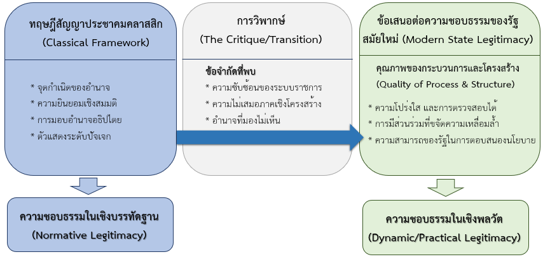
This article is a theoretical academic study that aims to analyze and critically examine the concept of state legitimacy within the framework of social contract theory as developed by Thomas Hobbes, John Locke, and Jean-Jacques Rousseau. The analysis focuses on three key dimensions: assumptions about human nature, forms of sovereignty, and the status of citizens as providers of political consent. The article employs conceptual analysis and theoretical comparison to explore both the shared foundations and the differences among these thinkers as a basis for explaining the legitimacy of the modern state. The findings indicate that, despite important differences, Hobbes, Locke, and Rousseau share a common assumption that links the legitimacy of political authority to the consent of individuals as contracting parties. However, when applied to the context of the modern state where power operates through institutions, public policy, and complex administrative processes this framework proves insufficient in fully explaining the legitimacy of political authority. The critique developed in this article centers on three main issues: the problem of hypothetical consent that lacks procedural manifestation, structural inequalities that render contracting parties unequal in practice, and the limitations of sovereignty-based models in explaining institutional forms of power in contemporary states. In response, the article proposes a shift in evaluating legitimacy from the origin of authority toward the quality of political processes and institutional structures, emphasizing participation, transparency, and the capacity of the state to reduce structural inequalities. This perspective allows for a more grounded understanding of legitimacy in relation to the dynamics of contemporary society.
References
ชัยณรงค์ ศรีมันตะ. (2563). ธรรมชาติมนุษย์ในปรัชญาของโทมัส ฮอบส์. วารสารวิชาการมนุษยศาสตร์และสังคมศาสตร์ มหาวิทยาลัยบูรพา, 28(1), 48–72.
ศุภชัย ศุภผล. (2562). ปรัชญาการเมืองเบื้องต้น (พิมพ์ครั้งที่ 4). กรุงเทพฯ: สำนักพิมพ์มหาวิทยาลัยรามคำแหง.
อภิรดี โกเฮง และขวัญชนก สายชมภู. (2567). ทฤษฎีสัญญาประชาคมกับอำนาจอธิปไตยของประชาชนไทย. วารสารวิชาการรัฐศาสตร์และรัฐประศาสนศาสตร์, 6(1), 202–210.
รัฐธรรมนูญแห่งราชอาณาจักรไทย พุทธศักราช 2560. (2560, 6 เมษายน). ราชกิจจานุเบกษา. เล่ม 134 ตอนที่ 40 ก. หน้า 1-90.
Foucault, M. (2007). Security, Territory, Population: Lectures at the Collège de France, 1977–1978 (M. Senellart, Ed.; G. Burchell, Trans.). New York: Palgrave Macmillan.
Fraser, N. (2009). Scales of Justice: Reimagining Political Space in A Globalizing World. New York: Columbia University Press.
Hobbes, T. (1996). Leviathan (Original Work Published 1651). Cambridge, England: Cambridge University Press.
Locke, J. (1988). Two Treatises of Government (Original Work Published 1689). Cambridge, England: Cambridge University Press.
Mills, C. W. (1997). The Racial Contract. Ithaca, NY: Cornell University Press.
Pateman, C. (1988). The Sexual Contract. Stanford, CA: Stanford University Press.
Rousseau, J.-J. (2011). The Social Contract (Original Work Published 1762). London: Penguin Books.
Downloads
Published
How to Cite
Issue
Section
License
Copyright (c) 2026 Academic Journal of Political Science and Public Administration

This work is licensed under a Creative Commons Attribution-NonCommercial-NoDerivatives 4.0 International License.