INTEGRATED SECURITY DEVELOPMENT IN BORDERLANDS UNDER THE CONTEXT OF CROSS-BORDER CONFLICT: A CASE STUDY OF MAE SOT DISTRICT, TAK PROVINCE
Keywords:
Human Security, Thai–Myanmar Border, Area-based Governance, Mae SotAbstract
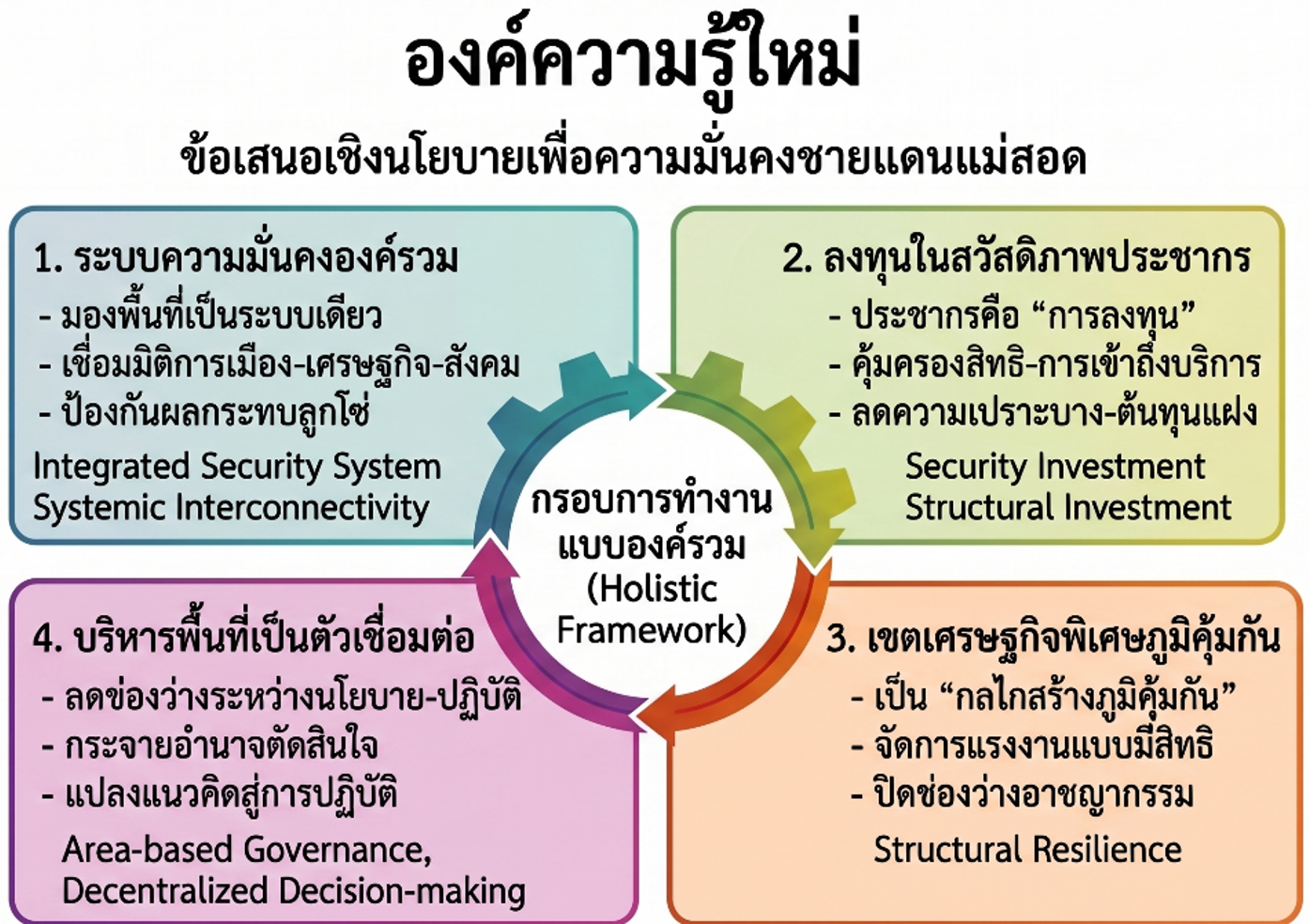
Border management along the Thai-Myanmar frontier currently faces complex, multi-dimensional cross-border vulnerabilities. Analyzing security in the Mae Sot District of Tak Province through the lenses of Human Security and Securitization Theory reveals a critical need to transcend traditional, state-centric security paradigms. This necessitates an integrated analytical approach encompassing political, economic, social, health, and environmental dimensions. The prevailing challenges in the region stem not only from external conflicts but also from structural constraints within the fragmented Thai bureaucratic system, which often result in a lack of policy unity and continuity. Transforming borderlands from "risk zones" into "strategic areas of opportunity" requires a paradigm shift toward Area-based Governance with genuine decision-making authority. Furthermore, the role of Special Economic Zones must be redefined as instruments for structural resilience. Systematically integrating state security with human security within policy design serves as a vital condition for achieving sustainable security and development in border regions.
References
สำนักงานสภาความมั่นคงแห่งชาติ. (2568). คำแถลงการณ์ สำนักงานสภาความมั่นคงแห่งชาติ ประเด็นสถานการณ์บริเวณชายแดนไทย – กัมพูชา. สืบค้นเมื่อ 2 เมษายน 2569 จาก https://shorturl.asia/mr2HP.
สำนักงานสภาพัฒนาการเศรษฐกิจและสังคมแห่งชาติ. (2561). ยุทธศาสตร์ชาติ (พ.ศ. 2561–2580) ฉบับประชาชน. กรุงเทพฯ: สำนักงานสภาพัฒนาการเศรษฐกิจและสังคมแห่งชาติ.
สำนักงานสภาพัฒนาการเศรษฐกิจและสังคมแห่งชาติ. (2565). การค้าชายแดนไทยกับประเทศเพื่อนบ้านประจำปี 2565. กรุงเทพฯ: สำนักงานสภาพัฒนาการเศรษฐกิจและสังคมแห่งชาติ.
Acharya, A. (2001). Constructing a security community in Southeast Asia: ASEAN and the problem of regional order. London: Routledge.
Brauch, H. G. et al. (2011). Coping with global environmental change, disasters and security: Threats, challenges, vulnerabilities and risks. Berlin: Springer-Verlag.
Buzan, B. et al. (1998). Security: A new framework for analysis. Boulder, CO: Lynne Rienner Publishers.
Caballero-Anthony, M. (2010). Non-traditional security challenges, regional governance, and the ASEAN political-security community (APSC). The Pacific Review, 23(2), 165–182.
Commission on Human Security. (2003). Human security now. New York: United Nations.
Duffield, M. (2007). Development, security and unending war: Governing the world of peoples. Cambridge: Polity Press.
International Organization for Migration (IOM). (2022). World migration report 2022. Geneva: International Organization for Migration.
Newman, E. (2010). Critical human security studies. Review of International Studies, 36(1), 77–94.
_____. (2011). A human security interpretation of international conflict. International Studies Review, 13(2), 346–347.
Paris, R. (2001). Human security: Paradigm shift or hot air?. International Security, 26(2), 87–102.
United Nations Development Programme (UNDP). (1994). Human development report 1994: New dimensions of human security. New York: Oxford University Press.
Downloads
Published
How to Cite
Issue
Section
Categories
License
Copyright (c) 2026 Academic Journal of Political Science and Public Administration

This work is licensed under a Creative Commons Attribution-NonCommercial-NoDerivatives 4.0 International License.