PARTICIPATORY SOLID WASTE MANAGEMENT AT THE SUBDISTRICT LEVEL, A CASE STUDY OF BAN PHO SUBDISTRICT MUNICIPALITY, MUEANG DISTRICT, NAKHON RATCHASIMA PROVINCE
Keywords:
Solid Waste Management, Public Participation, Local Government, Ban Pho Subdistrict MunicipalityAbstract
This research article aimed to 1. assess the situation and problems surrounding solid waste management in Ban Pho Subdistrict Municipality; 2. investigate the forms of public participation in solid waste management; and 3. propose appropriate approaches for enhancing public participation in waste management within the study area. The study employs a qualitative research methodology under an interpretive paradigm. Data were collected from 40 key informants through in-depth interviews and analyzed using descriptive analysis in conjunction with triangulation techniques.
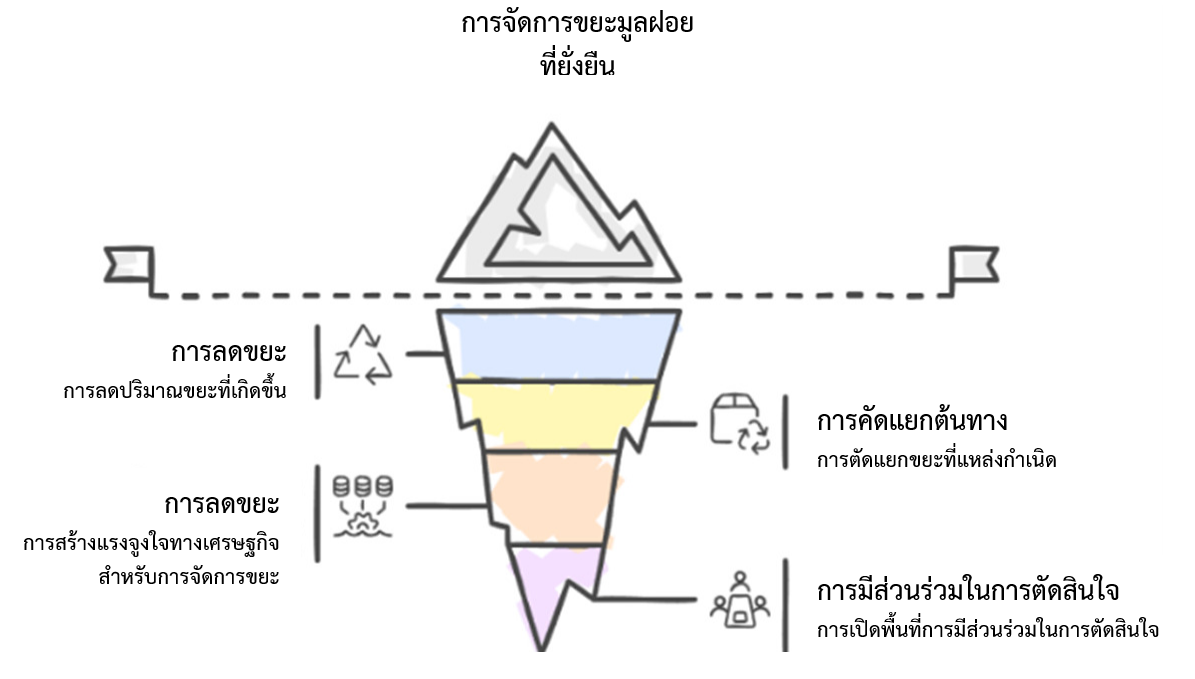
The research findings revealed that: 1. the volume of solid waste in the area has continuously increased, with the majority consisting of general waste and organic household garbage. Waste separation at the source remains unsystematic, resulting in a significant management burden on the local government; 2. public participation occurs at four levels, namely information receiving, consultation, public hearings, and decision-making. However, deeper levels of participation remain limited and are largely conducted through community representatives rather than direct involvement; and 3. appropriate approaches to promote participation include promoting waste reduction based on the 3R principles, encouraging source separation, establishingg community-based waste banks, and creating participatory platforms that enable citizens to engage in planning and rule-setting processes alongside local authorities. From an analytical perspective, the study highlights a critical gap between “awareness” and “practice,” as well as limitations in participatory mechanisms that do not sufficiently facilitate genuine shared decision-making. Therefore, sustainable waste management requires an integrated approach that combines behavioral change based on the 3R principles with the strengthening of participatory empowerment mechanisms.
References
กรมควบคุมมลพิษ. (2567). รายงานสถานการณ์มลพิษของประเทศไทย ปี 2567. สืบค้นเมื่อ 19 มกราคม 2569 จาก https://www.pcd.go.th/publication/30311/.
ชฎาพร ยางเงิน. (2568). การศึกษาแนวทางการจัดการขยะมูลฝอยในชุมชนเทศบาลร่วมใจสามัคคี อำเภอเมือง จังหวัดยโสธร. Journal of Academic and Research in Social Sciences, 1(1), 1–9.
ชาย โพธิสิตา. (2564). ศาสตร์และศิลป์การวิจัยเชิงคุณภาพ (พิมพ์ครั้งที่ 9). กรุงเทพฯ: อมรินทร์พริ้นติ้ง แอนด์ พับลิชซิ่ง.
ณัชชา ปริเปรมกุล และจิรวัฒน์ เมธาสุทธิรัตน์. (2568). ปัจจัยที่ส่งผลต่อการมีส่วนร่วมของประชาชนในการจัดการขยะมูลฝอยในชุมชนเทศบาลเมืองเบตง จังหวัดยะลา. Journal of Public Policy and Public Affairs, 4(1), 41–62.
ตรียากานต์ พรมคำ. (2563). การศึกษาสภาพปัญหาการจัดการขยะมูลฝอยในเขตเทศบาลเมืองเพชรบูรณ์ จังหวัดเพชรบูรณ์. Research Community and Social Development Journal, 14(4), 52–62.
เทศบาลตำบลบ้านโพธิ์. (2566). สภาพทั่วไป. สืบค้นเมื่อ 19 มกราคม 2569 จาก https://shorturl.asia/Y7Rgl.
ธงพล พรหมสาขา ณ สกลนคร. (2562). แนวทางการส่งเสริมแนวคิดระบบเศรษฐกิจหมุนเวียนขององค์กรปกครองส่วนท้องถิ่นเพื่อการพัฒนาชุมชนอย่างยั่งยืน (วิทยานิพนธ์ปริญญาศิลปศาสตรมหาบัณฑิต สาขาวิชาพัฒนามนุษย์และสังคม). กรุงเทพฯ: จุฬาลงกรณ์มหาวิทยาลัย.
นันทะ บุตรน้อย และคณะ. (2567). การตรวจสอบสามเส้าในการวิจัยทางสังคมศาสตร์. วารสารมณีเชษฐาราม วัดจอมมณี, 7(6), 1184–1198.
พรพิมล อริยะวงษ์ และคณะ (2567). แนวทางการบริหารจัดการขยะสำหรับองค์กรปกครองส่วนท้องถิ่นกรณีศึกษาเทศบาลเมืองพิชัย จังหวัดลำปาง. วารสารการพัฒนาชุมชนและคุณภาพชีวิต, 12(1), 70–85.
ศิริชัย จันพุ่ม และคณะ. (2568). การศึกษาสภาพปัญหาและความต้องการในการจัดการขยะของชุมชนในเขตเทศบาลจังหวัดขอนแก่น. วารสารศูนย์อนามัยที่ 9, 19(2), 551–567.
ศูนย์วิจัยกสิกรไทย. (2567). ธุรกิจเชื้อเพลิงขยะยังคงเติบโต แรงหนุนพลังงานจากขยะของภาครัฐเพื่อจัดการปัญหาขยะ และการเปลี่ยนถ่ายไปสู่พลังงานทดแทน. สืบค้นเมื่อ 19 มกราคม 2569 จาก https://www.kasikornresearch.com.
สมประสงค์ กลิ่นจันทร์ และจักรวาล สุขไมตรี. (2568). แนวทางการจัดการขยะมูลฝอยของเทศบาลเมืองท่าโขลง อำเภอคลองหลวง จังหวัดปทุมธานี. วารสารส่งเสริมและพัฒนาวิชาการสมัยใหม่, 3(4), 522–536.
สำนักงานเลขาธิการสภาผู้แทนราษฎร. (2560). รัฐธรรมนูญแห่งราชอาณาจักรไทย พุทธศักราช 2560. กรุงเทพฯ: สำนักงานเลขาธิการสภาผู้แทนราษฎร.
Amasuomo, E. & Baird, J. (2016). The Concept of Waste and Waste Management. Journal of Management and Sustainability, 6(4), 88–96.
Arnstein, S. R. (1969). A Ladder of Citizen Participation. Journal of the American Planning Association, 35(4), 216–224.
Habermas, J. (1984). The Theory of Communicative Action: Volume 1. Reason and The Rationalization of Society. Boston, MA: Beacon Press.
Miezah, K. et al. (2015). Municipal solid waste characterization and quantification as a measure towards effective waste management in Ghana. Waste Management, 46, 15–27.
Pretty, J. N. (1995). Participatory Learning for Sustainable Agriculture. World Development, 23(8), 1247–1263.
Rogers, E. M. (2003). Diffusion of Innovations (5th ed.). New York: Free Press.
Rowe, G. & Frewer, L. J. (2000). Public Participation Methods: A Framework for Evaluation. Science, Technology, & Human Values, 25, 3–29.
Downloads
Published
How to Cite
Issue
Section
Categories
License
Copyright (c) 2026 Academic Journal of Political Science and Public Administration

This work is licensed under a Creative Commons Attribution-NonCommercial-NoDerivatives 4.0 International License.