CROSS-BORDER ENVIRONMENTAL GOVERNANCE IN MANAGING CONTAMINANT PROBLEMS IN WATER RESOURCES IN THE UPPER NORTHERN REGION
Keywords:
Cross-Border Environmental Governance, Contaminant Management, Upper Northern Water Resources Thailand, Kok River BasinAbstract
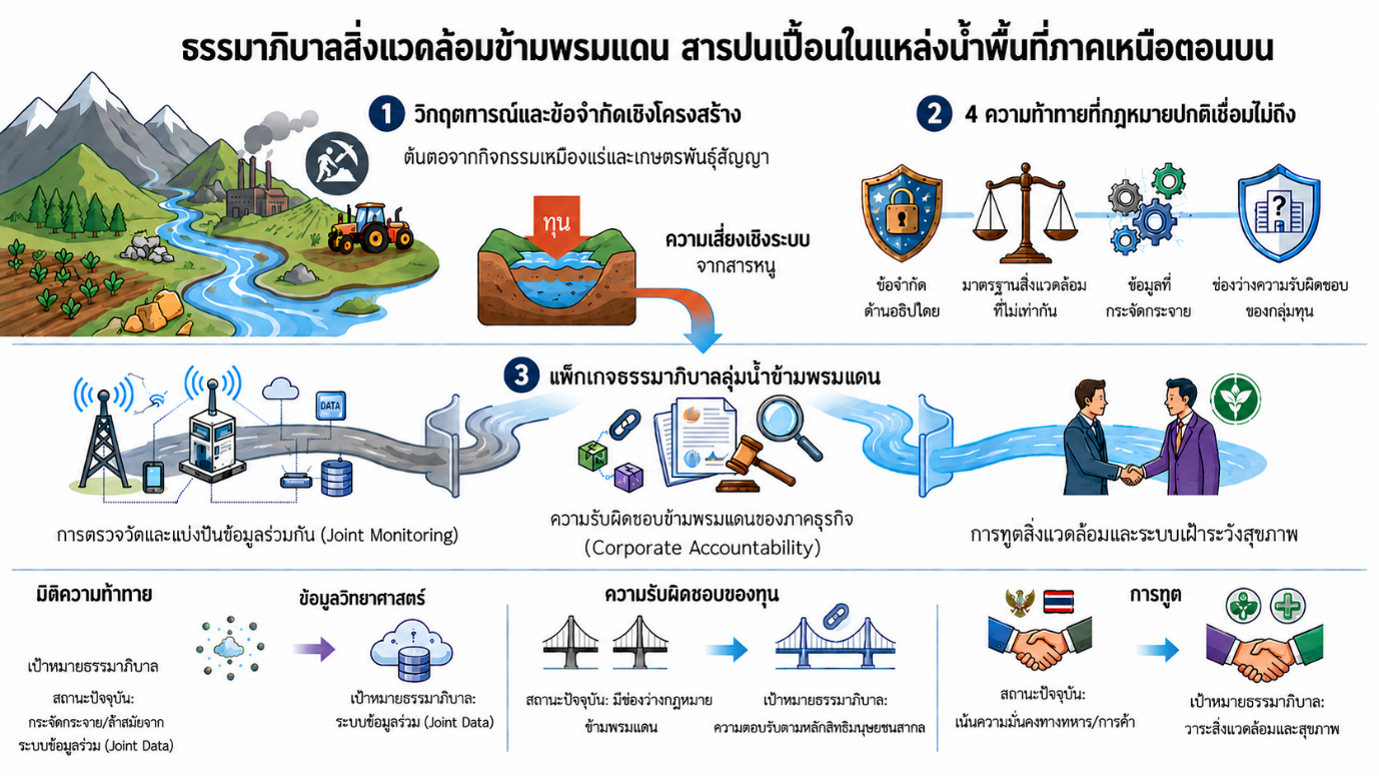
This article analyzes the crisis of arsenic and pollutant contamination in the river basin systems of Upper Northern Thailand, which have transboundary connections with Myanmar and Laos, through the conceptual framework of transboundary environmental governance. The study aims to explain the sources of contamination, analyze governance challenges, and propose policy guidelines. The findings reveal that the degradation of river basins is a consequence of the dynamics of border capitalism. The primary sources of contamination originate from mining activities and upstream land clearing, compounded by ecological pressures from agricultural chemicals in contract farming systems and waste management issues from twin border cities. Managing this crisis transcends the dimensions of environmental science, extending into four key structural challenges: 1. Sovereignty constraints and the complex security landscape in neighboring states; 2. the asymmetry of environmental standards between countries; 3. the lack of a systematic, shared scientific database; and 4. the accountability gap of transnational capital groups that domestic laws cannot reach. Consequently, this article proposes elevating the management approach from reactive measures to a comprehensive transboundary river basin governance package. This includes four key dimensions: driving joint monitoring and data-sharing mechanisms; enforcing extraterritorial corporate responsibility laws throughout the supply chain; elevating environmental diplomacy alongside the support of Track 2 Diplomacy; and integrating environmental management with public health surveillance and community remediation systems. These measures aim to establish a collaborative river basin resource management structure that is efficient, transparent, and sustainable.
References
กรมควบคุมโรค. (2568). กรมควบคุมโรค เตือนภัยสารหนูปนเปื้อนในแม่น้ำกก แนะประชาชนหลีกเลี่ยงการใช้น้ำจากแหล่งน้ำเสี่ยง พร้อมติดตามอาการผิดปกติอย่างใกล้ชิด. สืบค้นเมื่อ 9 มีนาคม 2569 จาก https://www.ddc.moph.go.th/brc/news.php?deptcode=brc&news=52866.
_____. (2569). กรมควบคุมโรคขยายผลการเฝ้าระวังสุขภาพประชาชน กรณีผลศึกษาพบสารหนูในพื้นที่ลุ่มน้ำกก พร้อมดูแลประชาชนกลุ่มเสี่ยงอย่างใกล้ชิด. สืบค้นเมื่อ 9 มีนาคม 2569 จาก https://ddc.moph.go.th/brc/news.php?deptcode=brc&news=58852&news_views=599.
กรมคุ้มครองสิทธิและเสรีภาพ. (2566). แผนปฏิบัติการระดับชาติว่าด้วยธุรกิจกับสิทธิมนุษยชน ระยะที่ 2 (พ.ศ. 2566–2570). สืบค้นเมื่อ 9 มีนาคม 2569 จาก https://www5.dpim.go.th/km/2023/09/20/.
วสันต์ ปวนปันวงศ์. (2561). ยุทธศาสตร์ความร่วมมือทางเศรษฐกิจ อิรวดี-เจ้าพระยา-แม่โขง : การเปลี่ยนแปลงของสังคมเกษตรกรในการทำเกษตรแบบพันธะสัญญาในพื้นที่ชายแดนไทย-เมียนมาร์. วารสารสุโขทัยธรรมาธิราช, 31(2), 44–64.
สำนักงานสิ่งแวดล้อมและควบคุมมลพิษที่ 1 (เชียงใหม่). (2568). สถานการณ์คุณภาพสิ่งแวดล้อมในแม่น้ำกกและลำน้ำสาขา แม่น้ำสาย แม่น้ำรวก แม่น้ำโขง และผลกระทบกรณีปัญหาสารปนเปื้อนเกินค่ามาตรฐาน. กรุงเทพฯ: สืบค้นเมื่อ 9 มีนาคม 2569 จาก https://shorturl.asia/XM8Ps.
ASEAN Environment Knowledge Hub. (2022). Water Resources Management About. Retrieved March 9, 2026, from https://environment.asean.org/water-resource-management/about.
International Crisis Group. (2024). Ethnic Autonomy and Its Consequences in Post-Coup Myanmar. Retrieved March 9, 2026, from https://www.crisisgroup.org/brf/asia/south-east-asia/myanmar/b180-ethnic-autonomy-and-its-consequences-post-coup-myanmar.
Jepsen, M. R. et al. (2019). What awaits Myanmar’s uplands farmers? Lessons learned from Mainland Southeast Asia. Land, 8(2), 1–23.
Mekong River Commission. (2025). Mekong River Commission Addresses Kok River Water Quality Concerns, Regional Meeting Set for Next Steps. Retrieved March 9, 2026, from https://shorturl.asia/dtY84.
_____. (2025). Mekong River Commission Updates on Response to Arsenic Contamination in The Mekong River. Retrieved March 9, 2026, from https://shorturl.asia/9Kpi7.
Office of the United Nations High Commissioner for Human Rights. (2011). Guiding Principles on Business and Human Rights: Implementing The United Nations “Protect, Respect and Remedy” Framework. New York, NY: United Nations.
_____. (2022). Extraterritorial Application of Human Rights Requires Multilateral Approach – UN Expert. Retrieved March 9, 2026, from https://shorturl.asia/fXPLu.
Organisation for Economic Co-operation and Development. (2015). OECD Principles on Water Governance. Retrieved from https://shorturl.asia/N92HL.
_____. (2018). OECD Due Diligence Guidance for Responsible Business Conduct. Paris, France: OECD Publishing.
_____. (2021). Water Governance in Asia-Pacific. Paris, France: OECD Publishing.
Pounpunwong, W. (2025). Contract Farming: States, Capitalists, and Farmers on The Mae Sot, Thailand-Myawaddy Myanmar Border. Burapha Journal of Political Economy, 13(1), 108–128.
Downloads
Published
How to Cite
Issue
Section
License
Copyright (c) 2026 Academic Journal of Political Science and Public Administration

This work is licensed under a Creative Commons Attribution-NonCommercial-NoDerivatives 4.0 International License.