DEVELOPMENT OF GUIDELINES FOR WATER RESOURCE MANAGEMENT IN CRITICAL DROUGHT NAKON RATCHASIMA’S N0N-IRRIGATION AREA
Keywords:
Water Resource Management, Drought Risk, Non-Irrigation Areas, Drought Management, Community ParticipationAbstract
This research article aimed to develop guidelines for water resource management in critical drought Nakhon Ratchasima’s non-irrigation areas. This study uses qualitative research methods, applying a participatory action research approach. Data were collected from 68 key informants at four levels, including household, community, local administrative, and provincial levels. Research instruments consisted of document analysis, in-depth interviews, group interviews, field observations, and participatory workshops. Data were analyzed using content analysis and analytical description. The study was conducted from April 2020 to October 2021 in communities outside irrigation zones that had experienced drought more than five times during 2011–2019.
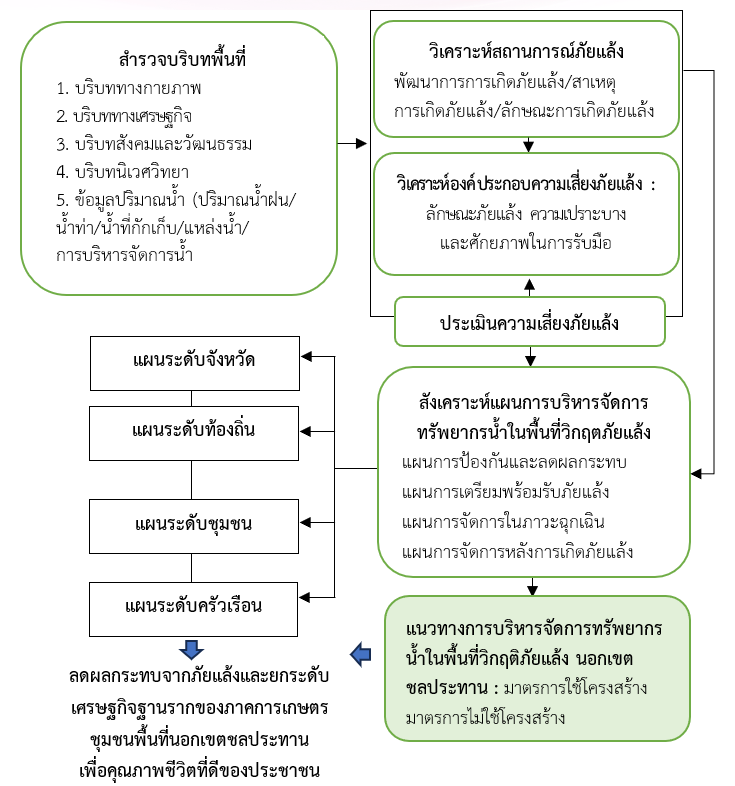
The findings revealed that drought risk in the study areas resulted from the interaction among drought characteristics, physical and social vulnerability, and coping capacity limitations. The proposed water resource management guidelines were linked to the National Disaster Prevention and Mitigation Plan B.E. 2564–2570 and consisted of two major approaches: structural measures and non-structural measures. Structural measures included the development of waterway network systems, water allocation systems, monkey-cheek retention areas, and the enhancement of water conveyance routes. Non-structural measures including the promotion of drought risk assessment, the preparation of maps showing water flow routes and risk-prone areas, the promotion of community-based water management systems, the promotion of knowledge management in water resource management, and the promotion of public participation in water management. The study highlighted that effective water resource management in non-irrigation areas requires the integration of drought risk analysis, adaptive water management, and multi-level participation in order to strengthen long-term water security and community resilience.
References
กัญญาณัฐ จตุเทน. (2566). แนวทางการพัฒนาการจัดการภัยแล้งของครัวเรือนเกษตรกรในพื้นที่ชานเมืองขอนแก่น: กรณีศึกษาบ้านเหล่าเกวียนหัก ตำบลบ้านทุ่ม อำเภอเมืองขอนแก่น จังหวัดขอนแก่น. Journal of Spatial Development and Policy, 1(5), 13–30.
คณะกรรมการป้องกันและบรรเทาสาธารณภัยแห่งชาติ. (2564). แผนการป้องกันและบรรเทาสาธารณภัยแห่งชาติ พ.ศ. 2564-2570. สืบค้นเมื่อ 20 มีนาคม 2569 จาก https://shorturl.asia/3gAOr.
จำลอง โพธิ์บุญ. (2566). การพัฒนาศักยภาพชุมชนในการปรับตัวต่อปัญหาภัยแล้ง: กรณีศึกษาชุมชนสายทอง อำเภอป่าโมก จังหวัดอ่างทอง. วารสารการจัดการสิ่งแวดล้อมและความยั่งยืน, 19(2), 4–27.
จีรนันท์ ยายะวงษ์ และกัมปนาท วงษ์วัฒนพงษ์. (2564). แนวทางการบริหารจัดการปัญหาภัยแล้ง ในเขตพื้นที่องค์การบริหาร ส่วนตำบลโป่งแดงอำเภอเมืองตาก จังหวัดตาก. Journal of Modern Learning Development, 6(2), 86-99.
ชิษณุพงศ์ ยศบุญยืน และคณะ. (2566). การมีส่วนร่วมของประชาชนต่อการแก้ไขปัญหาภัยแล้งแบบยั่งยืนในเทศบาลตำบลทาปลาดุก อำเภอแม่ทา จังหวัดลำพูน. วารสารภูมินิเวศพัฒนาอย่างยั่งยืน, 4(1), 1–14.
แผนพัฒนาเศรษฐกิจและสังคมแห่งชาติ ฉบับที่ 13 (พ.ศ. 2566-2570). (2565, 1 พฤศจิกายน). ราชกิจจานุเบกษา. เล่ม 139 ตอนพิเศษ 258 ง. หน้า 13.
พหลศักดิ์ คะทัศน์ และคณะ. (2565). การจัดการน้ำสำหรับการเกษตรในภาวะภัยแล้งของเกษตรกรผู้ใช้น้ำโครงการส่งน้ำและบำรุงรักษาแม่แฝก–แม่งัด อำเภอสันทราย จังหวัดเชียงใหม่. วารสารวิจัยและส่งเสริมวิชาการเกษตร, 39(3), 169–179.
วรัชยา เชื้อจันทึก และพัชรินทร์ วิทยาเอนกนันท์. (2561). การพัฒนาการบริหารจัดการความเสี่ยงของภาคการเกษตรบนพื้นที่เสี่ยงภัยแล้ง (รายงานผลการวิจัย). กรุงเทพฯ: สำนักงานกองทุนสนับสนุนการวิจัย.
_____. (2562). การพัฒนาแผนการบริหาร จัดการความเสี่ยงของภาคการเกษตรบนพื้นที่เสี่ยงภัยแล้งเพื่อเพิ่มประสิทธิภาพภารกิจการปกครองระดับท้องถิ่น: กรณีศึกษา องค์การบริหารส่วนตำบลกุดพิมาน อำเภอด่านขุนทด จังหวัดนครราชสีมา. วารสารรัฐศาสตร์และรัฐประศาสนศาสตร์, 10(1), 75-94.
วรัชยา เชื้อจันทึก. (2561). การพัฒนารูปแบบการบริหารจัดการทรัพยากรน้ำแบบบูรณาการระดับลุ่มน้ำของลุ่มน้ำลำตะคอง (รายงานผลการวิจัย). กรุงเทพฯ: สำนักงานคณะกรรมการวิจัยแห่งชาติ.
สาธิกา นาวีระ และคณะ. (2564). ความสำเร็จในการปรับตัวต่อผลกระทบจากภัยแล้งของชุมชน: ศึกษากรณี ชุมชนบ้านลิ่มทอง อำเภอนางรอง จังหวัดบุรีรัมย์. วารสารการจัดการสิ่งแวดล้อมและความยั่งยืน, 17(2), 82-95.
สำนักงานป้องกันและบรรเทาสาธารณภัยจังหวัดนครราชสีมา. (2559). สรุปพื้นที่ประสบภัยพิบัติฉุกเฉินเหตุอุทกภัย ประจำปี 2550-2559. นครราชสีมา: สำนักงานป้องกันและบรรเทาสาธารณภัยจังหวัดนครราชสีมา.
Baas, S. et al. (2008). Disaster risk management systems analysis: A guide book.. Retrieved March 20, 2026, from https://www.fao.org/4/i0304e/i0304e.pdf.
Chou, J. S. & Wu, J. H. (2014). Success factors of enhanced disaster resilience in urban communities. Natural Hazards, 74(2), 661–686.
Liu, Y. et al. (2019). Integrated risk assessment for agricultural drought and flood disasters based on entropy information diffusion theory in the middle and lower reaches of the Yangtze River, China. International Journal of Disaster Risk Reduction, 38, 101194.
Lottering, S. J. et al. (2021). Assessing the social vulnerability of small-scale farmers to drought in uMsinga, KwaZulu-Natal. International Journal of Disaster Risk Reduction, 65, 102568.
Sahana. V. et al. (2021). Drought vulnerability and risk assessment in India: Sensitivity analysis and comparison of aggregation techniques. Journal of Environmental Management, 299(1), 113689.
Downloads
Published
How to Cite
Issue
Section
License
Copyright (c) 2026 Academic Journal of Political Science and Public Administration

This work is licensed under a Creative Commons Attribution-NonCommercial-NoDerivatives 4.0 International License.