STRATEGIES FOR DEVELOPING PUBLIC SECTOR PERSONNEL COMPETENCIES TOWARD DIGITAL GOVERNMENT
Keywords:
Public Sector Competency, Digital Government, Digital Leadership, Human Resource DevelopmentAbstract
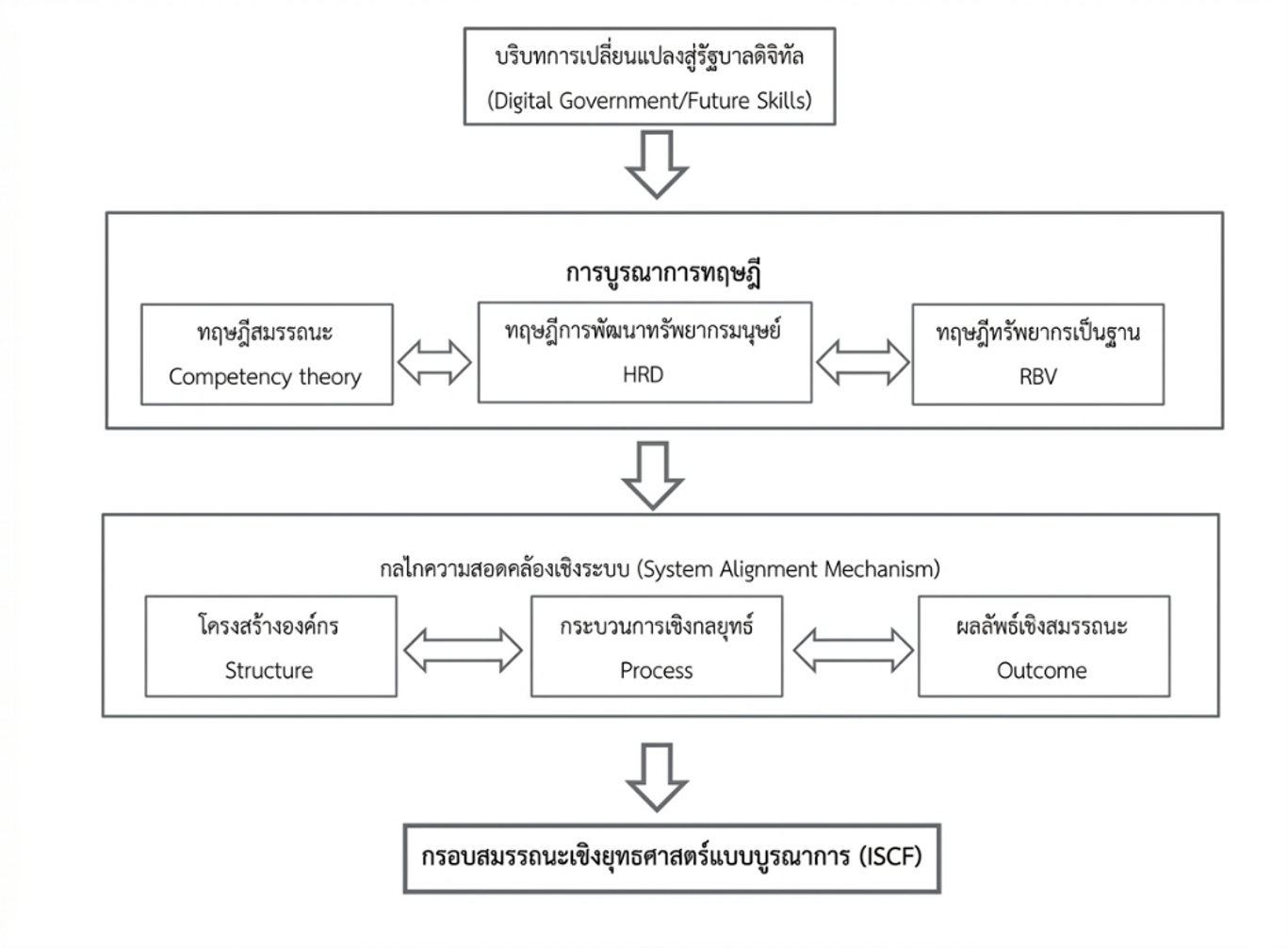
This academic article aims to analyze the development of public sector personnel competencies within the context of the transition toward digital government, which has compelled public organizations to transform their administrative approaches, operational processes, and public service delivery systems in response to rapid technological advancement and the evolving demands of citizens. The success of such transformation does not rely solely on the adoption of digital technologies; rather, it largely depends on the competencies of public sector personnel, which constitute a strategic factor in enabling public organizations to adapt and operate effectively in the digital era. The article synthesizes and critically examines relevant literature, including competency concepts, human resource development theories, and the resource-based view, in order to develop a systemic explanatory framework for public sector competency development. The literature synthesis indicates that the major challenge in developing public sector personnel competencies does not stem from the absence of development activities, but rather from systemic misalignment among organizational structures, development processes, and competency outcomes. Consequently, the potential of personnel cannot be effectively utilized to its fullest capacity. Furthermore, although previous literature has addressed competencies, human resource development, and the strategic value of human resources to a certain extent, it still lacks a comprehensive explanation of the systemic mechanisms that connect these components, particularly within the increasingly complex and rapidly changing context of digital government. Accordingly, this article proposes the Integrated Strategic Competency Framework (ISCF) to explain the systemic relationships among organizational structures, development processes, and competency outcomes. Academically, the proposed framework contributes to reducing the fragmentation of existing knowledge and advances the explanation of competency development from a component-based perspective toward a systemic and mechanistic perspective. Practically, the framework can be applied as a guideline for designing strategic approaches to public sector personnel development that are aligned with the context of digital government and contemporary organizational transformation.
References
วิโรจน์ สารรัตนะ. (2557). ภาวะผู้นำ ทฤษฎีและนานาทัศนะร่วมสมัยปัจจุบัน. กรุงเทพฯ: ทิพย์วิสุทธิ์.
สำนักงานพัฒนารัฐบาลดิจิทัล (องค์การมหาชน). (2566). แผนพัฒนารัฐบาลดิจิทัลของประเทศไทย พ.ศ. 2566-2570. กรุงเทพฯ: สำนักงานพัฒนารัฐบาลดิจิทัล (องค์การมหาชน).
Barney, J. B. (1991). Firm resources and sustained competitive advantage. Journal of Management, 17(1), 99–120.
Boyatzis, R. E. (1982). The competent manager: A model for effective performance. New York: John Wiley & Sons.
______. (2008). Competencies in the 21st century. Journal of Management Development, 27(1), 5-12.
Garavan, T. N. (2007). A strategic perspective on human resource development. Advances in Developing Human Resources, 9(1), 11–30.
Garavan, T. N. et al. (2012). Mapping talent development: Definition, scope and architecture. European Journal of Training and Development, 36(1), 5–24.
Janssen, M. & Estevez, E. (2013). Lean government and platform-based governance—Doing more with less. Government Information Quarterly, 30(Suppl. 1), S1–S8.
McClelland, D. C. (1973). Testing for competence rather than for “intelligence.” American Psychologist, 28(1), 1–14.
Mergel, I. et al. (2019). Defining digital transformation: Results from expert interviews. Government Information Quarterly, 36(4), 101385.
Moynihan, D. P. (2008). The dynamics of performance management: Constructing information and reform. Washington, DC: Georgetown University Press.
Nadler, L. (1984). The handbook of human resource development. New York: John Wiley & Sons.
OECD. (2021). Public employment and management 2021: The future of the public service. Paris: OECD Publishing.
Osborne, S. P. (2010). The new public governance? Emerging perspectives on the theory and practice of public governance. London, UK: Routledge.
Spencer, L. M., Jr. & Spencer, S. M. (1993). Competence at work: Models for superior performance. New York: John Wiley & Sons.
Swanson, R. A. & Holton, E. F., III. (2001). Foundations of human resource development. San Francisco, CA: Berrett-Koehler.
Teece, D. J. (2016). Dynamic capabilities and entrepreneurial management in large organizations: Toward a theory of the (entrepreneurial) firm. European Economic Review, 86, 202–216.
Winter, S. G. (2003). Understanding dynamic capabilities. Strategic Management Journal, 24(10), 991–995.
Downloads
Published
How to Cite
Issue
Section
Categories
License
Copyright (c) 2026 Academic Journal of Political Science and Public Administration

This work is licensed under a Creative Commons Attribution-NonCommercial-NoDerivatives 4.0 International License.