QUALITATIVE ANALYSIS OF THE CONSTITUTION UNDER SECTION 213 TO REDUCE THE JUSTICE ACCESSIBILITY GAP
Keywords:
Qualitative Analysis, Reducing The Gap, Access to Justice, Section 213 of The ConstitutionAbstract
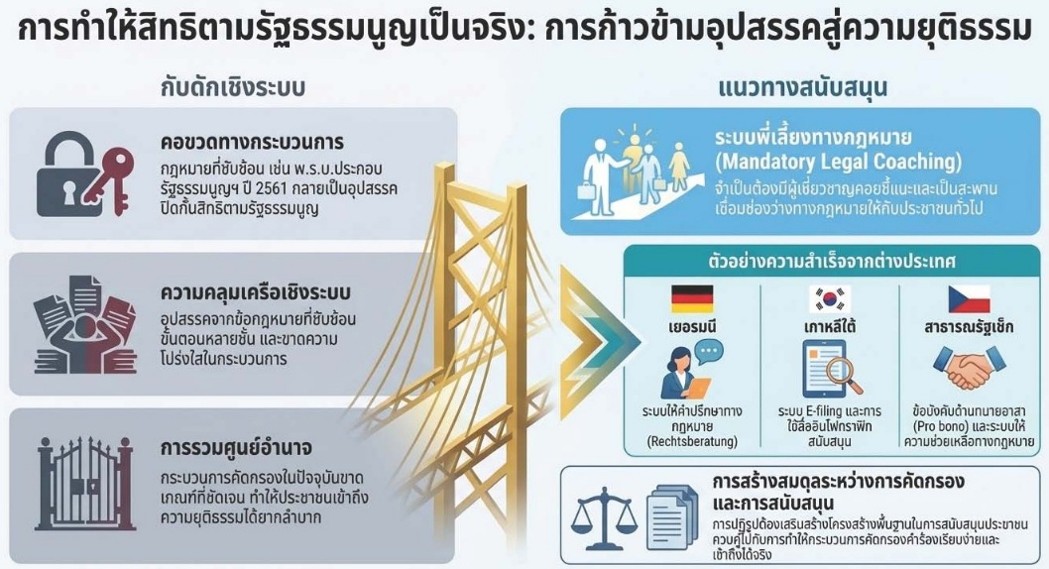
This research article aims to examine structural and practical problems arising from the Organic Act on the Procedures of the Constitutional Court B.E. 2561 (2018), particularly Sections 46–48, including the role of the Ombudsman and the need for support mechanisms for complainants. It also compares such mechanisms with those in foreign jurisdictions to propose reforms that align the system with the intent of Section 213 of the Constitution. This is qualitative research. The population consists of individuals who have submitted or previously submitted petitions to the Constitutional Court, as well as stakeholders in the field of rights and liberties, totaling 51 participants. The research instrument is an interview schedule. Data are collected from documentary research, legal texts, petition statistics, and comparative case studies from Germany, South Korea, and the Czech Republic. Data is analyzed using content analysis, inductive analysis, and categorical classification.
The findings show that 1. Sections 46–48 are complex in language, conditions, and procedures, creating legal and procedural traps that substantially limit the effective exercise of the right to petition under Section 213; 2. the Ombudsman’s role as a mandatory filtering channel produces an institutional bottleneck, adding layers and delays that cause some petitioners to lose opportunities for meaningful redress; 3. petitioners express a clear need for “legal coaching” to help interpret the law, structure petitions, and identify rights-violating acts in a legally relevant way; and 4. comparative lessons indicate that strict screening mechanisms can coexist with strong support structures, such as legal clinics, e-filing systems, and legal aid networks. Key recommendations include establishing a Constitutional Justice Clinic or special service unit to act as a legal coach, transforming the Ombudsman’s role from a mandatory filter to an advisory body, and developing an online interactive system to assist with preliminary screening and structuring of petitions. These measures aim to strengthen the “supportive infrastructure” alongside screening mechanisms, so that the right under Section 213 can move from the level of constitutional text to concrete, exercisable rights in the daily lives of citizens.
References
นภนันทน์ จันทโลธร. (2566). การคุ้มครองสิทธิและเสรีภาพตามรัฐธรรมนูญโดยศาลรัฐธรรมนูญ. วารสารบัณฑิตศึกษานิติศาสตร์, 16(4), 489-518.
วรเจตน์ ภาคีรัตน์. (2553). การร้องทุกข์ทางรัฐธรรมนูญในระบบกฎหมายเยอรมัน : วิเคราะห์เปรียบเทียบการฟ้องคดีโดยประชาชนต่อศาลรัฐธรรมนูญในระบบกฎหมายไทย. วารสารนิติศาสตร์. 39(3), 469-509.
สำนักงานศาลรัฐธรรมนูญ. (2560). รัฐธรรมนูญแห่งราชอาณาจักรไทย พุทธศักราช 2560. กรุงเทพฯ: สำนักงานศาลรัฐธรรมนูญ.
Bobek, M. (2016). Central European judges under the European influence: The transformative power of the EU revisited. Hart Publishing.
Jakab, A. et al. (2017). Comparative constitutional reasoning. Cambridge: Cambridge University Press.
Kim, J. C. (2012). Constitutional Law. Korea Legislation Research Institution. Introduction to Korean Law. Berlin-Heidelberg: Springer.
Kischel, U. (2019). Comparative Law. Oxford, UK: Oxford University Press.
Kokubun, N. (2020). Korean Constitutional Court and democracy. Nagoya University Asian Law Bulletin, 5, 35–51.
Kommers, D. P. (1994). The Federal Constitutional Court in the German political system. Comparative Political Studies, 26, 470.
Kommers, D. P. & Miller, R. A. (2012). The constitutional jurisprudence of the Federal Republic of Germany (3rd ed.). Durham, NC: Duke University Press.
Stone Sweet, A. (2000). Governing with judges: Constitutional politics in Europe. Oxford, UK: Oxford University Press.
Downloads
Published
How to Cite
Issue
Section
License
Copyright (c) 2026 Academic Journal of Political Science and Public Administration

This work is licensed under a Creative Commons Attribution-NonCommercial-NoDerivatives 4.0 International License.