ASSESSMENT OF DIGITAL PUBLIC SERVICE DELIVERY AND DEVELOPMENT OF STRATEGIC RECOMMENDATIONS FOR LOCAL ADMINISTRATIVE ORGANIZATIONS IN CHIANG RAI PROVINCE
Keywords:
Digital Public Service Delivery, Local Administrative Organizations, Digital Government, Strategic Recommendations, Digital TransformationAbstract
Objectives of this research article were: 1. assess the implementation level of digital public service delivery among local administrative organizations in Chiang Rai Province based on seven digital service dimensions; 2. examine the problems, constraints, needs, and enabling factors associated with digital public service delivery; and 3. develop strategic recommendations appropriate to the local context. An explanatory sequential mixed methods design was employed. In the quantitative phase, the sample comprised 70 chief administrators, deputy chief administrators, or heads of administrative offices selected through simple random sampling. In the qualitative phase, in-depth interviews were conducted with five key informants, followed by a focus group discussion with five experts and local administrators selected through purposive sampling. The research instruments consisted of a questionnaire, a semi-structured interview protocol, and a focus group discussion guide. The questionnaire demonstrated item–objective congruence indices ranging from 0.67 to 1.00 and an overall reliability coefficient of .927. Quantitative data were analyzed using frequency, percentage, mean, and standard deviation, while qualitative data were analyzed through content analysis. The findings were integrated during interpretation and the development of strategic recommendations.
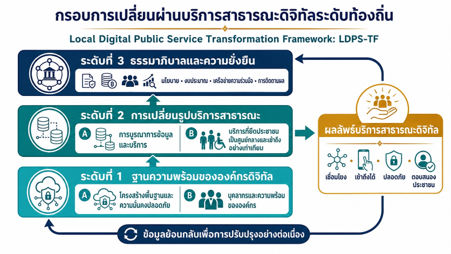
The findings revealed that: 1. the overall implementation level of digital public service delivery was high ( = 4.30, SDSDSD = 0.14). The Law Portal received the highest mean score, followed by Digital ID and the Electronic Document System, whereas the Biz Portal and Government Information Center received the lowest mean scores; 2. the major problems and enabling conditions concerned digital infrastructure and cybersecurity readiness, interorganizational data integration, personnel competencies, equitable access to services, and policy support mechanisms; and 3. five strategic areas were proposed: strengthening digital infrastructure and cybersecurity; developing personnel and organizational capabilities; promoting citizen-centered and inclusive services; integrating data and services across agencies; and advancing policy implementation and collaborative networks. These findings were synthesized into the Local Digital Public Service Transformation Framework (LDPS-TF), which connects digital organizational readiness, public service transformation, and governance for sustainability.
References
จักรกฤษ กมุทมาศ. (2565). แนวโน้มของการประยุกต์ใช้เทคโนโลยีดิจิทัลสำหรับการบริหารงานองค์กรปกครองส่วนท้องถิ่น: กรณีศึกษาเทศบาลในพื้นที่ขอนแก่นเมืองอัจฉริยะ. วารสารบริหารธุรกิจและการบัญชี มหาวิทยาลัยขอนแก่น, 6(3), 77–101.
นิติกรณ์ ฉันท์วงศ์ชนะ และคณะ. (2557). ข้อเสนอเชิงยุทธศาสตร์เพื่อเสริมสร้างประสิทธิผลการบริหารจัดการด้านการเรียนการสอนด้วยเทคโนโลยีสารสนเทศและการสื่อสารในโรงเรียนมัธยมศึกษา. วารสารบัณฑิตศึกษา มหาวิทยาลัยราชภัฏวไลยอลงกรณ์ ในพระบรมราชูปถัมภ์, 8(1), 71–86.
วัชรพล อรุณรัตน์ และธนัสถา โรจนตระกูล. (2566). ผลสัมฤทธิ์การบริหารงานบุคคลขององค์กรปกครองส่วนท้องถิ่นยุคดิจิทัล. Journal of Roi Kaensarn Academi, 8(1), 429–443.
วิรัช วิรัชนิภาวรรณ. (2561). การบริหารจัดการยุคดิจิทัลมีผลต่อการให้บริการสาธารณะของกรุงเทพมหานครตามแนวคิดการบริหารจัดการที่ยั่งยืน. วารสารวิชาการมหาวิทยาลัยการจัดการและเทคโนโลยีอีสเทิร์น, 15(2), 370–383.
สำนักงานพัฒนารัฐบาลดิจิทัล (องค์การมหาชน). (2566). แผนพัฒนารัฐบาลดิจิทัลของประเทศไทย พ.ศ. 2566–2570. สืบค้นเมื่อ 6 กรกฎาคม 2567 จาก https://www.dga.or.th/policy-standard/policy-regulation/dga-019/dga-027/dg-plan-2566-2570/.
สำนักงานส่งเสริมการปกครองท้องถิ่นจังหวัดเชียงราย. (2566). ข้อมูลองค์กรปกครองส่วนท้องถิ่นจังหวัดเชียงราย. สืบค้นเมื่อ 6 สิงหาคม 2567 จาก https://www.ts-local.com/demo_local/province/?province=เชียงราย.
องค์การบริหารส่วนจังหวัดเชียงราย. (2567). รายงานผลการดำเนินงานด้านดิจิทัล. สืบค้นเมื่อ 12 มีนาคม 2568 จาก https://www.chiangraipao.go.th/ita68/showList?cid=50.
อารีรัตน์ แก่นลืม และคณะ. (2566). การส่งเสริมและพัฒนาท้องถิ่นภายใต้การขับเคลื่อนการพัฒนาประเทศไทย 4.0. Journal of Modern Learning Development, 8(4), 206–218.
Denhardt, J. V. & Denhardt, R. B. (2003). The new public service: Serving, not steering. Armonk, NY: M.E. Sharpe.
Hood, C. (1991). A public management for all seasons?. Public Administration, 69(1), 3–19.
Moore, M. H. (1995). Creating public value: Strategic management in government. Cambridge, MA: Harvard University Press.
Osborne, S. P. (2006). The new public governance?. Public Management Review, 8(3), 377–387.
Downloads
Published
How to Cite
Issue
Section
Categories
License
Copyright (c) 2026 Academic Journal of Political Science and Public Administration

This work is licensed under a Creative Commons Attribution-NonCommercial-NoDerivatives 4.0 International License.