SUCCESS FACTORS IN THE NEGOTIATION TO RESOLVE THE COMMUNIST PARTY OF MALAYA (CPM) PROBLEM IN THAILAND
Keywords:
Communist Party of Malaya (CPM), Hat Yai Peace Accord, Success FactorsAbstract
This research article aims to examine the success factors in the peace negotiation process to end the armed struggle of the Communist Party of Malaya (CPM) in Thailand, which led to the signing of the Hat Yai Peace Accord on December 2, 1989. The study employs qualitative research methodology using document analysis of primary sources from the CPM, the Thai government, and the Malaysian government, as well as secondary sources, non-participant observation, and in-depth interviews with two key informant groups: former CPM members in Thailand and Malaysia, and Thai and Malaysian government officials involved in the negotiation process, totaling 21 participants. The collected data were analyzed using content analysis.
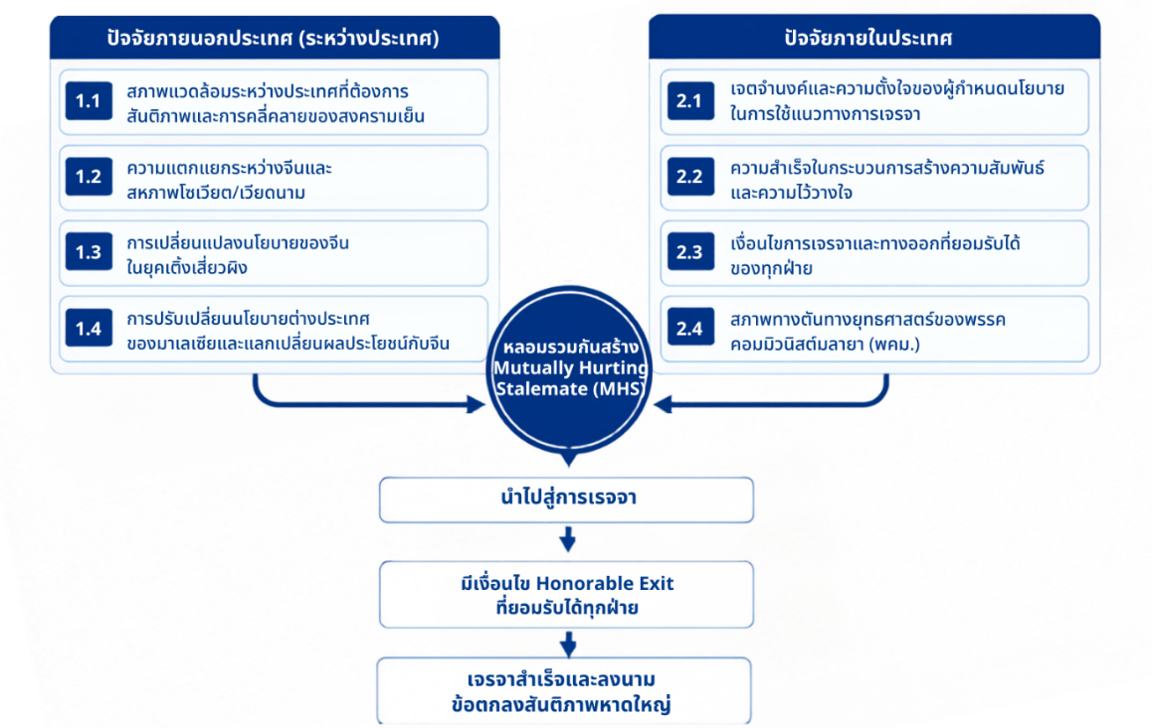
The findings reveal that the factors driving the success of the negotiation can be divided into two categories. The first category consists of four external or international factors: 1. the peaceful environment and the Cold War détente; 2. the Sino-Soviet Split and the Sino-Vietnamese conflict; 3. China's policy transformation under Deng Xiaoping; and 4. Malaysia's proactive diplomacy in establishing a Quid Pro Quo arrangement with China. The second category consists of four domestic factors within Thailand: 1. the political will of leaders to pursue negotiation; 2. the success of rapport and trust-building; 3. mutually acceptable and honorable negotiation conditions for all parties; and 4. strategic stalemate. These factors converged to create the conditions of a Mutually Hurting Stalemate as conceptualized in Zartman's Ripeness Theory, producing the ripe moment that ultimately led to the negotiation and the achievement of the peace accord.
References
เฉิน เฉิน. (2531). ทำไมการปฏิวัติมลายาประสบความล้มเหลว (อา หสุย, ผู้แปล). [เอกสารอัดสำเนา].
ประทุมพร วัชรเสถียร. (2553). โลกร่วมสมัย 2: คำตอบที่คนรุ่นใหม่ใคร่รู้. กรุงเทพฯ: ปาเจรา.
วรศักดิ์ มหัทธโนบล. (2564). ครองแผ่นดินจีน: พรรค ผู้นำ อำนาจรัฐ (พิมพ์ครั้งที่ 2, ฉบับปรับปรุง). กรุงเทพฯ: สำนักพิมพ์แห่งจุฬาลงกรณ์มหาวิทยาลัย.
สุธาชัย ยิ้มประเสริฐ (บ.ก.). (2557). ประวัติศาสตร์คู่ขนาน: เรื่องเล่าเลขาธิการพรรคคอมมิวนิสต์มลายา (ธันว์รวี, ผู้แปล). กรุงเทพฯ: พี.เพรส.
Amer, R. (2007). Resolution of the Cambodian conflict: Assessing the explanatory value of Zartman's ‘ripeness theory’. Journal of Peace Research, 44(6), 729–742.
Australian Foreign Affairs Record. (1978, November). Visit to Malaysia by Deng Xiaoping. Australian Foreign Affairs Record, 49(11), 545–546.
Chin, C. C. & Hack, K. (Eds.). (2004). Dialogues with Chin Peng: New light on the Malayan Communist Party. Singapore: Singapore University Press.
Crocker, C. A. et al. (Eds.). (1999). Herding cats: Multiparty mediation in a complex world. Washington, DC: United States Institute of Peace Press.
Harris, A. W. (2010). Coming to terms with separatist insurgencies. Negotiation Journal, 26(3), 327–356.
National Archive of Malaysia. (n.d.). 36 tahun hubungan diplomatik Malaysia China.
Nibhatsukit, W. (2025). A paradigm shift in policy-making: The evolution of Thailand’s anti-communism strategy through Prime Minister’s Office Order No. 66/2523. Journal of Arts and Thai Studies, 47(1), E4312, 1–13.
Rosenau, J. N. (Ed.). (1969). Linkage politics: Essays on the convergence of national and international systems. New York, NY: Free Press.
Saravanamuttu, J. (2010). Malaysia’s foreign policy, the first fifty years: Alignment, neutralism, Islamism. Singapore: Institute of Southeast Asian Studies.
Schiff, A. (2014). Reaching a mutual agreement: Readiness theory and coalition building in the Aceh peace process. Negotiation and Conflict Management Research, 7(1), 57–82.
Yahuda, M. (1996). The international politics of the Asia-Pacific, 1945–1995. London: Routledge.
Zartman, I. W. (2000). Ripeness: The hurting stalemate and beyond. In National Research Council (Ed.), International conflict resolution after the Cold War (pp. 225–250). Washington, DC: National Academies Press.
Downloads
Published
How to Cite
Issue
Section
Categories
License
Copyright (c) 2026 Academic Journal of Political Science and Public Administration

This work is licensed under a Creative Commons Attribution-NonCommercial-NoDerivatives 4.0 International License.