THE Developing Phenomenon-Based Learning Plans to Enhance High School Students’ Environmental Science Competencies: Integrating the PISA 2025 Science Framework
Article Sidebar
Main Article Content
Abstract
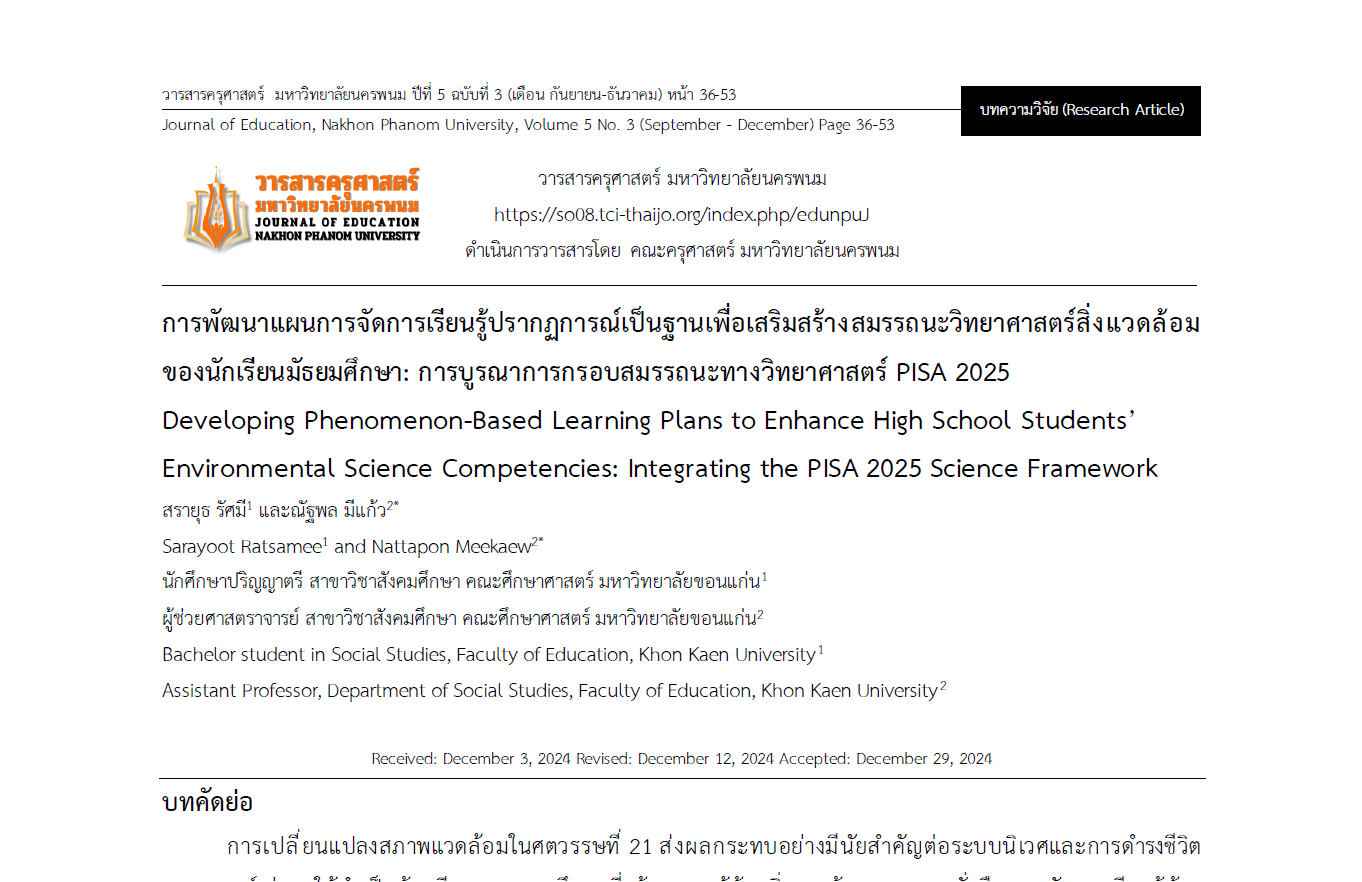
Environmental changes today have significantly impacted ecosystems and human livelihoods. Traditional environmental education often lacks a connection between theoretical concepts and real-world phenomena and the development of essential skills to enhance environmental knowledge and awareness. Therefore, integrating phenomenon-based learning (PhenoBL) plans to improve environmental science competencies is crucial to fostering students’ literacy of environmental issues and their ability to connect related knowledge to real-world phenomena. This study aimed to 1) develop PhenoBL plans to enhance high school students’ environmental science competencies and 2) assess high school students’ environmental science competencies based on the PISA 2025 environmental science competencies framework. The target group consisted of 80 Grade 10 students selected through Simple Random Sampling. The research tools included 1) PhenoBL plans focused on the freshwater swamp forest, consisting of four lessons totaling four hours, 2) a 20-item environmental science competencies test, with a passing criterion of 70%, 3) evaluation of the development of the learning management plan, and 4) an in-depth interview guide. Data were analyzed using mean, standard deviation and percentage.
The findings revealed that 1) the PhenoBL plans enabled students to connect relationships within ecosystems, promote systems thinking, solve environmental problems, and foster environmental awareness while also developing essential 21st-century skills, and 2) 87.25% of the students achieved environmental literacy passing criterion, with an average score of 16.76 (SD = 2.87), equivalent to 83.80%. The study highlighted the importance of linking classroom learning with real-world phenomena and recommended policy initiatives to develop PhenoBL plans at the national level. Furthermore, it emphasized the need to support teacher training to equip educators for context-based learning management that addressed local and environmental challenges.
Article Details

This work is licensed under a Creative Commons Attribution-NonCommercial-NoDerivatives 4.0 International License.
บทความที่ได้รับการตีพิมพ์เป็นลิขสิทธิ์ของวารสารครุศาสตร์ คณะครุศาสตร์ มหาวิทยาลัยนครพนม ข้อความที่ปรากฏในบทความแต่ละเรื่องในวารสารครุศาสตร์เล่มนี้เป็นความคิดเห็นส่วนตัวของผู้เขียนแต่ละท่านไม่เกี่ยวข้องกับมหาวิทยาลัยนครพนม และคณาจารย์ท่านอื่น ๆ ในมหาวิทยาลัยฯ แต่อย่างใด ความรับผิดชอบองค์ประกอบทั้งหมดของบทความแต่ละเรื่องเป็นของผู้เขียนแต่ละท่าน หากมีความผิดพลาดใด ๆ ผู้เขียนแต่ละท่านจะรับผิดชอบบทความของตนเองแต่ผู้เดียว
References
กรรณิการ์ ธรรมพานิชวงค์, กฤษฎ์เลิศ สัมพันธารักษ์, และสวิสา พงษ์เพชร. (2567). การเปลี่ยนแปลงสภาพภูมิอากาศกับ
เศรษฐกิจ. กรุงเทพฯ: สถาบันวิจัยเศรษฐกิจ ป๋วย อึ๊งภากรณ์.
ชินกร พิมพิลา, ธนภูมิ ดีพรม, วีระยุทธ อ่อนสุระทุม, วุฒิชัย ฤทธิวงค์, อรอนงค์ แจ่มพิศ, จินตระวี บุตระ, ภูวนัย มุงคุณ,
ณัฐพัฒน์ หะสุนโม, ชลดา เส็งนา, และศุภกร รัตนจันทร์. (2564). การศึกษาวิถีชีวิตและความหลากหลายทาง
ชีวภาพของป่าบุ่งป่าทามในลำน้ำสงคราม บ้านนาสีนวล ต.หนองแปน อ.เจริญศิลป์ จ.สกลนคร. โรงเรียนบ้านนา
สีนวล สำนักงานเขตพื้นที่ประถมศึกษาสกลนคร.
ภาคภูมิ เนียมบุญ และกรกนก เลิศเดชาภัทร. (2567). การจัดการเรียนรู้เพื่อส่งเสริมสมรรถนะทางวิทยาศาสตร์สิ่งแวดล้อม.
วารสารหน่วยวิจัยวิทยาศาสตร์ เทคโนโลยี และสิ่งแวดล้อมเพื่อการเรียนรู้, 15(1), 133-151.
สิริวิมล ยืนสี. (2567). การพัฒนาสมรรถนะทางวิทยาศาสตร์สิ่งแวดล้อม เรื่อง มนุษย์กับความยั่งยืนของสิ่งแวดล้อม ด้วยการ
จัดการเรียนรู้โดยใช้หลักฐานของนักเรียนชั้นมัธยมศึกษาปีที่ 6. การศึกษามหาบัณฑิต สาขาวิชา
วิทยาศาสตร์ศึกษา มหาวิทยาลัยนเรศวร]. พิษณุโลก: มหาวิทยาลัยนเรศวร.
สำนักงานนโยบายและแผนทรัพยากรธรรมชาติและสิ่งแวดล้อม. (2565). รายงานสถานการณ์ทรัพยากรธรรมชาติและสิ่งแวดล้อม
ประจำปี 2565. กรุงเทพฯ: สำนักงานนโยบายและแผนทรัพยากรธรรมชาติและสิ่งแวดล้อม.
Adipat, S. (2024) Transcending traditional paradigms: the multifaceted realm of phenomenon-based learning.
Front. Educ. https://www.frontiersin.org/journals/education/articles/10.3389/feduc.
1346403/full
Jokinen, P., & Rissanen, M. (2022). Phenomenon-Based Learning: Developing 21st century skills in
environmental science education. Education for Sustainable Development, 13(2), 85-102.
Kauertz, A., Fischer, H. E., Mayer, J., Sumfleth, E., & Walpuski, M. (2010). Evaluation of the Standards of Science
Education for Lower Secondary Schools (ESNaS). In German National Standards in Science Education.
Koskinen, P., & Niemi, H. (2021). Integrating phenomenon-based learning into environmental education for
sustainable development. Journal of Environmental Education, 42(3), 299-310.
Mattila, P., & Silander, P. (2015). How to create the school of the future: Revolutionary thinking and design
from Finland. Oulu: Multiversum.
OECD. (2023). Environmental Sustainability Competence Framework. OECD Publications. https://www.oecd.org/
PISA 2025. (2024). SCIENCE FRAMEWORK. https://pisa-framework.oecd.org/science-2025/
