
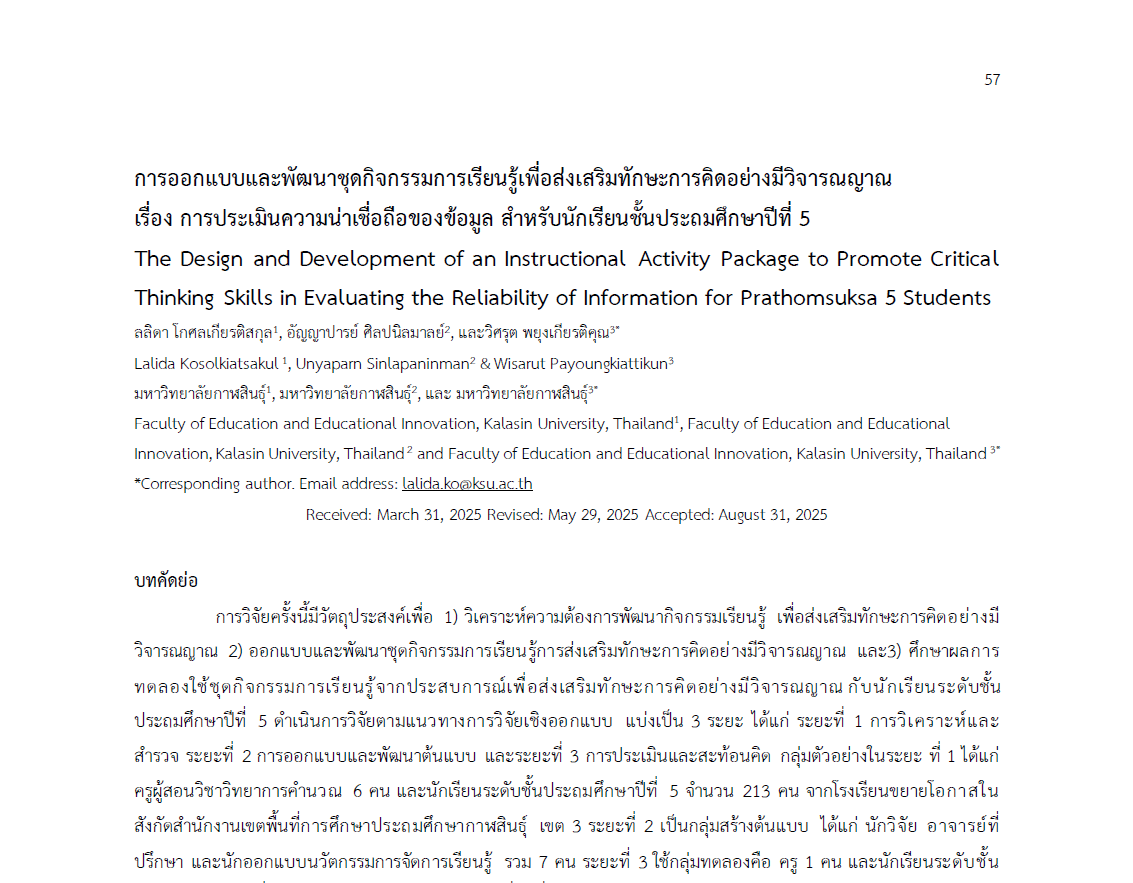
The Design and Development of an Instructional Activity Package to Promote Critical Thinking Skills in Evaluating the Reliability of Information for Prathomsuksa 5 Students
Article Sidebar
Main Article Content
Abstract
This research aimed to 1) analyze the needs for developing learning activities to enhance critical thinking skills, 2) design and develop a set of learning activities to foster such skills, and 3) investigate the effects of implementing experiential learning activities with Prathomsuksa 5 students. The study followed the principles of design-based research (DBR) and was conducted in three phases: Phase 1 – Needs analysis and exploration, Phase 2 – Design and development, and Phase 3 – Evaluation and reflection. In Phase 1, the sample included 6 computer science teachers and 213 Prathomsuksa 5 students from six opportunity expansion schools under Kalasin Primary Educational Service Area Office 3. In Phase 2, the prototype development group consisted of 3 researchers and academic advisors, and 4 instructional innovation designers, totaling 7 experts. In Phase 3, the implementation was conducted with one teacher and 31 Prathomsksa 5 students at Ban Din Chi School, an opportunity expansion school under the same educational service area. Research instruments included structured interview forms, focus group discussion records, Instructional activity quality assessment forms, critical thinking skills assessment tools, and satisfaction questionnaires.
Article Details

This work is licensed under a Creative Commons Attribution-NonCommercial-NoDerivatives 4.0 International License.
บทความที่ได้รับการตีพิมพ์เป็นลิขสิทธิ์ของวารสารครุศาสตร์ คณะครุศาสตร์ มหาวิทยาลัยนครพนม ข้อความที่ปรากฏในบทความแต่ละเรื่องในวารสารครุศาสตร์เล่มนี้เป็นความคิดเห็นส่วนตัวของผู้เขียนแต่ละท่านไม่เกี่ยวข้องกับมหาวิทยาลัยนครพนม และคณาจารย์ท่านอื่น ๆ ในมหาวิทยาลัยฯ แต่อย่างใด ความรับผิดชอบองค์ประกอบทั้งหมดของบทความแต่ละเรื่องเป็นของผู้เขียนแต่ละท่าน หากมีความผิดพลาดใด ๆ ผู้เขียนแต่ละท่านจะรับผิดชอบบทความของตนเองแต่ผู้เดียว
References
กระทรวงศึกษาธิการ. (2542). พระราชบัญญัติการศึกษาแห่งชาติ พ.ศ. 2542 และที่แก้ไขเพิ่มเติม (ฉบับที่ 2) พ.ศ. 2545, (ฉบับที่ 3) พ.ศ. 2553 และ (ฉบับที่ 4) พ.ศ. 2562. ราชกิจจานุเบกษา.
มานพ ชาชิโย. (2567). ผลของชุดกิจกรรมแบบประสบการณ์ต่อการเรียนรู้วิชาวิทยาศาสตร์ของนักเรียนชั้นประถมศึกษา. วารสารวิชาการมหาวิทยาลัยราชภัฏนครราชสีมา, 18(3), 25–39.
วราภรณ์ ตรงธิ, และ อังคณา ตุงคะสมิต. (2567). การพัฒนาทักษะการคิดอย่างมีวิจารณญาณของนักเรียนชั้นประถมศึกษาปีที่ 5 ด้วยกิจกรรมการเรียนรู้เชิงประสบการณ์ร่วมกับสื่อดิจิทัล. วารสารวิจัยและพัฒนาการศึกษา, 13(1), 45–58.
วีรพล สมิพิลา, วิไลรัตน์ สุขเกษม, และกมลวรรณ กวางทอง. (2567). การเรียนรู้แบบนำตนเองและประสบการณ์เพื่อพัฒนาทักษะการคิดอย่างมีวิจารณญาณ. วารสารครุศาสตร์วิจัย, 10(2), 101–114.
สุวิมล ว่องวาณิช. (2566). การวิจัยเชิงออกแบบเพื่อพัฒนานวัตกรรมการเรียนรู้. กรุงเทพฯ: สำนักพิมพ์แห่งจุฬาลงกรณ์ มหาวิทยาลัย.
สำนักงานคณะกรรมการการศึกษาขั้นพื้นฐาน. (2551). หลักสูตรแกนกลางการศึกษาขั้นพื้นฐาน พุทธศักราช 2551. กรุงเทพฯ: สกศ.
อภิสิทธิ์ ไล่ศัตรูไกล. (2557). Design Thinking กระบวนการคิดเชิงออกแบบเพื่อสร้างนวัตกรรม. กรุงเทพฯ: สำนักพิมพ์อมรินทร์.
Dewey, J. (1910). How we think. Boston: D.C. Heath & Co.
Mirattanaphrai, K., & Srikoon, S. (2025). The effectiveness of educational design research in enhancing critical thinking in primary schools. Educational Research and Development Journal, 12(2), 88–102.
OECD. (2021). 21st-Century Readers: Developing Literacy Skills in a Digital World. OECD Publishing. https://doi.org/10.1787/a83d84cb-en
Pumyoch, S., & Srikoon, S. (2024). Development of design-based learning model to enhance students’ cognitive competence. Journal of Education and Innovation, 9(1), 21–35.
