Education Recovery After COVID-19 Pandemic in Schools under Nakhon Phanom Primary Educational Service Area Office 2
Article Sidebar
Main Article Content
Abstract
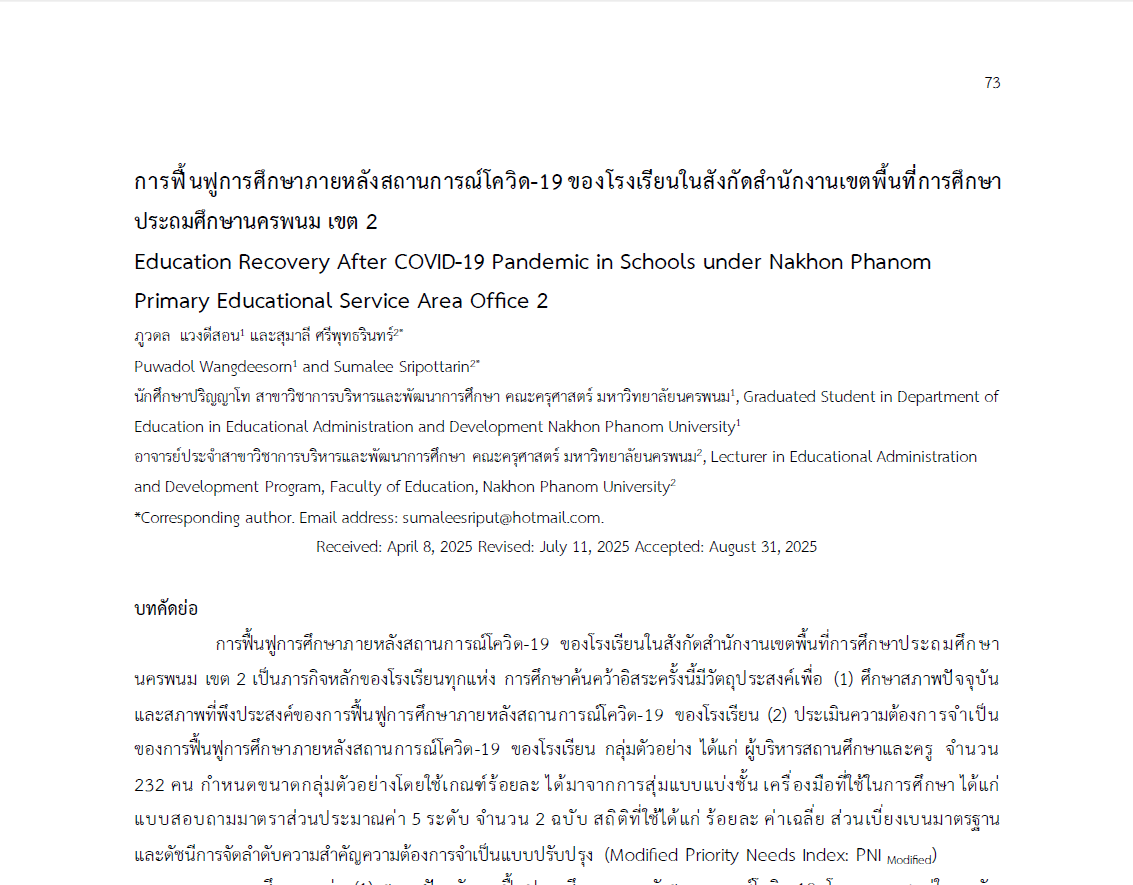
Education recovery following the COVID-19 pandemic is a core mission for all schools operating under the oversight of the Nakhon Phanom Primary Educational Service Area Office 2. This study aimed to (1) study the current and desired situations of education recovery after coronavirus 2019 pandemic in schools, (2) assess the needs and priorities of education recovery after coronavirus 2019 pandemic in schools. The sample consisted of 232 school administrators and teachers. The sample size was determined using percentage criteria, and they were selected by stratified rand sampling. The instrument used in the study were two five-rating scale questionnaires. The statistics employed were percentage, mean, standard deviation and the modified priority needs index (PNIModified).
The results found that (1) the current and desired situations in the development of education recovery after coronavirus 2019 pandemic in overall were at the high and highest level, respectively. (2) The results of need assessment for education recovery after coronavirus 2019 pandemic in schools, ranked from the highest to the lowest values, were as follows: Enhancing Learning Effectiveness, Foundational Knowledge Building, Learning Assessment, Child Access and Psychological Well-being.
Article Details

This work is licensed under a Creative Commons Attribution-NonCommercial-NoDerivatives 4.0 International License.
บทความที่ได้รับการตีพิมพ์เป็นลิขสิทธิ์ของวารสารครุศาสตร์ คณะครุศาสตร์ มหาวิทยาลัยนครพนม ข้อความที่ปรากฏในบทความแต่ละเรื่องในวารสารครุศาสตร์เล่มนี้เป็นความคิดเห็นส่วนตัวของผู้เขียนแต่ละท่านไม่เกี่ยวข้องกับมหาวิทยาลัยนครพนม และคณาจารย์ท่านอื่น ๆ ในมหาวิทยาลัยฯ แต่อย่างใด ความรับผิดชอบองค์ประกอบทั้งหมดของบทความแต่ละเรื่องเป็นของผู้เขียนแต่ละท่าน หากมีความผิดพลาดใด ๆ ผู้เขียนแต่ละท่านจะรับผิดชอบบทความของตนเองแต่ผู้เดียว
References
กรมควบคุมโรค. (2563). โรคติดเชื้อไวรัสโคโรนา 2019 (COVID-19). กรมควบคุมโรค. https://ddc.moph.go.th/viralpneumonia/index.php
ทรงยศ รังสรรค์มณีนิล และพร้อมพิไล บัวสุวรรณ. “ปัจจัยที่ส่งผลต่อการบริหารงานวิชาการเพื่อฟื้นฟูภาวะถดถอยทางการเรียนรู้ของผู้เรียนในโรงเรียมัธยมศึกษา”วารสารรัชดีภาคย์ (วารสารออนไลน์). 17(53), 120-138
นรรธพร จันทร์เฉลี่ย เสริบุตร. (2566). มาตรการฟื้นฟูความรู้ถดถอยในเด็ก (Learning Loss). Starfish Education. https://www.starfishlabz.com/blog/579-มาตรการฟื้นฟูความรู้ถดถอยในเด็ก-learning-loss-โดย-starfish-education
บุญชม ศรีสะอาด. (2560). การวิจัยเบื้องต้น (พิมพ์ครั้งที่ 10). กรุงเทพฯ: สุวีริยาสาส์น.
ภูมิพัฒน์ ศรีวชิรพัฒน์. (2022). กลยุทธ์เพื่อลดภาวะถดถอยทางการเรียนรู้ของนักเรียนไทยจากการเรียนการสอนออนไลน์ในสถานการณ์การแพร่ระบาดของเชื้อไวรัสโควิด-19. วารสารสังคมศาสตร์บูรณาการ มหาวิทยาลัยมหิดล, 9(1), 71-86.
วิธิดา พรหมวงศ์, ทัศนา ประสานตรี, สุมาลี ศรีพุทธรินทร์. (2564). สภาพปัจจุบัน ปัญหา และแนวทางแก้ปัญหาการจัดการเรียนรู้ในช่วงการแพร่ระบาดของเชื้อไวรัสโควิด-19 ของโรงเรียน ในสังกัดสำนักงานเขตพื้นที่การศึกษาประถมศึกษานครพนม เขต 1. วารสารรัชต์ภาคย์, 15(40), 200-213.
สุวิมล ว่องวาณิช. (2558). การศึกษาประเมินความต้องการจําเป็น Need assessment research. (พิมพ์ครั้งที่ 3 ฉบับปรับปรุง). กรุงเทพฯ: สํานักพิมพ์แห่งจุฬาลงกรณ์มหาวิทยาลัย.
สำนักงานเขตพื้นที่การศึกษาประถมศึกษานครพนม เขต 2. (2567). ข้อมูลพื้นฐานโรงเรียนสังกัด สพป.นครพนม เขต 2. นครพนม:กลุ่มสารสนเทศสำนักนโยบายและแผนการศึกษาขั้นพื้นฐาน.
สำนักงานเลขาธิการสภาการศึกษา. (2565). การศึกษาภาวะถดถอยทางการเรียนรู้ของผู้เรียนระดับการศึกษาขั้นพื้นฐานในสถานการณ์โควิด-19 : สภาพการณ์ บทเรียน และแนวทางการพัฒนาคุณภาพการเรียนรู้. สำนักงานเลขาธิการสภาการศึกษา.
(2565ข). มาตรการฟื้นฟูภาวะถดถอยทางการเรียนรู้. สำนักงานเลขาธิการสภาการศึกษา.
. (2564, กุมภาพันธ์ 14). รายงานผลการศึกษาภาวะถดถอยทางการเรียนรู้ของผู้เรียนระดับการศึกษาขั้นพื้นฐานในสถานการณ์โควิด-19 : สภาพการณ์บทเรียนและแนวทางการพัฒนาคุณภาพการเรียนรู้. สำนักงานเลขาธิการสภาการศึกษา. https://backoffice.onec.go.th/uploads/Book/1932-file.pdf
Cao, W., Fang, Z., Hou, G., Han, M., Xu, X., Dong, J., & Zheng, J. (2020). The psychological impact of the COVID-19 epidemics on college students in China. Psychiatry Research, 287, 112934. https://doi.org/10.1016/j.psychres.2020.112934
Coe, A. B., Elliott, M. H., Gatewood, S. B., Goode, J. V. R., & Moczygemba, L. R. (2022). Perceptions and predictors of intention to receive the COVID-19 vaccine. Research in Social and Administrative Pharmacy, 18(4), 2593-2599. doi: 10.1016/j.sapharm.2021.04.023
García-Peñalvo, F. J. (2021). Digital transformation in the universities: implications of the COVID-19 pandemic. Education in the knowledge society (EKS), (22), 1. http://orcid.org/0000-0001-9987-5584
Khan, J, M., & Ahmed, J. (2021). Child education in the time of pandemic: Learning loss and dropout, Children and Youth Services Review, 127, 106065. DOI:10.1016/j.childyouth.2021.106065
Pereda, N., & Díaz-Faes, D. A. (2020). Family violence against children in the wake of COVID-19 pandemic: a review of current perspectives and risk factors. Child and adolescent psychiatry and mental health, 14(1), 40. DOI: 10.1186/s13034-020-00347-1
Sabates, R., Carter, E., & Stern, J. (2021). Using educational transitions to estimate learning loss due to COVID-19 school closures: The case of complementary basic education in Ghana. International Journal of Educational Development, 82,102377. DOI: 10.5281/zenodo.3888219.
Schleicher, A. (2020). The Impact of COVID-19 on Education: Insights from" Education at a Glance 2020". OECD Publishing.
