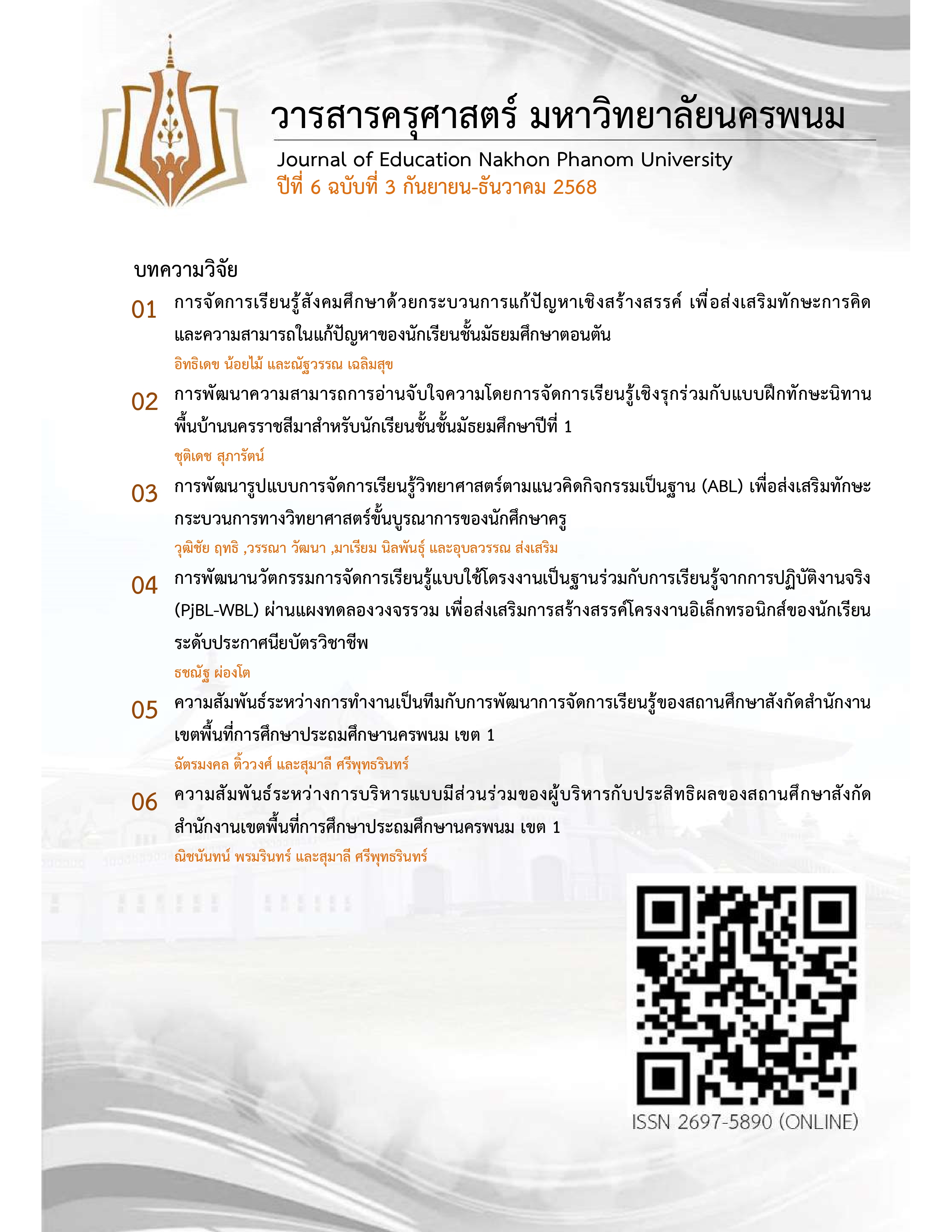
Social Studies Instruction Using Creative Problem-Solving Processes to Enhance Thinking Skills and Problem-Solving Abilities of Lower Secondary School Students
Article Sidebar
Main Article Content
Abstract
The objectives of this study were: 1) to compare the thinking skills and problem-solving abilities of lower secondary school students before and after participating in learning activities based on the Creative Problem Solving (CPS) process; 2) to compare the thinking skills and problem-solving abilities of the students after receiving CPS-based instruction with the criterion of 70 percent; and 3) to examine the students’ satisfaction with social studies learning through the CPS process. The sample group consisted of 35 Grade 7 students enrolled in the second semester of the 2024 academic year, selected through cluster random sampling. The research instruments included: 1) lesson plans, 2) a thinking skills test, 3) a problem-solving ability test, and 4) a satisfaction questionnaire. Data were analyzed using mean, standard deviation, and t-test statistics.
The findings revealed that: 1) the students’ thinking skills after receiving CPS-based instruction were significantly higher than before the instruction at the .05 level, and significantly higher than the 70 percent criterion at the .05 level; 2) the students’ problem-solving abilities after instruction were significantly higher than before the instruction at the .05 level, and significantly higher than the 70 percent criterion at the .05 level; and 3) the students’ overall satisfaction with social studies learning through the CPS process was at a high level.
Keywords: Creative Problem-Solving (CPS) process, thinking skills, problem-solving ability
Article Details

This work is licensed under a Creative Commons Attribution-NonCommercial-NoDerivatives 4.0 International License.
บทความที่ได้รับการตีพิมพ์เป็นลิขสิทธิ์ของวารสารครุศาสตร์ คณะครุศาสตร์ มหาวิทยาลัยนครพนม ข้อความที่ปรากฏในบทความแต่ละเรื่องในวารสารครุศาสตร์เล่มนี้เป็นความคิดเห็นส่วนตัวของผู้เขียนแต่ละท่านไม่เกี่ยวข้องกับมหาวิทยาลัยนครพนม และคณาจารย์ท่านอื่น ๆ ในมหาวิทยาลัยฯ แต่อย่างใด ความรับผิดชอบองค์ประกอบทั้งหมดของบทความแต่ละเรื่องเป็นของผู้เขียนแต่ละท่าน หากมีความผิดพลาดใด ๆ ผู้เขียนแต่ละท่านจะรับผิดชอบบทความของตนเองแต่ผู้เดียว
References
กระทรวงศึกษาธิการ. (2551). หลักสูตรแกนกลางการศึกษาขั้นพื้นฐาน พุทธศักราช 2551. กรุงเทพฯ: โรงพิมพ์ชุมนุมสหกรณ์การเกษตรแห่งประเทศไทย.
ณัฏฐพงศ์ กาญจนฉายา. (2559). การจัดการเรียนการสอนตามกระบวนการแก้ปัญหาเชิงสร้างสรรค์. Journal of Multidisciplinary in Social Sciences, 12(3), 207–224.
ดารินทร์ งามสันเทียะ พินดา วราสุนันท์ และวิชา อุ่นวรรณธรรม. (2563). การพัฒนาความสามารถในการแก้ปัญหาและ ความคิดสร้างสรรค์ทางคณิตศาสตร์ เรื่อง ความน่าจะเป็นของเหตุการณ์ โดยใช้กระบวนการแก้ปัญหาเชิงสร้างสรรค์ของนักเรียนชั้นมัธยมศึกษาปีที่ 3. วารสารศึกษาศาสตร์ มหาวิทยาลัยขอนแก่น. 43(3), 15-29
ทิพย์วรรณ จันทร์เขียว และชมนาด เชื้อสุวรรณทวี. (2565). การจัดการเรียนรู้โดยใช้กระบวนการแก้ปัญหาเชิงสร้างสรรค์ร่วมกับเทคนิคเพื่อนคู่คิด (Think-Pair-Share) ที่มีต่อความสามารถ ในการแก้ปัญหาเชิงสร้างสรรค์ทางคณิตศาสตร์ของนักเรียนชั้นมัธยมศึกษาปีที่ 1 โรงเรียนสาธิตมหาวิทยาลัยศรีนครินทรวิโรฒ ประสานมิตร (ฝ่ายมัธยม). วารสารมหาจุฬานาครทรรศน์. 9(5), 174-185.
นพคุณ คุณาชีวะ. (2566). การจัดการเรียนรู้แบบการแก้ปัญหาอย่างสร้างสรรค์ (CPS). Interdisciplinary Academic and Research Journal, 3(6), 649–668.
นาตยา ปิลันธนานนท์. (2564). สังคมศึกษา ยุคมาตรฐานกำกับ. กรุงเทพฯ: ห้างหุ้นส่วนจำกัดโรจนพริ้นท์ติ้ง.
เศรษฐศิษฏ์ จตุเทน และมณฑา ชุ่มสุคนธ์. (2567). การพัฒนาทักษะการคิดแก้ปัญหาอย่างสร้างสรรค์และผลสัมฤทธิ์ทางการเรียนด้วยการจัดการเรียนรู้แบบแก้ปัญหาอย่างสร้างสรรค์ ร่วมกับเกมมิฟิเคชั่นรายวิชา ส15101 สังคมศึกษา ชั้นประถมศึกษาปีที่ 5 โรงเรียนสงเปลือยวิทยายน. วารสาร มจร อุบลปริทรรศน์. 9(2), 155-167.
สิริลักษณ์ ตาณพันธุ์ และวลัย อิศรางกูร ณ อยุธยา. (2560). ผลของการจัดกิจกรรมการเรียนรู้สังคมศึกษาโดยใช้กระบวนการแก้ปัญหาเชิงสร้างสรรค์ที่มีต่อความสามารถในการคิดสร้างสรรค์และการคิดอย่างมีวิจารณญาณของนักเรียนระดับชั้นมัธยมศึกษาปีที่ 3. วารสารอิเล็กทรอนิกส์ทางการศึกษา(OJED) จุฬาลงกรณ์มหาวิทยาลัย. 12(3), 313-329
เสมอกาญจน์ โสภณหิรัญรักษ์ สุรวิทย์ อัสสพันธุ์ และธิดา ทับพันธุ์. (2566). การศึกษาและพัฒนาองค์ประกอบด้านสมรรถนะในการแก้ปัญหาเชิงสร้างสรรค์ จากกระบวนการแก้ปัญหาเชิงสร้างสรรค์. วารสารบัณฑิตศึกษา มหาวิทยาลัยราชภัฏวไลยอลงกรณ์ในพระบรมราชูปถัมภ์, 17(3), 209-224.
Best, J. W. (1981). Research in Education. (4ed.). Englewood Cliff, Prentice - Hall.
Gaglione, M. (2021). Nurturing Creative Problem Solving in Social Sciences in Middle School Students. St. John’s University, New York. Retrieved https://scholar.stjohns.edu/theses_dissertations/168/
Kemmis, S., McTaggart, R., and Nixon, R. (2014). The action research planner: Doing criticalparticipatory action research. New York: Spinger
Samson, P. L. (2015). Fostering student engagement: Creative problem-solving in small group facilitations. Collected Essays on Learning and Teaching, 8, 153–160. Retrieved from https://files.eric.ed.gov/fulltext/EJ1069715.pdf
Treffinger, D. J., Selby, E. C., & Isaksen, S. G. (2008). Understanding individual problem-solving style: A key to learning and applying creative problem solving. Learning and Individual Differences, 18(4), 390-401.
Trilling, B., & Fadel, C. (2009). 21st century skills: Learning for life in our times. Jossey-Bass/Wiley.
World Economic Forum. (2025). Future of Jobs Report 2025. Retrieved from https://www.weforum.org/publications/the-future-of-jobs-report-2025/digest/
