
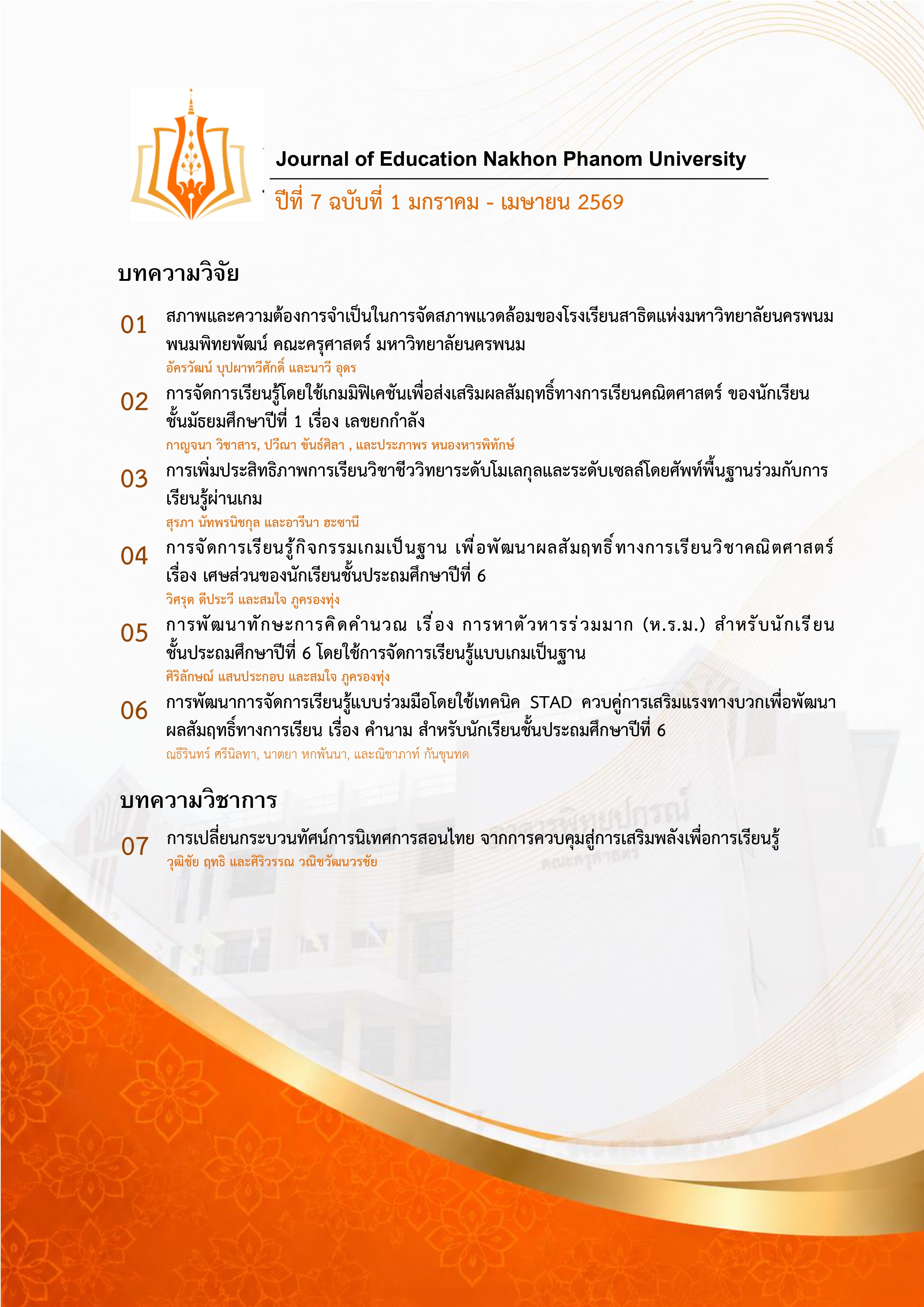
The Development of Cooperative Learning Management Using STAD Technique Combined with Positive Reinforcement to Enhance Learning Achievement in Nouns for Grade 6 Students
Article Sidebar
Main Article Content
Abstract
This research aimed to develop learning achievement in nouns for Grade 6 students using cooperative learning with the STAD technique combined with positive reinforcement. The target group consisted of 13 Grade 6 students at Ban Sang Saen School in the first semester of the 2025 academic year, selected through purposive sampling from all students in the class taught by the researcher. The experiment was conducted over 5 weeks, twice a week, 60 minutes per session, totaling 10 sessions, using a one-group pretest-posttest design. The research instruments included 8 lesson plans, a 30-item multiple-choice test with 4 options, and a satisfaction questionnaire. Data were analyzed using mean, standard deviation, and the Wilcoxon Signed Rank Test.
The results showed that all lesson plans had high appropriateness levels, with an efficiency of 78.95/79.37, exceeding the standard criterion of 75/75, and an effectiveness index of 0.6863 or 68.63%. Learning achievement after the intervention was significantly higher than before at the .05 level. Students expressed high satisfaction with the learning management in all aspects.
Keywords: Cooperative Learning, STAD Technique, Positive Reinforcement, Learning Achievement, Nouns
Article Details

This work is licensed under a Creative Commons Attribution-NonCommercial-NoDerivatives 4.0 International License.
บทความที่ได้รับการตีพิมพ์เป็นลิขสิทธิ์ของวารสารครุศาสตร์ คณะครุศาสตร์ มหาวิทยาลัยนครพนม ข้อความที่ปรากฏในบทความแต่ละเรื่องในวารสารครุศาสตร์เล่มนี้เป็นความคิดเห็นส่วนตัวของผู้เขียนแต่ละท่านไม่เกี่ยวข้องกับมหาวิทยาลัยนครพนม และคณาจารย์ท่านอื่น ๆ ในมหาวิทยาลัยฯ แต่อย่างใด ความรับผิดชอบองค์ประกอบทั้งหมดของบทความแต่ละเรื่องเป็นของผู้เขียนแต่ละท่าน หากมีความผิดพลาดใด ๆ ผู้เขียนแต่ละท่านจะรับผิดชอบบทความของตนเองแต่ผู้เดียว
References
Ali, R. (2008). The effect of using STAD cooperative learning technique on student achievement in mathematics. International Journal of Educational Research, 45(2), 112–125.
กระทรวงศึกษาธิการ. (2560). หลักสูตรแกนกลางการศึกษาขั้นพื้นฐาน พุทธศักราช 2551
(ฉบับปรับปรุง พ.ศ. 2560). ชุมนุมสหกรณ์การเกษตรแห่งประเทศไทย.
ละดา ดอนหงษา, สุภาวรรณ ขันธวัตร์, และสุรินยา ศรีขวาชัย. (2568).
ผลการจัดการเรียนรู้แบบร่วมมือแบบ STAD เสริมด้วยเกมการศึกษาต่อผลสัมฤทธิ์ทางการเรียนภาษาไทยของนักเรียน ชั้นประถมศึกษาปีที่ 2. วารสารการบริหารและพัฒนาวิทยาลัยพิชญบัณฑิต, 8(1).
https://so12.tci-thaijo.org/index.php/pcbu/article/view/5471
บุญชม ศรีสะอาด. (2560). การวิจัยเบื้องต้น (พิมพ์ครั้งที่ 10). สุวีริยาสาส์น.
ระวีณ์นุช ศิริบูรณ์. (2564). การพัฒนาผลสัมฤทธิ์ด้านการอ่านและการเขียนสะกดคำพื้นฐานโดยใช้กิจกรรมการเรียนรู้แบบร่วมมือ เทคนิค STAD ประกอบแบบฝึกทักษะ สำหรับนักเรียนชั้นประถมศึกษาปีที่ 2
[วิทยานิพนธ์ปริญญามหาบัณฑิต, มหาวิทยาลัยมหาสารคาม]. ฐานข้อมูลวิทยานิพนธ์ไทย. https://fulltext.rmu.ac.th/fulltext/2564/M129983/Siriboon%20Praweenut.pdf
ล้วน สายยศ, และอังคณา สายยศ. (2538). เทคนิคการวัดผลการเรียนรู้. สุวีริยาสาส์น.
Skinner, B. F. (1953). Science and human behavior. Macmillan.
Slavin, R. E. (1995). Cooperative learning: Theory, research, and practice (2nd ed.). Allyn & Bacon.
สนทยา คำออน. (2560). การพัฒนาผลสัมฤทธิ์ทางการเรียนวิชาคณิตศาสตร์โดยใช้การจัดการเรียนรู้แบบร่วมมือเทคนิค STAD ของนักเรียนชั้นประถมศึกษาปีที่ 5 [วิทยานิพนธ์ปริญญามหาบัณฑิต, มหาวิทยาลัยมหาสารคาม].
Thorndike, E. L. (1911). Animal intelligence: Experimental studies. Macmillan.
Vygotsky, L. S. (1978). Mind in society: The development of higher psychological processes. Harvard University Press.
